MCQ
From the following diode circuit. Which diode in forward biased condition
  • A


  • C

  • D

Answer

Correct option: B.

b

Need a full question paper?

Generate a complete, print-ready paper with questions like this in minutes — across 16+ boards, with answer keys.


Start Generating Free

Similar questions

$A$ closed planar wire loop of area $A$ and arbitrary shape is placed in a uniform magnetic field of magnitude $B$, with its plane perpendicular to magnetic field. The resistance of the wire loop is $R$. The loop is now turned upside down by $180^o$ so that its plane again becomes perpendicular to the magnetic field. The total charge that must have flowed through the wire ring in the process is
An electromagnetic wave is represented by the electric field $\vec E = {E_0}\hat n\,\sin \,\left[ {\omega t + \left( {6y - 8z} \right)} \right]$. Taking unit vectors in $x, y$ and $z$ directions to be $\hat i,\hat j,\hat k$ ,the direction of propogation $\hat s$, is
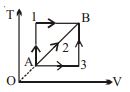
A given mass of a gas expands from a state $A$ to the state $B$ by three paths $1, 2$ and $3$ as shown in $T-V$ indicator diagram. If $W_1, W_2$ and $W_3$ respectively be the work done by the gas along the three paths, then
The position of a particle related to time is given by $x =\left(5 t ^2-4 t +5\right) m$. The magnitude of velocity of the particle at $t=2\,s$ will be $...........ms^{-1}$
The fundamental frequency of a sonometre wire is $n.$ If its radius is doubled and its tension becomes half, the material of the wire remains same, the new fundamental frequency will be
A body of mass $40\,kg$ resting on rough horizontal surface is subjected to a force $P$ which is just enough to start the motion of the body. If $\mu_{ s }=5, \mu_{ x }=0.4$, $g =10\,m / s ^2$ and the force $P$ is continuously applied on the body, then the acceleration of the body is $.........m/s^{2}$
According to Poiseuille's law, the pressure drop per unit length required (overcome viscous forces is $\Delta P =\frac{8 \eta v }{ r ^2}$, where $r$ is the radius of cross section, $v$ is the fluid velocity and $\eta$ is the coefficient of viscosity. A capillary tube of radius a is dipped in a liquid of density $\rho$, surface tension $T$ and coefficient of viscosity $\eta$. The liquid starts rising in it so that its height $h ( t )$ is a function of time t. The resulting rate of change of the momentum of liquid column in the capillary (taking vertically up to be positive direction and the contact angle to be close to $\left.0^{\circ}\right)$ is $-\pi a ^2 \rho gh + F$. Then $F$ is $[ g$ is the acceleration due to gravity):
The kinetic energy of an electron revolving around a nucleus will be
A disc with a flat small bottom beaker placed on it at a distance $R$ from its center is revolving about an axis passing through the center and perpendicular to its plane with an angular velocity $\omega$. The coefficient of static friction between the bottom of the beaker and the surface of the disc is $\mu$. The beaker will revolve with the disc if 
Assertion : Isobutanal does not give iodoform test.
Reason : It does not have $\alpha  - $ hydrogen