A body of mass $40\,kg$ resting on rough horizontal surface is subjected to a force $P$ which is just enough to start the motion of the body. If $\mu_{ s }=5, \mu_{ x }=0.4$, $g =10\,m / s ^2$ and the force $P$ is continuously applied on the body, then the acceleration of the body is $.........m/s^{2}$
AIIMS 2015, Difficult
Download our app for free and get started
(b)
Since $P$ is the force which is just enough to start the motion of the body,
$P =\mu_{ s } N =\mu_{ s }\,mg$
When the body moves under this force, the net force on body is given by
$F=m a=P-f$
$\Rightarrow ma =\mu_{ s } mg -\mu_{ k } N$
$= m \left(\mu_{ s }-\mu_{ k }\right) g$
$\Rightarrow a =\left(\mu_{ s }-\mu_{ k }\right) g$
$=(0.5-0.4)(10)\,m / s ^2$
$\Rightarrow a =1\,m / s ^2$

Download our appand get started for free
Experience the future of education. Simply download our apps or reach out to us for more information. Let's shape the future of learning together!No signup needed.*
Similar Questions
- 1A body of $5\, kg$ weight kept on a rough inclined plane of angle $30^o$ starts sliding with a constant velocity. Then the coefficient of friction isView Solution
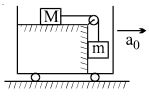
- 2Imagine the situation in which the given arrangement is placed inside a trolley that can move only in the horizontal direction, as shown in figure. If the trolley is accelerated horizontally along the positive $x$ -axis with $a_0$, then Identify the correct statement $(s)$ related to the tension $T$ in the stringView Solution
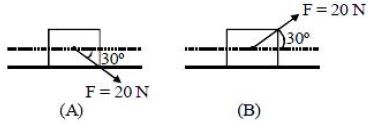
- 3A block of mass $5\, kg$ is $(i)$ pushed in case $(A)$ and $(ii)$ pulled in case $(B)$, by a force $F = 20\, N$, making an angle of $30^o$ with the horizontal, as shown in the figures. The coefficient of friction between the block and floor is $\mu = 0.2$. The difference between the accelerations of the block, in case $(B)$ and case $(A)$ will be $....... ms^{-2}$ .$(g = 10\, ms^{-2})$View Solution
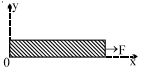
- 4A uniform rod of length $L$ and mass $M$ has been placed on a rough horizontal surface. The horizontal force $F$ applied on the rod is such that the rod is just in the state of rest. If the coefficient of friction varies according to the relation $\mu = Kx$ where $K$ is a $+$ ve constant. Then the tension at mid point of rod isView Solution
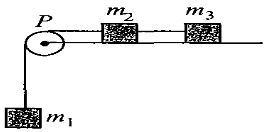
- 5A system consists of three masses $m_1 , m_2$ and $m_3$ connected by a string passing over a pulley $P.$ The mass $m_1$ hangs freely and $m_2$ and $m_3$ are on a rough horizontal table (the coefficient of friction $= \mu ).$ The pulley is frictionless and of negligible mass. The downward acceleration of mass $m_1$ is $(Assume\, m = m_2 = m_3 = m)$View Solution
- 6View SolutionA car when passes through a convex bridge exerts a force on it which is equal to
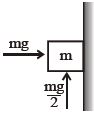
- 7View SolutionA block pressed against the vertical wall is in equilibrium. The minimum coefficient of friction is:-
- 8A car has to move on a level turn of radius $450\,m.$ If the coefficient of static friction between tyre and the road is $\mu = 0.2.$ Find the maximum speed the car can take without skidding is given by ........ $m/s$View Solution
- 9On a rough horizontal surface, a body of mass $2 \,kg$ is given a velocity of $10 \,m/s$. If the coefficient of friction is $0.2$ and $g = 10\, m/{s^2}$, the body will stop after covering a distance of ........ $m$View Solution
- 10A bullet of mass $20\, g$ travelling horizontally with a speed of $500 \,m/s$ passes through a wooden block of mass $10.0 \,kg$ initially at rest on a surface. The bullet emerges with a speed of $100\, m/s$ and the block slides $20 \,cm$ on the surface before coming to rest, the coefficient of friction between the block and the surface. $(g = 10\, m/s^2)$View Solution