Question
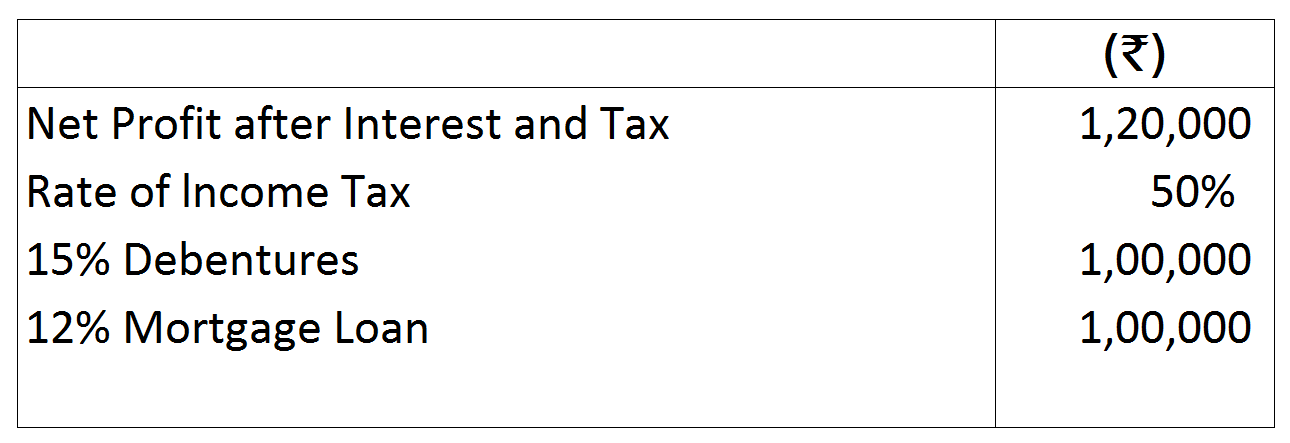
From the following information, calculate Proprietary Ratio:

Answer

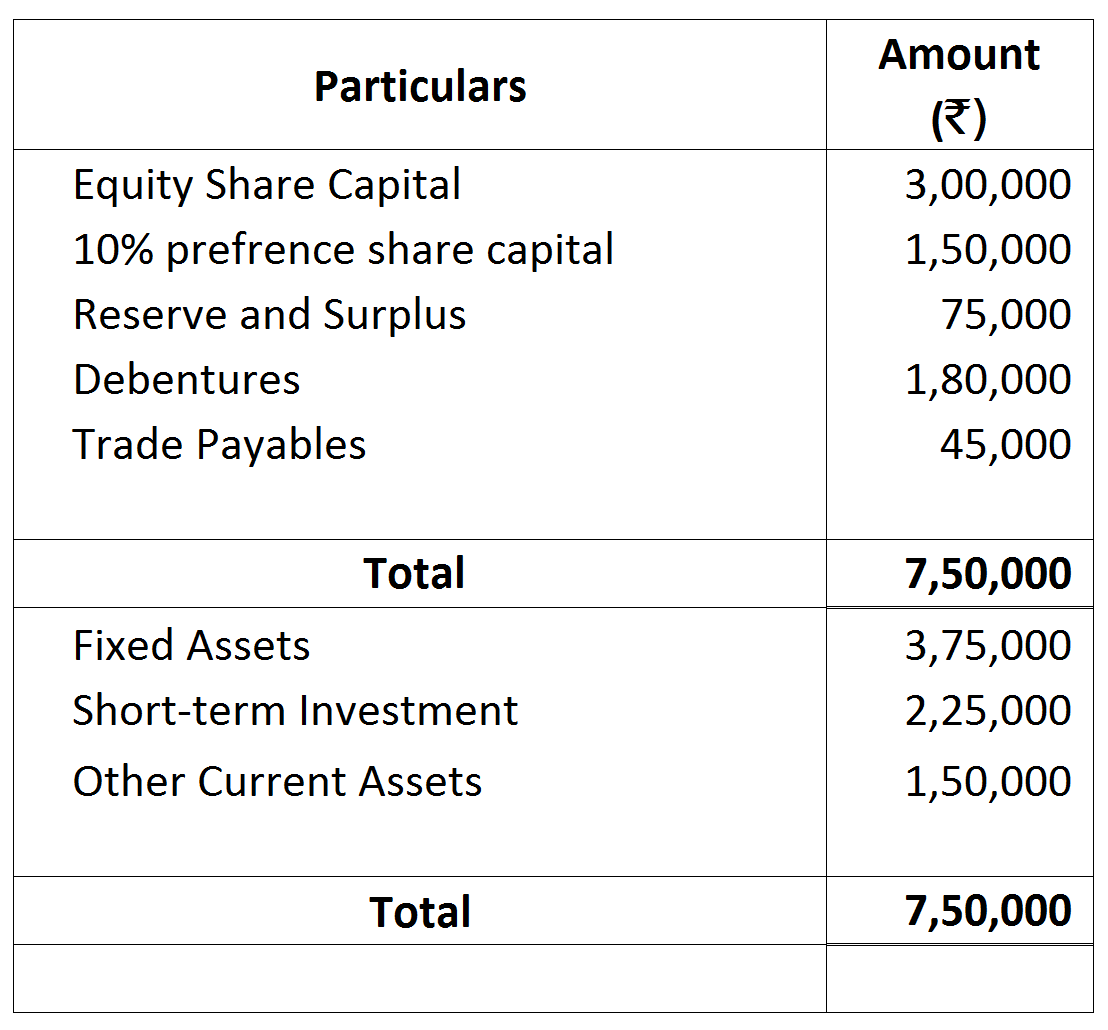
Total Assets = Fixed Assets + Current Assets + Investments
= 3,75,000 + 1,50,000 + 2,25,000 = 7,50,000
Shareholders’ Funds = Equity Share Capital + Preference Share Capital + Reserves and Surplus
= 3,00,000 + 1,50,000 + 75,000 = 5,25,000
$\text{Proprietary Ratio}=\frac{\text{Shareholder's Fund}}{\text{Total Assets}}$
$=\frac{5,25,000}{7,50,000}=0.70:1$

Need a full question paper?

Generate a complete, print-ready paper with questions like this in minutes — across 16+ boards, with answer keys.

Start Generating Free

Similar questions

X Ltd. took over the following assets and liabilities of Y Ltd:
Land & Building ₹ 20,00,000; Stock ₹ 5,00,000; Sundry Debtors ₹ 2,50,000 and Sundry Creditors ₹ 2,00,000.
X Ltd. paid purchase consideration by issuing Bank Draft of ₹ 16,00,000 and 50,000 Equity Shares of ₹ 20 each at 10% premium. Calculate purchase consideration and pass journal entries in the books of X Ltd.
Current Assets are ₹ 7,50,000 and Working Capital is ₹ 2,50,000. Calculate Current Ratio.
From the following information, calculate interest coverage ratio and give your comments also:
Capital Employed ₹ 10,00,000; Fixed Assets ₹ 7,00,000; Current Liabilities ₹ 1,00,000. There are no Long-term Investments. Calculate Current Ratio.
[Hint: Current Assets = Capital Employed + Current Liabilities - Fixed Assets.]
Identify the transactions as belonging to:
  1. Operating Activities.
  2. Investing Activities.
  3. Financing Activities.
  4. Cash and Cash Equivalents.
  1. Cash Sale of Goods.
  2. Cash Received against Revenue from Services rendered.
  3. Cash Purchase of Goods.
  4. Cash Paid against Services Taken.
  5. Patents Purchased.
  6. Marketable Securities.
  7. Bank Overdraft.
  8. Proceeds from Issue of Debentures.
  9. Purchase of Shares.
  10. Repayment of Long-term Loan.
  11. Commission Received.
  12. Redemption of Debentures.
  13. Interest on Debentures.
  14. Interest on Investments.
  15. Income Tax Paid.
  16. Income Tax Paid on Gain of Sale of Asset.
  17. Cash Received from Debtors.
  18. Cash Paid to Creditors.
Pass journal entries for the forfeiture and re-issue in the following cases:
C Ltd. forfeited 700 shares of ₹ 10 each fully-called-up-on which the holder has paid application money @ ₹ 3 and allotment money @ ₹ 2 per share. Out of these, 300 shares were re-issued as fully paid @ ₹ 7 per share.
Under what heads and sub-heads the following items will appear in the Balance Sheet of a company as per revised Schedule VI, Part - I of Companies Act 1956.
  1. Premium on redemption of Debentures.
  2. Loose tools.
  3. Alances with banks.
K Ltd. took over the assets of ₹ 15,00,000 and liabilities of ₹ 5,00,000 of P Ltd. for a purchase consideration of ₹ 13,68,500. ₹ 25,500 were paid by issuing a promissory note in favour of P Ltd. payable after two months and the balance was paid by issue of equity shares of ₹ 100 each at a premium of 25%.
Pass necessary journal entries for the above transactions in the books of K Ltd.
Total Debt ₹ 15,00,000; Current Liabilities ₹ 5,00,000; Capital Employed ₹ 15,00,000. Calculate Total Assets to Debt Ratio.
Under which major head/sub-head will the following items be presented in the Balance Sheet of a company as per Schedule III, Part I of the Companies Act, 2013?
  1. Computer software
  2. Calls-in-advance
  3. Outstanding salary
  4. Securities Premium Reserve
  5. Patents
  6. Interest accrued on Investment.