Question
From the given example, find if the motion is one or two or three-dimensional.
  1. A kite flying in the sky.
  2. A cricket ball hit by a player.
  3. Moon revolving around the earth.
  4. The motion of a stone in a circle.

Answer

  1. A flying kite in the sky comes under three-dimensional motion.
  2. A cricket ball hit by a player comes under two-dimensional motion.
  3. Moon revolving around the sun-earth comes under two-dimensional motion.
  4. The motion of the stone in circular motion comes under two-dimensional motion.

Need a full question paper?

Generate a complete, print-ready paper with questions like this in minutes — across 16+ boards, with answer keys.

Start Generating Free

Similar questions

A player throws a ball upwards with an initial speed of 29.4m s–1.
What are the velocity and acceleration of the ball at the highest point of its motion?
Show that the dimensions of the displacement current $\in_0\frac{\text{d}\phi_\text{E}}{\text{dt}}$ are that of an electric current.
The radius of a planet is R1 and a satellite revolves round it in a circle of radius R2. The time period of revolution is T. Find the acceleration due to the gravitation of the planet at its surface.
Why do different planets have different escape velocities?
Give the location of the centre of mass of a:
  1. Sphere.
  2. Cylinder.
  3. Ring, and
  4. Cube, each of uniform mass density.
Does the centre of mass of a body necessarily lie inside the body?
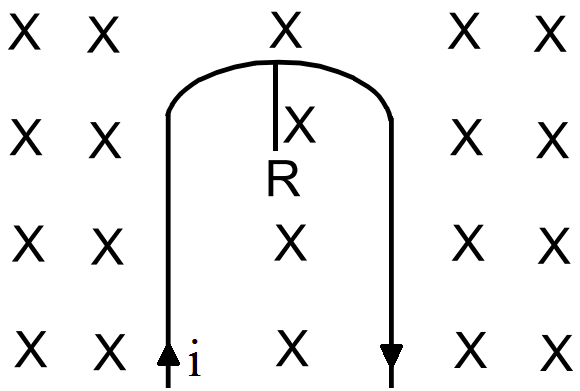
A rigid wire consists of a semi-circular portion of radius R and two straight sections The wire is partially immersed in a perpendicular magnetic field B, as shown in the figure. Find the magnetic force on the wire if it carries a current i.

The radius of a solid sphere is measured to be 11.24cm. What is the surface area of the sphere to appropriate significant figures?
Find the scalar product of two vectors $\vec{\text{a}}=(3\hat{\text{i}}-4\hat{\text{j}}+5\hat{\text{k}})$ and $\vec{\text{b}}=(-2\hat{\text{i}}+\hat{\text{j}}-3\hat{\text{k}}).$
A block of mass M is held against a rough vertical wall by pressing it with a finger. If the coefficient of friction between the block and the wall is $\mu$ and the acceleration due to gravity is g, calculate the minimum force required to be applied by the finger to hold the block against the wall?
A body of mass 10 g is 6cm performs simple harmonic motion on a long line, its maximum speed is $12 ~\text {cm / second}$. Find the period and maximum potential energy.