MCQ
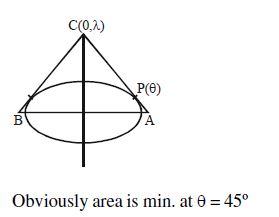
From the point$ C(0,\lambda )$ two tangents are drawn to ellipse $x^2\ +\ 2y^2\ = 4$ cutting major axis at $A$ and $B$. If  area of $\Delta$ $ABC$ is minimum, then value of $\lambda$  is-
  • A
    $\sqrt 2 $
  • $2$
  • C
    $2\sqrt 2 $
  • D
    $8$

Answer

Correct option: B.
$2$
b

Need a full question paper?

Generate a complete, print-ready paper with questions like this in minutes — across 16+ boards, with answer keys.

Start Generating Free

Similar questions

The distance of the point ($x_1​, y_1$​) from the origin:
If $y + 3x = 0$ is the equation of a chord of the circle, $x^2 + y^2 - 30x = 0,$ then the equation of the circle with this chord as diameter is
All possible two factors products are formed from numbers $1, 2, 3, 4, ...., 200$. The number of factors out of the total obtained which are multiples of $5$ is
The position vectors of the four angular point of a tetrahedron OABC are (0, 0, 0), (0, 0, 2), (0, 4, 0) and (6, 0, 0) respectively. Find the coordinates of cenroid:
The number of ways 10 digit numbers can be written using the digits 1 and 2 is:
If $\cot\text{x}-\tan\text{x}=\sec\text{x},$ then, x is equal to:
Consider the following lists:

$List-I$ $List-II$
($I$) $\left\{x \in\left[-\frac{2 \pi}{3}, \frac{2 \pi}{3}\right]: \cos x+\sin x=1\right\}$ ($P$) has two elements 
($II$) $\left\{x \in\left[-\frac{5 \pi}{18}, \frac{5 \pi}{18}\right]: \sqrt{3} \tan 3 x=1\right\}$ ($Q$) has three elements
($III$) $\left\{x \in\left[-\frac{6 \pi}{5}, \frac{6 \pi}{5}\right]: 2 \cos (2 x)=\sqrt{3}\right\}$ ($R$) has four elements
($I$) $\left\{x \in\left[-\frac{6 \pi}{5}, \frac{6 \pi}{5}\right]: 2 \cos (2 x)=\sqrt{3}\right\}$ ($S$) has five elements 
($VI$) $\left\{x \in\left[-\frac{7 \pi}{4}, \frac{7 \pi}{4}\right]: \sin x-\cos x=1\right\}$ ($T$) has six elements

The correct option is:

The letters of the word '$MANKIND$' are written in all possible orders and arranged in serial order as in an English dictionary. Then the serial number of the word '$MANKIND$' is $.....$
Locus of the point given by the equations $x = \frac{{2at}}{{1 + {t^2}}}$, $y = \frac{{a(1 - {t^2})}}{{1 + {t^2}}}\;\;( - 1 \le t \le 1)$ is a
The solution set of the equation $pq{x^2} - {(p + q)^2}x + {(p + q)^2} = 0$ is