MCQ
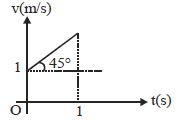
From the $v-t$ graph, the
  • A
    speed at $t = 1\,s$ is $1.2\, m/s$
  • B
    acceleration is $2\, m/s^2$
  • average speed during $1^{st}\, second$ is $1.5\, m/s$
  • D
    speed of the particle can be zero

Answer

Correct option: C.
average speed during $1^{st}\, second$ is $1.5\, m/s$
c
$v_{avg}=\frac{\text { distance }}{\text { time }}$

$v_{avg}=\frac{\frac{1}{2}(1+2) \times 1}{1}$

$=\frac{3}{2}=1.5 \mathrm{m} / \mathrm{s}$
Need a full question paper?

Generate a complete, print-ready paper with questions like this in minutes — across 16+ boards, with answer keys.
Start Generating Free

Similar questions

The coefficient of superficial expansion of a solid is $2 \times 10^{-5} {°C^{-1}}$. It's coefficient of linear expansion is
In an $H_2$ gas process, $PV^2 =$ constant. The ratio of work done by gas to change in its internal energy is
A vessel contains oil (density =$ 0.8 \;gm/cm^3$) over mercury (density = $13.6\; gm/cm^3$). A homogeneous sphere floats with half of its volume immersed in mercury and the other half in oil. The density of the material of the sphere in $ gm/cm^3$ is
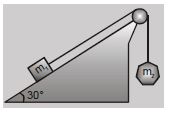
A block of mass $m_1 = 2\,\,kg$  on a smooth inclined plane at angle $30^o$  is connected to a second block of mass $m_2 = 3\,\,kg$  by a cord passing over a frictionless pulley as shown in fig. The acceleration of each block is ....... $m/sec^2$  (assume $g = 10\,\,m/sec^2$ )
What will be the formula of mass of the earth in terms of $g, R$ and $G$ ?
Two stones are projected so as to reach the same distance from the point of projection on a horizontal surface. The maximum height reached by one exceeds the other by an amount equal to half the sum of the height attained by them. Then, angle of projection of the stone which attains smaller height is $........$
Velocity of a body on reaching the point from which it was projected upwards, is
$1 \,g=$ …… $a.m.u.$
A particle of mass $m$ is moving in a circular path of constant radius $r$ such that its centripetal acceleration ${a_c}$ is varying with time t as, ${a_c} = {k^2}r{t^2}$, The power delivered to the particle by the forces acting on it is
If the radius of a solid sphere is $35\,\,cm,$  calculate the radius of gyration when the axis is along a tangent