MCQ
Fusion processes, like combining two deuterons to form a He nucleus are impossible at ordinary temperatures and pressure. The reasons for this can be traced to the fact:
  • A
    Nuclear forces have short range.
  • B
    Nuclei are positively charged.
  • $A$ and $B$ both
  • D
    The original nuclei must first break up before combining with each other.

Answer

Correct option: C.
$A$ and $B$ both
Key coneept:
Nuclear Fusion: In nuclear fusion two or more than two lighter nuclei combine to form a single heavy nucleus. The mass of a single nucleus so formed is less than the sum of the masses of parent nuclei. This difference in mass results in the release of tremendous amount of energy To achieve fusion, you need to create special conditions to overcome this tendency.
Here are the conditions that make fusion possible:
High Temperature: The high temperature gives the hydrogen atoms enough energy to overcome the electrical repulsion between the protons.
  1. Fusion requires temperatures about $100$ million Kelvin $($approximately six times hotter titan the sun’s core$).$
  2. At these temperatures, hydrogen is a plasma, not a gas. Plasma is a high$-$energy state of matter in which all the electrons are stripped from atoms and move freely about.
  3. The sun achieves these temperatures by its large mass and the force of gravity compressing this mass in the core. We must use energy from microwaves, lasers and ion particles to achieve these temperatures.
High pressure: Pressure squeezes the hydrogen atoms together. They must be within $1 \times 10^{-15}$ metres of each other to fuse.
  1. The sun uses its mass and the force of gravity to squeeze hydrogen atoms together in its core.
  2. We must squeeze hydrogen atoms together by using intense magnetic fields, powerful lasers or ion beams.
Fusion processes are impossible at ordinary temperatures and pressures. The reason is that nuclei are positively charged and nuclear forces are short range strongest forces. In order to force two hydrogen nuclei together, we need to have a very high pressure, or a very high temperature, or both. A high pressure helps because it causes all the hydrogen nuclei in the sun to squeeze into a smaller space. Then there is more chance of one hydrogen bumping into another. A high temperature helps because it makes the hydrogen nuclei move faster. They need this extra speed so that they can get close together and join. It is as if the nucleus has to break through a barrier, and so the faster it is moving, the greater chance it has.
So, at the "normal" temperature and pressure on earth, a hydrogen nucleus has basically no chance of ever joining with another hydrogen nucleus.
Important point: We know that in the middle of the sun, where the temperature is about $16$ million degrees, and the pressure is $250$ billion atmospheres, hydrogen nuclei will sometimes have enough energy to join together. $($An atmosphere is the "normal", pressure of the air here on earth. A pressure of $250$ billion atmospheres is like having a large mountain piled on top of you!$)$

Need a full question paper?

Generate a complete, print-ready paper with questions like this in minutes — across 16+ boards, with answer keys.

Start Generating Free

Similar questions

A metal ball of radius $R$ is placed concentrically inside a hollow metal sphere of inner radius $2R $ and outer radius $3R$. The ball is given a charge $+2Q$ and the hollow sphere a total charge $- Q$. The electrostatic potential energy of this system is :
A proton and an alpha particle both enter a region of uniform magnetic field $B,$ moving at right angles to field $B$. If the radius of circular orbits for both the particles is equal and the kinetic energy acquired by proton is $1 \ MeV$ the energy acquired by the alpha particle will be:
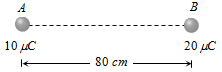
In the given figure distance of the point from A where the electric field is zero is
Two lenses have focal lengths $f_1$ and $f_2$ and their dispersive powers are $\omega_1$ and $\omega_2$ respectively. They will together form an achromatic combination if
A particle of charge $1\  \mu C\  \&\  mass$ $1\  gm$ moving with a velocity of $4\  m/s$ is subjected to a uniform electric field of magnitude $300\  V/m$ for $10\  sec$. Then it's final speed cannot be.......$m/s$
Average energy stored in a pure inductance $L$ when a current $i$ flows through it, is
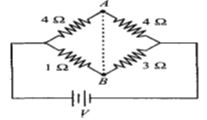
In the circuit shown, if a conducting wire is connected between points $A$ and $B,$ the current in this wire will
At what angle should an unpolarised beam be incident on a crystal of $\mu = \sqrt 3$ , so that reflected beam is polarised ..........$^o$
A thin equiconvex glass lens of refractive index $1.5$ has power of $5 D$. When the lens is immersed in a liquid of refractive index $\mu$, it acts as a divergent lens of focal length $100 \,cm$. The value of $\mu$ of liquid is .....
Avalanche breakdown is due to