MCQ
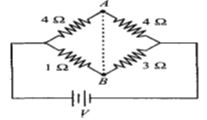
In the circuit shown, if a conducting wire is connected between points $A$ and $B,$ the current in this wire will
- Aflow from $A$ to $B $
- ✓flow from $B $ to $A$
- Cflow in the direction which will be decided by the vaule of $V$
- Dbe zero
Potential difference between $C$ and $A=V_{C}-V_{A}$
$=\frac{V}{8} \times 4=\frac{V}{2}\, \mathrm{volt}$
Current through $C B D$, $I^{\prime}=\frac{V}{4}\, amp$
Potential difference between $C$ and $B=V_{C}-V_{B}$
$=\frac{V}{4} \times 1=\frac{V}{4} \,\text { volt. }$
Potential between $A$ and $B=V_{A}-V_{B}$
$\therefore \quad V_{A}-V_{B}=V_{C}-V_{B}-\left(V_{C}-V_{A}\right)=\frac{V}{4}-\frac{V}{2}=\frac{V}{4}$
$ \Rightarrow {V_A} - {V_B} < 0\quad or,\quad {V_A} < {V_B}$
As ${V_A} < {V_B}$, so direction of current will be from $B$ to $A$.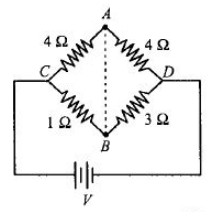
Generate a complete, print-ready paper with questions like this in minutes — across 16+ boards, with answer keys.
$(i)$ Light can be totally internally reflected when it passes from $B$ to $A$
$(ii)$ Light can be totally internally reflected when it passes from $A$ to $B$
$(iii)$ Critical angle for total internal reflection is ${i_B} - {i_A}$
$(iv)$ Critical angle between $A$ and $B$ is ${\sin ^{ - 1}}\left( {\frac{{\sin {i_A}}}{{\sin {i_B}}}} \right)$