Question
$\text{f}(\text{x})=\sin +\sqrt{3}\cos\text{x}$ is maximum when x =
  1. $\frac{\pi}{3}$
  2. $\frac{\pi}{4}$
  3. $\frac{\pi}{6}$
  4. $0$ 

Answer

  1. $\frac{\pi}{6}$

Solution:

$\text{f}(\text{x})=\sin +\sqrt{3}\cos\text{x}$

$\Rightarrow\text{f}'(\text{x})=\cos\text{x}-\sqrt{3}\sin\text{x}$

For maxima or maxima,

f'(x) = 0

$\cos\text{x}-\sqrt{3}\sin\text{x}=0$

$\Rightarrow\ \tan\text{x}=\frac{1}{\sqrt{3}}\Rightarrow\text{x}=\frac{\pi}{6}$

$\text{f}''\Big(\frac{\pi}{6}\Big)=-\sin\frac{\pi}{6}-\sqrt{3}\cos\frac{\pi}{6}=\frac{-1-\sqrt{3}}{2}<0$

function has local maima at $\text{x}=\frac{\pi}{6}$

Need a full question paper?

Generate a complete, print-ready paper with questions like this in minutes — across 16+ boards, with answer keys.
Start Generating Free

Similar questions

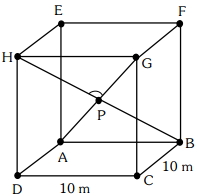
A hall has a square floor of dimension $10\, \mathrm{~m} \times 10\, \mathrm{~m}$ (see the figure) and vertical walls. If the angle $GPH$ between the diagonals $\mathrm{AG}$ and $\mathrm{BH}$ is $\cos ^{-1} \frac{1}{5}$, then the height of the hall (in $meters$) is :
A solution of the equation ${\tan ^{ - 1}}(1 + x)$ $ + {\tan ^{ - 1}}(1 - x)$ $ = \frac{\pi }{2}$ is
Let $|M|$ denote the determinant of a square matrix $M$. Let $g:\left[0, \frac{\pi}{2}\right] \rightarrow R$ be the function defined by

$g(\theta)=\sqrt{f(\theta)-1}+\sqrt{f\left(\frac{\pi}{2}-\theta\right)-1}$

where

$f(\theta)=\frac{1}{2}\left|\begin{array}{ccc}1 & \sin \theta & 1 \\ -\sin \theta & 1 & \sin \theta \\ -1 & -\sin \theta & 1\end{array}\right|+\left|\begin{array}{ccc}\sin \pi & \cos \left(\theta+\frac{\pi}{4}\right) & \tan \left(\theta-\frac{\pi}{4}\right) \\ \sin \left(\theta-\frac{\pi}{4}\right) & -\cos \frac{\pi}{2} & \log _e\left(\frac{4}{\pi}\right) \\ \cot \left(\theta+\frac{\pi}{4}\right) & \log _e\left(\frac{\pi}{4}\right) & \tan \pi\end{array}\right|$.

Let $p (x)$ be a quadratic polynomial whose roots are the maximum and minimum values of the function $g(\theta)$, and $p(2)=2-\sqrt{2}$. Then, which of the following is/are TRUE ?

$(A)$ $p \left(\frac{3+\sqrt{2}}{4}\right)<0$

$(B)$ $p \left(\frac{1+3 \sqrt{2}}{4}\right)>0$

$(C)$ $p \left(\frac{5 \sqrt{2}-1}{4}\right)>0$

$(D)$ $p \left(\frac{5-\sqrt{2}}{4}\right)<0$

Two cards are drawn from a well shuffled deck of 52 playing cards with replacement. The probability that both cards are queen is
  1. $\frac{1}{13}\times\frac{1}{13}$
  2. $\frac{1}{13}+\frac{1}{13}$
  3. $\frac{1}{13}\times\frac{1}{17}$
  4. $\frac{1}{13}\times\frac{4}{5}$
Choose the correct answer from the given four options.
The distance of the plane $\vec{\text{r}}\Big(\frac{2}{7}\hat{\text{i}}+\frac{3}{7}\hat{\text{j}}-\frac{6}{7}\hat{\text{k}}\Big)=1$ from the origin is:
If P be the point (2, 6, 3) then the equation of the plane trough P, at right angles to OP, where ′O′ is the origin is:
The area bounded by the lines y = |x| - 1 and y = -|x| + 1 is:
  1. 1 sq. unit
  2. 2 sq. unit
  3. $2\sqrt{2}\text{ sq}.\text{units}$
  4. 4 sq. units
If $y=\log \left(\frac{1-x^2}{1+x^2}\right)$, then $\frac{d y}{d x}$ is equal to
Let $a = i - j,\,\,b = j - k,\,\,c = k - i.$ If $\hat d$ is a unit vector such that $a\,.\,\hat d = 0 = [b\,\,c\,\,\hat d],$ then $\hat d$ is equal to
If f(x) = |x - 3| and g(x) = fof(x), then for x > 10, g'(x) is equal to:
  1. 1
  2. -1
  3. 0
  4. None of these.