Question
Need a full question paper?
Generate a complete, print-ready paper with questions like this in minutes — across 16+ boards, with answer keys.
Explore more
Similar questions
The plate resistance of a triode is $8\text{k}\Omega$ and the transconductance is 2.5 milliohm. (a) If the plate voltage is increased by 48V and the grid voltage is kept constant, what will be the increase in the plate current? (b) With plate voltage kept constant at this increased value, by how much should the grid voltage be decreased in order to bring the plate current back to its initial value?
→The human body has an average temperature of 98°F. Assume that the vapour pressure of the blood in the veins behaves like that of pure water. Find the minimum atmospheric pressure which is necessary to prevent the blood from boiling. Use figure. of the text for the vapour pressures. 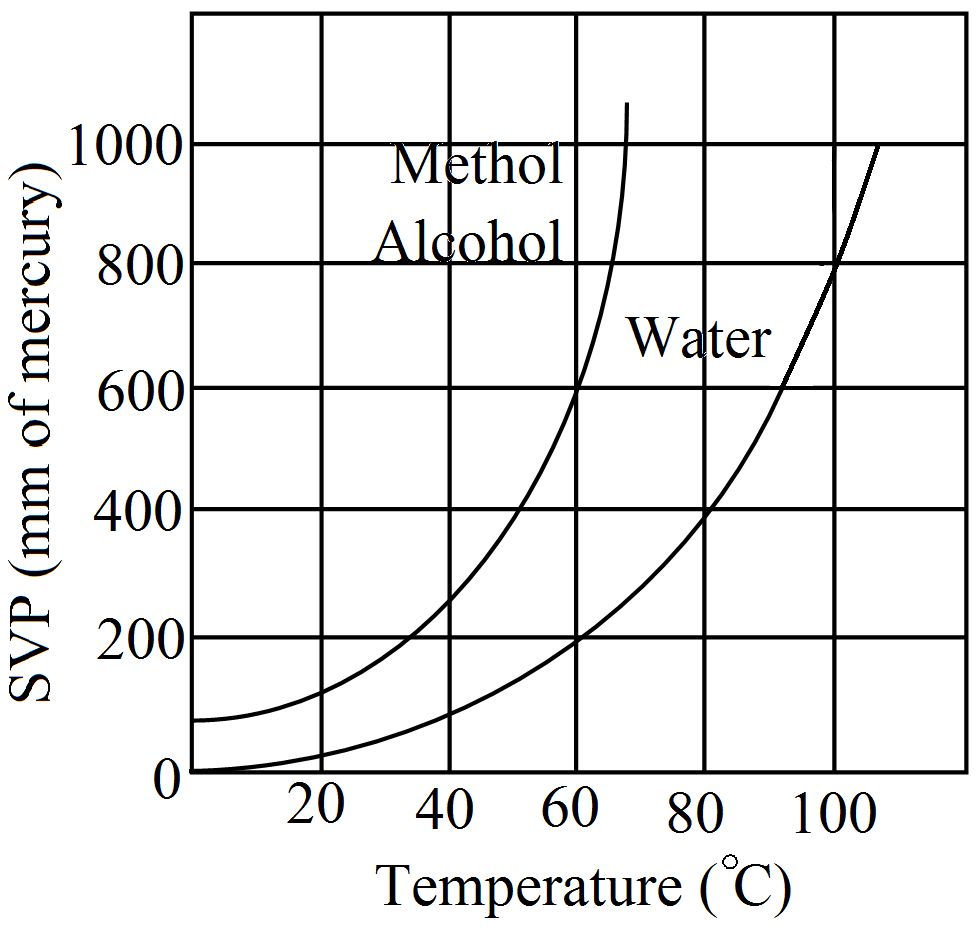
Read the passage given below and answer the following questions from (i) to (v).
A motion that repeats itself at regular intervals of time is called periodic motion. Very often, the body undergoing periodic motion has an equilibrium position somewhere inside its path. When the body is at this position no net external force acts on it. Therefore, if it is left there at rest, it remains there forever. If the body is given a small displacement from the position, a force comes into play which tries to bring the body back to the equilibrium point, giving rise to oscillations or vibrations. Every oscillatory motion is periodic, but every periodic motion need not be oscillatory. Circular motion is a periodic motion, but it is not oscillatory. The smallest interval of time after which the motion is repeated is called its period. Let us denote the period by the symbol T. Its SI unit is second. The reciprocal of T gives the number of repetitions that occur per unit time. This quantity is called the frequency of the periodic motion. It is represented by the symbol n. The relation between n and T is $\text{n}=\frac{1}{\text{T}}$. The unit of n is thus $s^{-1}$. After the discoverer of radio waves, Heinrich Rudolph Hertz (1857–1894), a special name has been given to the unit of frequency. It is called hertz (abbreviated as Hz). Answer the following.
→A motion that repeats itself at regular intervals of time is called periodic motion. Very often, the body undergoing periodic motion has an equilibrium position somewhere inside its path. When the body is at this position no net external force acts on it. Therefore, if it is left there at rest, it remains there forever. If the body is given a small displacement from the position, a force comes into play which tries to bring the body back to the equilibrium point, giving rise to oscillations or vibrations. Every oscillatory motion is periodic, but every periodic motion need not be oscillatory. Circular motion is a periodic motion, but it is not oscillatory. The smallest interval of time after which the motion is repeated is called its period. Let us denote the period by the symbol T. Its SI unit is second. The reciprocal of T gives the number of repetitions that occur per unit time. This quantity is called the frequency of the periodic motion. It is represented by the symbol n. The relation between n and T is $\text{n}=\frac{1}{\text{T}}$. The unit of n is thus $s^{-1}$. After the discoverer of radio waves, Heinrich Rudolph Hertz (1857–1894), a special name has been given to the unit of frequency. It is called hertz (abbreviated as Hz). Answer the following.
- Every oscillatory motion is periodic motion true or false?
- True
- False
- Circular motion is
- Oscillatory motion
- Periodic motion
- Rotational motion
- None of these
- Define period. Give its SI unit and dimensions
- Define frequency of periodic motion. How it is related to time period
- What is oscillatory motion
Read the passage given below and answer the following questions from 1 to 5. Moment of Inertia A heavy wheel called flywheel is attached to the shaft of steam engine, automobile engine etc., because of its large moment of inertia, the flywheel opposes the sudden increase or decrease of the speed of the vehicle. It allows a gradual change in the speed and prevents jerky motion and hence ensure smooth ride of passengers.
→- Moment of inertia of a body depends upon:
- axis of rotation
- torque
- angular momentum
- angular velocity
- A particle of mass 1 kg is kept at (1m, 1m, 1m). The moment of inertia of this particle about Z-axis would be:
- $1 kg-m^2$
- $2 kg-m^2$
- $3 kg-m^2$
- (None of the above)
- Moment of inertia of a rod of mass m and length l about its one end is I. If one-fourth of its length is cut away, then moment of inertia of the remaining rod about its one end will be:
- $\frac{3}{4}\text{I}$
- $\frac{9}{16}\text{I}$
- $\frac{27}{64}\text{I}$
- $\frac{\text{I}}{16}$
- A circular disc is to be made by using iron and aluminium, so that it acquires maximum moment of inertia about its geometrical axis. It is possible with:
- iron and aluminium layers in alternate order
- aluminium at interior and iron surrounding it
- iron at interior and aluminium surrounding it
- Either (a) or (c)
- Three thin rods each of length L and mass M are placed along X ,Y and Z -axes such that one end of each rod is at origin. The moment of inertia of this system about Z-axis is:
- $\frac{2}{3}\text{ML}^2$
- $\frac{4\text{ML}^2}{3}$
- $\frac{5\text{ML}^2}{3}$
- $\frac{\text{ML}^2}{3}$
Read the passage given below and answer the following questions from $1$ to $5.$ The rules for determining the uncertainty or error in the measured quantity in arithmetic operations can be understood from the following examples. a.) If the length and breadth of a thin rectangular sheet are measured, using a metre scale as $16.2\ cm$ and, $10.1\ cm$ respectively, there are three significant figures in each measurement. It means that the length L may be written as L = 16.2 ± 0.1cm = 16.2cm ± 0.6%. Similarly, the breadth b may be written as $b = 10.1 ± 0.1\ cm = 10.1\ cm ± 1\%$ Then, the error of the product of two (or more) experimental values, using the combination of errors rule, will be $L*b = 163.62\ cm^2 + 1.6% = 163.62 + 2.6\ cm^2 $ This leads us to quote the final result as $L*b = 164 + 3\ cm^2.$ Here $3\ cm^2$ is the uncertainty or error in the estimation of area of rectangular sheet. b) If a set of experimental data is specified to $n$ significant figures a result obtained by combining the data will also be valid to n significant figures.However, if data are subtracted, the number of significant figures can be reduced.For example, $12.9g – 7.06g$, both specified to three significant figures, cannot properly be evaluated as 5.84g but only as $5.8g$, as uncertainties in subtraction or addition combine in a different fashion (smallest number of decimal places rather than the number of significant figures in any of the number added or subtracted). c.) The relative error of a value of number specified to significant figures depends not only on n but also on the number itself. For example, the accuracy in measurement of mass $1.02g$ is $± 0.01g$ whereas another measurement $9.89g$ is also accurate to $± 0.01g$. The relative error in $1.02g$ is: $= (± 0.01/1.02) \times 100\% = ± 1\%$ Similarly, the relative error in $9.89\ g$ is $= (± 0.01/9.89) \times 100\% = ± 0.1%$ Finally, remember that intermediate results in a multi-step computation should be calculated to one more significant figure in every measurement than the number of digits in the least precise measurement. $d.$) The nature of a physical quantity is described by its dimensions. All the physical quantities represented by derived units can be expressed in terms of some combination of seven fundamental or base quantities. We shall call these base quantities as the seven dimensions of the physical world, which are denoted with square brackets $[ ]$. Thus, length has the dimension $[L],$ mass $[M],$ time $[T],$ electric current $[A]$, thermodynamic temperature $[K]$, luminous intensity $[cd],$ and amount of substance $[mol]$. The dimensions of a physical quantity are the powers (or exponents) to which the base quantities are raised to represent that quantity. Note that using the square brackets $[ ]$ round a quantity means that we are dealing with ‘the dimensions of’ the quantity. In mechanics, all the physical quantities can be written in terms of the dimensions $[L], [M]$ and $[T]$. For example, the volume occupied by an object is expressed as the product of length, breadth and height, or three lengths. Hence the dimensions of volume are $[L] \times [L] \times [L] = [L^3].$
→- Dimensions of area is:
- $[L^2]$
- $[L^3]$
- $[M^2]$
- None of these
- dimensions of volume are:
- $[L^2]$
- $[L]$
- $[L^3]$
- None of these
- What is uncertainty in physics$?$ Explain with one example:
- define dimensions of a physical quantity:
- Give list for $7$ base quantities with dimensions:
A bar magnet makes 40 oscillations per minute in an oscillation magnetometer. An identical magnet is demagnetized completely and is placed over the magnet in the magnetometer. Find the time taken for 40 oscillations by this combination. Neglect any induced magnetism.
Read the passage given below and answer the following questions from 1 to 5. When a body is subjected to a deforming force, a restoring force is developed in the body. This restoring force is equal in magnitude but opposite in direction to the applied force. The restoring force per unit area is known as stress. If F is the force applied normal to the cross–section and A is the area of cross section of the body. Magnitude of the stress $=\frac{\text{F}}{\text{A}}$ The SI unit of stress is $N-m^{-2}$ or Pascal (Pa) and its dimensional formula is $[ML^{-1} T^{-2}]$. The restoring force per unit area in this case is called tensile stress. If the cylinder is compressed under the action of applied forces, the restoring force per unit area is known as compressive stress. Tensile or compressive stress can also be termed as longitudinal stress. In both the cases, there is a change in the length of the cylinder. The change in the length ΔL to the original length L of the body is known as longitudinal strain. The restoring force per unit area developed due to the applied tangential force is known as tangential or shearing stress.
→- Restoring force per unit area is called as:
- Stress
- Strain
- Modulus of elasticity
- None of these
- Ratio of change in dimension to original dimension is called:
- Stress
- Strain
- Modulus of elasticity
- None of these
- Define shear stress.
- Define stress. Give its SI unit and dimension.
- Define strain. Give its SI unit and dimension
The moon rotates about the earth in such a way that only one hemisphere of the moon faces the earth. Can we ever see the ''other face'' of the moon from the earth? Can a person on the moon ever see all the faces of the earth? 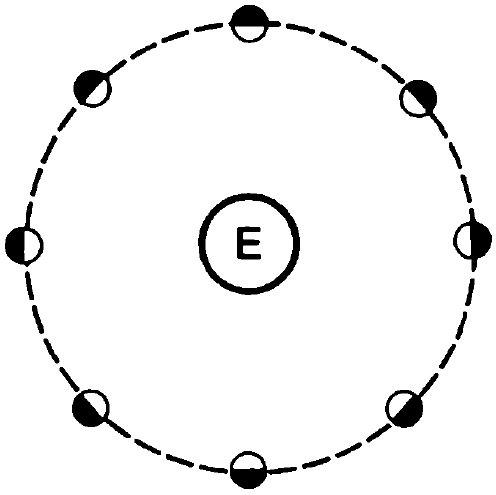
Read the passage given below and answer the following questions from (i) to (iv). Zeroth Law of Thermodynamics states that two systems in thermal equilibrium with a third system separately are in thermal equilibrium with each other. The Zeroth Law clearly suggests that when two systems A and B, are in thermal equilibrium, there must be a physical quantity that has the same value for both. This thermodynamic variable whose value is equal for two systems in thermal equilibrium is called temperature (T). Thus, if A and B are separately in equilibrium with C, TA = TC and TB = TC. This implies that TA = TB i.e. the systems A and B are also in thermal equilibrium. Zeroth Law of Thermodynamics leads to the concept of internal energy of a system. We know that every bulk system consists of a large number of molecules. Internal energy is simply the sum of the kinetic energies and potential energies of these molecules. A certain amount of heat is supplied to the system’ or ‘a certain amount of work was done by the system its energy changes.
- Three thermodynamic systems are at temperature of 500 c .what can we say about them?
- Heat flows between them
- It obeys Zeroth Law of Thermodynamics
- Temperature of one system will increase and temperature of remaining two will decrease
- None of these
- Zeroth law of thermodynamics helped in the creation of which scale?
- Temperature
- Heat energy
- Pressure
- Internal energy
- State Zeroth Law of Thermodynamics:
- Define Internal energy of system:
Mr. Verma $(50kg)$ and Mr. Mathur $(60kg)$ are sitting at the two extremes of a $4m$ long boat $(40kg)$ standing still in water. To discuss a mechanics problem, they come to the middle of the boat. Neglecting friction with water, how far does the boat move on the water during the process?
→