MCQ
Geometrical isomers differ in
  • A
    Position of atoms
  • B
    Length of carbon
  • Spatial arrangement of atoms
  • D
    Position of functional group

Answer

Correct option: C.
Spatial arrangement of atoms
c
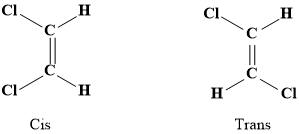
They have the same molecular formula and the same connectivity of atoms but differ in spatial arrangements of groups.

Geometrical isomerism is observed due to restricted rotation around the carbon-carbon double bond.

In geometrical isomerism there is no change in the position of the double bond or there is no change in the $C - C$ bond length there is only a change in the spatial arrangement of the groups across the double bond.
Need a full question paper?

Generate a complete, print-ready paper with questions like this in minutes — across 16+ boards, with answer keys.

Start Generating Free

Similar questions

The azeotropic mixture of water $(b.p.\,\,, Easy00\,^oC)$ and $HCl\,(b.p.\,\,85\,^oC)$ boils at $, Easy08.5\,^oC$. When this mixture is distilled it is possible to obtain
Consider the following compounds in the liquid form :

$O _2, HF , H _2 O , NH _3, H _2 O _2, CCl _4, CHCl _3, C _6 H _6, C _6 H _5 Cl \text {. }$

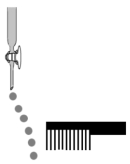
When a charged comb is brought near their flowing stream, how many of them show deflection as per the following figure?
The final product of the following sequence of reaction is

${(C{H_3}O)_2}CHC{H_2}C{H_2}C{H_2}Br\xrightarrow{{Mg}}\xrightarrow{{{H_2}C = O}}\xrightarrow[{heat}]{{{H_3}{O^ + }}}$

The amount of water produced (in $g$ ) in the oxidation of $1$ mole of rhombic sulphur by conc. $HNO _3$ to a compound with the highest oxidation state of sulphur is. . . . .  (Given data : Molar mass of water $=18 g mol ^{-1}$ )
Carbohydrates are stored in human body as
Which of the following elements are analogous to the lanthanides
Which of the following reactions occurs at the cathode of a common dry cell
For the estimation of nitrogen, $1.4\, g$ of an organic compound was digested by Kjeldahl method and the evolved ammonia was absorbed in $60\, mL$ of $\frac{M}{10}$ sulphuric acid. The unreacted acid required $20\, mL$ of $\frac{M}{10}$ sodium hydroxide for complete neutralization. The percentage of nitrogen in the compound is .....$\%$
$KMn{O_4}$ acts as an oxidising agent in the neutral medium and gets reduced to $Mn{O_2}$. The equivalent weight of $KMn{O_4}$ in neutral medium
Pure $'N_2'$ obtain by