Question
Get the electric field due to a uniformly charged infinite plane sheet.

Answer

Image
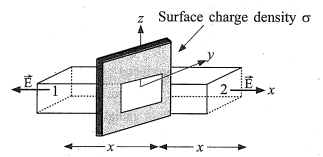
►Let $\sigma$ be the uniform surface charge density of an infinite plane sheet (Fig.). We take the $x$-axis normal to the given plane.
►By symmetry, the electric field will not depend on y and z coordinates and its direction at every point must be parallel to the x-direction.
►We can take the Gaussian surface to be a rectangular parallelpiped of cross-sectional area A, as shown. (A cylindrical surface will also do.)
►As seen from the figure, only the two faces 1 and 2 will contribute to the flux; electric field lines are parallel to the other faces and they, therefore, do not contribute to the total flux.
►Total flux passing through Gaussian surface.
$\begin{aligned}
\phi & =\text { Electric flux passing through Surface } 1 \\
& + \text { Electric flux passing through surface } 2 \\
\therefore \phi & =\text { EAcos } 0+\text { EA } \cos 0 \\
& =\text { EA }+ \text { EA } \\
& =2 EA
\end{aligned}$
►According to Gauss's law $=\phi=\frac{q}{\varepsilon_0}$
Thus, 2EA $=\frac{q}{\varepsilon_0}$
Where, $q=$ electric charge enclosed by
Gaussian surface
$\begin{aligned}
\quad q & =\text { Surface charge density } \times \text { Area } \\
\therefore \quad q & =\sigma A
\end{aligned}$
►Put the value in equation (3),
$\begin{array}{rlrl}
\therefore & 2 EA & =\frac{\sigma A }{\varepsilon_0} \\
\therefore & E & =\frac{\sigma}{2 \varepsilon_0} \\
2 EA & =\frac{\sigma A }{\varepsilon_0} \\
& \text { or, } & E & =\frac{\sigma}{2 \varepsilon_0}
\end{array}$
►Vectorically,
$\overrightarrow{ E }=\frac{\sigma}{2 \varepsilon_0} \hat{n}$
►Where $\hat{n}$ is a unit vector normal to the plane and going away from it, E is directed away from the plate if $\sigma$ is positive and toward the plate if $\sigma$ is negative.

Need a full question paper?

Generate a complete, print-ready paper with questions like this in minutes — across 16+ boards, with answer keys.
Start Generating Free

Similar questions

If the operating potential in an X-ray tube is increased by 1%, by what percentage does the cutoff wavelength decrease?
  1. Write the process of $\beta$ decay. How can radioactive nuclei emit $\beta$-particles even though they do not contain them? Why do all electrons emitted during $\beta$-decay not have the same energy? 
  2. A heavy nucleus splits into two lighter nuclei. Which one of the two - parent nucleus or the daughter nuclei has more binding energy per nucleon?
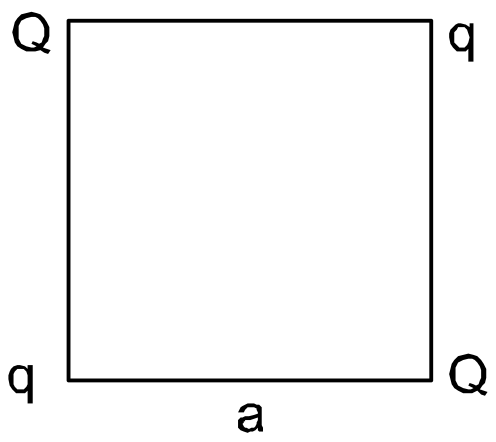
Four point charges Q, q, Q and q are placed at the corners of a square of side ‘a’ as shown in the figure.

Find the:

  1. Resultant electric force on a charge Q.
  2. Potential energy of this system.
For a given position of an object, an equiconvex lens forms its real image at a distance of 60cm from the lens. A convex mirror is now kept in between this image position and the convex lens. The final image formed by this combination coincides with the object when the distance between the convex lens and the convex mirror equals 25cm. Calculate the radius of curvature of the convex mirror.
A long straight wire of a circular cross-section of radius ‘a’ carries a steady current ‘I’. The current is uniformly distributed across the cross-section. Apply Ampere’s circuital law to calculate the magnetic field at a point ‘r’ in the region for (i) r < a and (ii) r > a.
Answer the following questions:
  1. In a double slit experiment using light of wavelength 600 nm, the angular width of the fringe formed on a distant screen is 0.1o. Find the spacing between the two slits.
  2. Light of wavelength 5000 Å. Propagating in air gets partly reflected from the surface of water. How will the wavelengths and frequencies of the reflected and refracted light be affected?
A ball of mass 0.50kg moving at a speed of 5.0m/s collides with another ball of mass 1.0kg. After the collision the balls stick together and remain motionless. What was the velocity of the 1.0kg block before the collision?
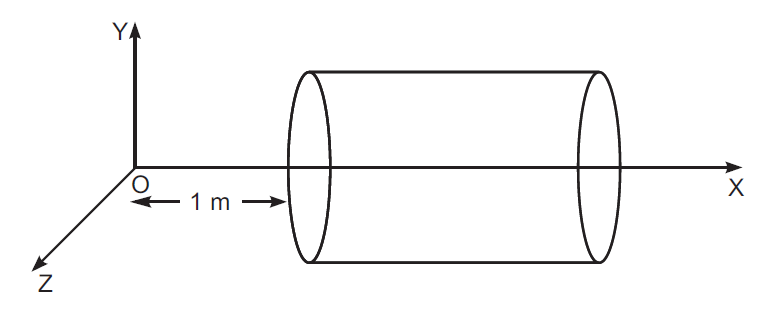
A hollow cylindrical box of length 1 m and area of cross-section 25 cm2 is placed in a three dimensional coordinate system as shown in the figure. The electric field in the region is given by$\overrightarrow{\text{E}} = 50\text{x}\hat{\text{i}},$ where E is in NC–1 and x is in metres. Find

  1. Net flux through the cylinder.
  2. Charge enclosed by the cylinder.

As the earth rotates about its axis, a person living in his house at the equator goes in a circular orbit of radius equal to the radius of the earth. Why does he/ she not feel weightless as a satellite passenger does?