Question
Get the electric field due to on infinitely long straight uniformly changed wire.

Answer

Image
$►$ Consider an infinitely long thin straight wire with uniform linear charge density $\lambda$.
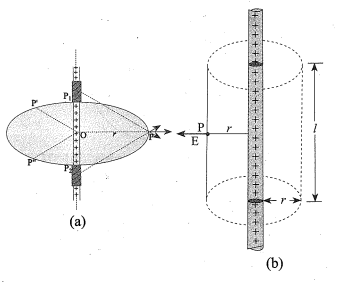
$►$ Suppose we take the radial vector from $O$ to $P$ and rotate it around the wire. The points $P , P ^{\prime}$, $P ^{\prime \prime}$ so obtained are completely equivalent with respect to the charged wire.
$►$ This implies that the electric field must have the same magnitude at these points.
$►$ The direction of electric field at every point must be radial $($ outward if $\lambda > 0$, inward if $\lambda < 0 ).$
$►$ Consider a pair of line elements $P_1$ and $P_2$ of the wire, as shown in Fig. $(a)$
$►$ The electric fields produced by the two elements of the pair when summed, give a resultant electric field which is radial $($the components normal to the radial vector cancel$).$
$►$ This is true for any such pair and hence the total field at any point $P$ is radial.
$►$ The electric field is everywhere radial in the plane cutting the wire normally, and its magnitude depends only on the radial distance $r$.
$►$ To calculate the field, imagine a cylindrical Gaussian surface, as shown in the Fig. $(b).$
$►$ Since the field is everywhere radial, flux through the two ends of the cylindrical Gaussian surface is zero.
$\phi=$ Flux through the curved surface of the cylinder
$\therefore \phi=\overrightarrow{ E } \cdot \overrightarrow{ S }$
$\therefore \phi= ES \cos 0 \quad(\overrightarrow{ E } \| \overrightarrow{ S })$
$\therefore \phi= E (2 \pi r l) \text { (S-area of curved surface) } \ldots$
$►$ As per Gauss's law, $\phi=\frac{q}{\varepsilon_0}$
but $q=\lambda l ($electric charge surrounded by Gaussian surface$)$
$\therefore \phi=\frac{\lambda l}{\varepsilon_0}$
$►$ Comparing equation $(1)$ and equation $(2),$
$E (2 \pi r l)=\frac{\lambda l}{\varepsilon_0}$
$E =\frac{1}{2 \pi \varepsilon_0} \cdot \frac{\lambda}{r}$
$►$ Electric field in vector form,
$\overrightarrow{ E }=\frac{1}{2 \pi \varepsilon_0} \cdot \frac{\lambda}{r} \hat{n}$
Where, $\hat{n}$ is unit vector in the direction of electric field.
OR $\overrightarrow{ E }=\frac{2 k \lambda}{r} \hat{n}\left[\text { where } k=\frac{1}{4 \pi \varepsilon_o}\right]$

Need a full question paper?

Generate a complete, print-ready paper with questions like this in minutes — across 16+ boards, with answer keys.
Start Generating Free

Similar questions

One end of a steel rod $(\text{K}=46\text{Js}^{-1}\text{m}^{-1}{^{\circ}}\text{C}^{-1})$ of length $1.0m$ is kept in ice at $0^\circ C$ and the other end is kept in boiling water at $100^\circ C$. The area of cross section of the rod is $0.04\ cm^2$. Assuming no heat loss to the atmosphere, find the mass of the ice melting per second. Latent heat of fusion of ice $=3.36\times10^5\text{Jkg}^{-1}.$
How electromagnetic waves are produced? What is the source of the energy accompanied by any propagating electromagnetic wave?
(i) In far switches of household electrical appliances
(ii) In medical diagnosis
A piece of wire carrying a current of 6.00A is bent in the form of a circular arc of radius 10.0cm, and it subtends an angle of 120° at the centre. Find the magnetic field B due to this piece of wire at the centre.
A table with smooth horizontal surface is placed in a cabin which moves in a circle of a large radius R (figure In). A smooth pulley of small radius is fastened to the table. Two masses m and 2m placed on the table are connected through a string going over the pulley. Initially the masses are held by a person with the strings along the outward radius and then the system is released from rest (with respect to the cabin). Find the magnitude of the initial acceleration of the masses as seen from the cabin and the tension in the string.
Consider two conducting spheres of radii $R_1$ and $R_2$ with $R_1 > R_2$​​​​​​​. If the two are at the same potential, the larger sphere has more charge than the smaller sphere. State whether the charge density of the smaller sphere is more or less than that of the larger one.
A constant force of 2.50N accelerates a stationary particle of mass 15g through a displacement of 2.50m. Find the work done and the average power delivered.
A resistor of 100 $\Omega$ and a capacitor of $100 / \pi\mu\text{F}$ are connected in series to a 220 V, 50 Hz a.c. supply.
  1. Calculate the current in the circuit.
  2. Calculate the (rms) voltage across the resistor and the capacitor. Do you find the algebraic sum of these voltages more than the source voltage? If yes, how do you resolve the paradox?
A block of 2kg is suspended from the ceiling through a massless spring of spring constant k = 100N/m. What is the elongation of the spring? If another 1kg is added to the block, what would be the further elongation?
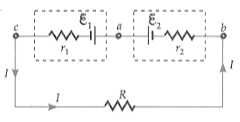
In Figure, $\varepsilon_1$ and $\varepsilon_2$ are respectively 2.0 V and 4.0 V and the resistances $r _1, r _2$ and R are respectively $1.0 \Omega$ $2.0 \Omega$ and $5.0 \Omega$. Calculate the current in the circuit. Also, calculate:
i. potential difference between the points b and a,
ii. potential difference between a and c.
Image
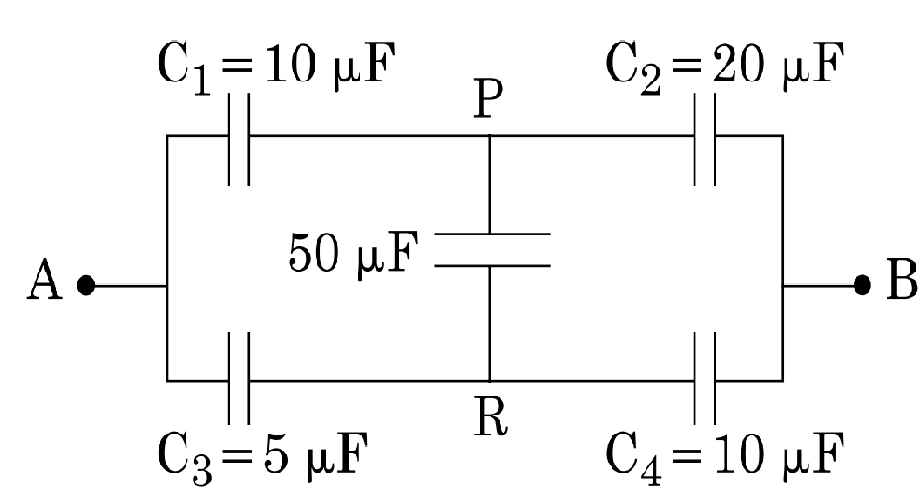
Calculate the equivalent capacitance between points $A$ and $B$ in the circuit below. If a battery of $10 V$ is connected across $A$ and $B,$ calculate the charge drawn from the battery by the circuit.