Questions

3 Marks Question

Take a timed test

11 questions · self-marked practice — reveal the answer and mark yourself.

Question 13 Marks
Derive the formula of electric field for a point on the axis of electric dipole.
Answer
Image
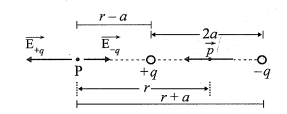
►As shown in Fig., suppose point $P$ is on the axis of dipole, at distance $' r\ '$ from its midpoint.
►We want to find electric field at point $P.$
►Electric field due to $+q$ charge of point $P.$
$\overrightarrow{ E }_{+q}=\frac{1}{4 \pi \varepsilon_0} \cdot \frac{q}{(r-a)^2} \cdot \hat{p}$
Where $\hat{p}$ is unit vector in the direction of dipole moment.
►Electric field due to charge $-q$ of point $P,$
$\overrightarrow{ E }_{-q}=-\frac{1}{4 \pi \varepsilon_0} \cdot \frac{q}{(r+a)^2} \cdot \hat{p}$
►The total field at $P$ is
$\overrightarrow{ E }=\overrightarrow{ E }_{+q}+\overrightarrow{ E }_{-q}$
$\therefore \overrightarrow{ E }=\frac{1}{4 \pi \varepsilon_0} \cdot \frac{q}{(r-a)^2} \cdot \hat{p}-\frac{1}{4 \pi \varepsilon_0} \cdot \frac{q}{(r+a)^2} \cdot \hat{p}$
$\therefore \overrightarrow{ E }=\frac{q}{4 \pi \varepsilon_0}\left[\frac{1}{(r-a)^2}-\frac{1}{(r+a)^2}\right] \hat{p}$
$\therefore \overrightarrow{ E }=\frac{q}{4 \pi \varepsilon_0}\left[\frac{(r+a)^2-(r-a)^2}{(r-a)^2(r+a)^2}\right] \hat{p}$
$\therefore \overrightarrow{ E }=\frac{q}{4 \pi \varepsilon_0}\left[\frac{r^2+2 r a+a^2-r^2+2 r a-a^2}{\left(r^2-a^2\right)^2}\right] \hat{p}$
$\therefore \overrightarrow{ E }=\frac{q}{4 \pi \varepsilon_0}\left[\frac{4 r a}{\left(r^2-a^2\right)^2}\right] \hat{p}$
$\therefore \overrightarrow{ E }=\frac{1}{4 \pi \varepsilon_0} \cdot \frac{(2 a q)(2 r)}{\left(r^2-a^2\right)^2} \cdot \hat{p}$
$\therefore \overrightarrow{ E }=\frac{1}{4 \pi \varepsilon_0} \cdot \frac{2 p r}{\left(r^2-a^2\right)^2} \cdot \hat{p}$
$(\because 2 a q= P$ electric dipole moment $)$
►Suppose, point $P$ is very far away As a result $r \gg a$,
so $a^2$ can be ignored compared to $r^2$
$\therefore \overrightarrow{ E }=\frac{1}{4 \pi \varepsilon_0} \cdot \frac{2 p r}{r^4} \cdot \hat{p}$
$\therefore \overrightarrow{ E }=\frac{1}{4 \pi \varepsilon_0} \cdot \frac{2 p}{r^3} \cdot \hat{p}$
View full question & answer
Question 23 Marks
Drive the formula of electric field for points on the equatorial plane at distance $r$ from the centre of electric dipole.
Answer
Image
$►$The perpendicular bisector of dipole is often called the equator.
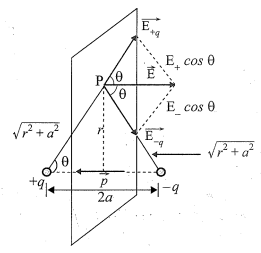
$►$As shown in figure a point $P$ is located at equator of dipole at distance $r$.
$►$The distance between point $P$ from $+q$ electric charge and $- q$ electric charge is $\sqrt{r^2+a^2}$
$►$Electric field due to $+q$ electric charge at point $P$ ,
$E _{+q}=\frac{1}{4 \pi \varepsilon_0} \frac{q}{r^2+a^2}$
$►$Electric field due to $-q$ electric charge at point $P$,
$E _{-q}=\frac{1}{4 \pi \varepsilon_0} \frac{q}{r^2+a^2}$
$►$At point P , their components $E _{+q} \sin \theta$ and $E \sin \theta$ normal to the axis of the dipole cancel each other because their magnitudes are equal and directions are opposite.
And components $E _{+} \cos \theta$ and $E _{-} \cos \theta$ along the axis add with each other because they are in the same direction which is opposite to $\hat{p}$
$►$Resultant electric field at point $P$
$\overrightarrow{ E }=-\left( E _{+q} \cos \theta+ E _{-q} \cos \theta\right) \hat{p}$
$\overrightarrow{ E }=-\left( E _{+q}+ E _{-q}\right) \cos \theta \hat{p}$
$\therefore \overrightarrow{ E }=-\left(\frac{1}{4 \pi \varepsilon_0} \cdot \frac{q}{\left(r^2+a^2\right)}+\frac{1}{4 \pi \varepsilon_0} \cdot \frac{q}{\left(r^2+a^2\right)}\right)$
$\therefore \frac{a}{\left(r^2+a^2\right)^{\frac{1}{2}}} \cdot \hat{p}$
$\therefore \overrightarrow{ E }=-\left[\frac{1}{4 \pi \varepsilon_0} \cdot \frac{2 q}{\left(r^2+a^2\right)}\right] \cdot \frac{a}{\left(r^2+a^2\right)^{\frac{1}{2}}} \cdot \hat{p}$
$\therefore \overrightarrow{ E }=-\frac{1}{4 \pi \varepsilon_0} \cdot \frac{p}{\left(r^2+a^2\right)^{\frac{3}{2}}} \cdot \hat{p}$
$(\because p=2 a q \text { electric dipole moment })$
$►$Suppose, the point $P$ is very far on the equator so $r \gg a$
so neglecting $a^2$ compare to $r^2$,
$\therefore \overrightarrow{ E }=-\frac{1}{4 \pi \varepsilon_0} \cdot \frac{p}{r^3} \cdot \hat{p}$
View full question & answer
Question 33 Marks
Get the electric field due to on infinitely long straight uniformly changed wire.
Answer
Image
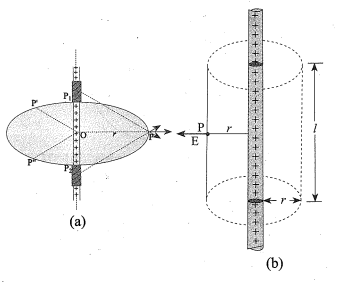
$►$ Consider an infinitely long thin straight wire with uniform linear charge density $\lambda$.
$►$ Suppose we take the radial vector from $O$ to $P$ and rotate it around the wire. The points $P , P ^{\prime}$, $P ^{\prime \prime}$ so obtained are completely equivalent with respect to the charged wire.
$►$ This implies that the electric field must have the same magnitude at these points.
$►$ The direction of electric field at every point must be radial $($ outward if $\lambda > 0$, inward if $\lambda < 0 ).$
$►$ Consider a pair of line elements $P_1$ and $P_2$ of the wire, as shown in Fig. $(a)$
$►$ The electric fields produced by the two elements of the pair when summed, give a resultant electric field which is radial $($the components normal to the radial vector cancel$).$
$►$ This is true for any such pair and hence the total field at any point $P$ is radial.
$►$ The electric field is everywhere radial in the plane cutting the wire normally, and its magnitude depends only on the radial distance $r$.
$►$ To calculate the field, imagine a cylindrical Gaussian surface, as shown in the Fig. $(b).$
$►$ Since the field is everywhere radial, flux through the two ends of the cylindrical Gaussian surface is zero.
$\phi=$ Flux through the curved surface of the cylinder
$\therefore \phi=\overrightarrow{ E } \cdot \overrightarrow{ S }$
$\therefore \phi= ES \cos 0 \quad(\overrightarrow{ E } \| \overrightarrow{ S })$
$\therefore \phi= E (2 \pi r l) \text { (S-area of curved surface) } \ldots$
$►$ As per Gauss's law, $\phi=\frac{q}{\varepsilon_0}$
but $q=\lambda l ($electric charge surrounded by Gaussian surface$)$
$\therefore \phi=\frac{\lambda l}{\varepsilon_0}$
$►$ Comparing equation $(1)$ and equation $(2),$
$E (2 \pi r l)=\frac{\lambda l}{\varepsilon_0}$
$E =\frac{1}{2 \pi \varepsilon_0} \cdot \frac{\lambda}{r}$
$►$ Electric field in vector form,
$\overrightarrow{ E }=\frac{1}{2 \pi \varepsilon_0} \cdot \frac{\lambda}{r} \hat{n}$
Where, $\hat{n}$ is unit vector in the direction of electric field.
OR $\overrightarrow{ E }=\frac{2 k \lambda}{r} \hat{n}\left[\text { where } k=\frac{1}{4 \pi \varepsilon_o}\right]$
View full question & answer
Question 43 Marks
Write down the Coulomb's law and get the vector form of it.
Answer
→ The electric force (Coulomb force) between two point stationary charges is proportional to the product of the values of the charges and inversely proportional to the square of the distance between them. The direction of this force is in the direction of the line joining the two charges.
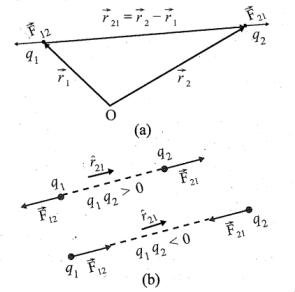
→ Let the position vectors of charges $q_1$ and $q_2$ be $\vec{r}_1$ and $\vec{r}_2$ respectively [see Fig. (a)].

Image


→ We denote force on $q_1$ due to $q_2$ by $\vec{F}_{12}$ and force on $q_2$ due to $q_1$ by $\overrightarrow{ F }_{21}$. The two point charges $q_1$ and $q_2$ have been numbered 1 and 2 for convenience and the vector leading from 1 to 2 is denoted by $\vec{r}_{21}$ :
$\vec{r}_{21}=\vec{r}_2-\vec{r}_1$

→ In the same way, the vector leading from 2 to 1 is denoted by $\vec{r}_{12}$ :
$\vec{r}_{12}=\vec{r}_1-\vec{r}_2=-\vec{r}_{21}$

→ The magnitude of the vectors $\vec{r}_{21}$ and $\vec{r}_{12}$ is denoted by $r_{21}$ and $r_{12}$, respectively $\left(r_{12}=r_{21}\right)$.
→ The direction of a vector is specified by a unit vector along the vector. To denote the direction from 1 to 2 (or from 2 to 1 ), we define the unit vectors:
$\hat{r}_{21}=\frac{\overrightarrow{r_{21}}}{r_{21}}, \hat{r}_{12}=\frac{\overrightarrow{r_{12}}}{r_{12}}, \hat{r}_{21}=-\hat{r}_{12}$

→ Coulomb's force law between two point charges

$q_1$ and $q_2$ located at $\vec{r}_1$ and $\vec{r}_2$, respectively is then expressed as
$\overrightarrow{ F }_{21}=\frac{1}{4 \pi \varepsilon_0} \frac{q_1 q_2}{r_{21}^2} \cdot \hat{r}_{21}$

→ Equation is valid for any sign of $q_1$ and $q_2$ whether positive or negative.
→ If $q_1$ and $q_2$ are of the same sign (either both positive or both negative), $F _{21}$ is along $\hat{r}_{21}$, which denotes repulsion, as it should be for like charges. If $q_1$ and $q_2$ are of opposite signs, $F_{21}$ is along $-\hat{r}_{21}=\hat{r}_{12}$, which denotes attraction, as expected for unlike charges.
→The force $\overrightarrow{ F }_{12}$ on charge $q_1$ due to charge $q_2$ is obtained from Eq. by simply interchanging 1 and 2 , i.e.,
$\overrightarrow{ F }_{12}=\frac{1}{4 \pi \varepsilon_0} \frac{q_1 q_2}{r_{12}^2} \hat{r}_{12}=-\overrightarrow{ F }_{21}$

→Thus, Coulomb's law agrees with Newton's third law.
View full question & answer
Question 53 Marks
Get the electric field due to a uniformly charged thin spherical shell.
Answer
Image
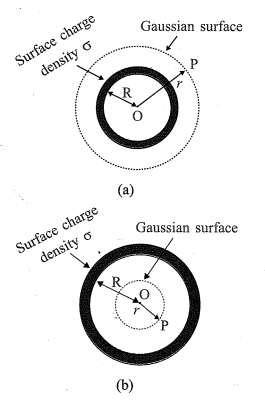
$►$Let $\sigma$ be the uniform surface charge density of a thin spherical shell of radius $R ($Fig.$).$
$(i)$ Field outside the shell :
$►$Consider a point $P$ outside the shell with radius vector $r$ Fig. $(a).$
$►$To calculate $E$ at $P$ , we take the Gaussian surface to be a sphere of radius $r$ and with centre $O$, passing through $P$ . All points on this sphere are equivalent relative to the given charged configuration.
$►$According to Gauss's law,
$\overrightarrow{ E } \cdot \overrightarrow{ S }=\frac{q}{\varepsilon_0}$
$\therefore E \cdot S \cos 0=\frac{q}{\varepsilon_0}$
$\therefore ES =\frac{q}{\varepsilon_0}$
$\text { But } S = 4 \pi r^2 \text { (area of Gaussian surface) }$
$\text { and } q= \sigma A (\text { Where } A \text { - area of spherical shell) }$
$= \sigma\left(4 \pi R ^2\right)$
But $S =4 \pi r^2 ($area of Gaussian surface$)$
and $q=\sigma A ($Where $A -$ area of spherical shell$)$
$($Total charge on spherical shell.$)$
$►$From equation $(1),$
$\therefore E \left(4 \pi r^2\right)=\frac{\sigma\left(4 \pi R ^2\right)}{\varepsilon_0}$
$\therefore E =\frac{\sigma R ^2}{\varepsilon_0 r^2}$
$►$But $\sigma=\frac{q}{A}=\frac{q}{4 \pi R ^2}$,
$\therefore E =\frac{1}{4 \pi \varepsilon_0} \cdot \frac{q}{r^2} ($From Eq. $(2))$
$►$The electric field is directed outward if $q>0$ and inward if $q<0$. This, however, is exactly the field produced by a charge q placed at the centre $O .$
Thus for points outside the shell, the field due to a uniformaly charged shell is as if the entire charge of the shell is concentrated at its centre.
$(ii)$ Field inside the shell :
$►$In Fig. $(b),$ the point $P$ is inside the shell. The Gaussian surface is again a sphere through $P$ centred at $O$ .
$►$Gaussian surface encloses no charge. From Gauss's law then gives the field due to a uniformly charged thin shell is zero at all points inside the shell.
View full question & answer
Question 63 Marks
Get the electric field due to a uniformly charged infinite plane sheet.
Answer
Image
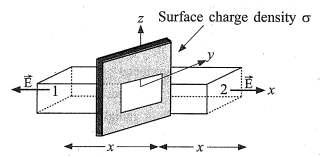
►Let $\sigma$ be the uniform surface charge density of an infinite plane sheet (Fig.). We take the $x$-axis normal to the given plane.
►By symmetry, the electric field will not depend on y and z coordinates and its direction at every point must be parallel to the x-direction.
►We can take the Gaussian surface to be a rectangular parallelpiped of cross-sectional area A, as shown. (A cylindrical surface will also do.)
►As seen from the figure, only the two faces 1 and 2 will contribute to the flux; electric field lines are parallel to the other faces and they, therefore, do not contribute to the total flux.
►Total flux passing through Gaussian surface.
$\begin{aligned}
\phi & =\text { Electric flux passing through Surface } 1 \\
& + \text { Electric flux passing through surface } 2 \\
\therefore \phi & =\text { EAcos } 0+\text { EA } \cos 0 \\
& =\text { EA }+ \text { EA } \\
& =2 EA
\end{aligned}$
►According to Gauss's law $=\phi=\frac{q}{\varepsilon_0}$
Thus, 2EA $=\frac{q}{\varepsilon_0}$
Where, $q=$ electric charge enclosed by
Gaussian surface
$\begin{aligned}
\quad q & =\text { Surface charge density } \times \text { Area } \\
\therefore \quad q & =\sigma A
\end{aligned}$
►Put the value in equation (3),
$\begin{array}{rlrl}
\therefore & 2 EA & =\frac{\sigma A }{\varepsilon_0} \\
\therefore & E & =\frac{\sigma}{2 \varepsilon_0} \\
2 EA & =\frac{\sigma A }{\varepsilon_0} \\
& \text { or, } & E & =\frac{\sigma}{2 \varepsilon_0}
\end{array}$
►Vectorically,
$\overrightarrow{ E }=\frac{\sigma}{2 \varepsilon_0} \hat{n}$
►Where $\hat{n}$ is a unit vector normal to the plane and going away from it, E is directed away from the plate if $\sigma$ is positive and toward the plate if $\sigma$ is negative.
View full question & answer
Question 73 Marks
Write Gauss's law and explain.
Answer
Image

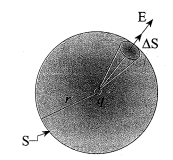
→ Let us consider the total flux through a sphere of radius $r$, which encloses a point charge $q$ at its centre. Divide the sphere into small area elements, as shown in fig.
→ The flux through an area element $\Delta S$ is
$\Delta \phi=\overrightarrow{ E } \cdot \Delta \overrightarrow{ S }=\frac{q}{4 \pi \varepsilon_0 r^2} \hat{r} \cdot \overrightarrow{\Delta S }$
→ The unit vector $\hat{r}$ is along the radius vector from the centre to the area element.
→ Now, since the normal to a sphere at every point is along the radius vector at that point, the area element $\Delta S$ and $\hat{r}$ have the same direction.
Therefore,
$\Delta \phi=\frac{q}{4 \pi \varepsilon_0 r^2} \Delta S$
→ The total flux through the sphere is obtained by adding up flux through all the different area elements:
→ Now S, the total area of the sphere, equals $4 \pi r^2$. Thus,
$\phi=\frac{q}{4 \pi \varepsilon_0 r^2} \times 4 \pi r^2=\frac{q}{\varepsilon_0}$
→ Equation (1) is a simple illustration of a general result of electrostatics called Gauss's law.
→ "The total electric flux associated with a closed surface is equal to the ratio of total enclosed charge and $\varepsilon_0$."
$\therefore \phi=\int \overrightarrow{ E } \cdot d \overrightarrow{ S }=\frac{\sum q}{\varepsilon_0}$
$\phi=\sum_{\text {avl } \Delta S } \frac{q}{4 \pi \varepsilon_0 r^2} \Delta S$
→ Since each area element of the sphere is at the same distance $r$ from the charge,
$\phi=\frac{q}{4 \pi \varepsilon_0 r^2} \sum_{\text {all } \Delta S } \Delta S =\frac{q}{4 \pi \varepsilon_0 r^2} S$
View full question & answer
Question 83 Marks
Get the total electric flux associated with a closed cylinder placed in a uniform electric field.
Answer
Image
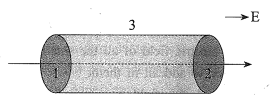
►The electric field is uniform and we are considering a closed cylindrical surface, with its axis parallel to the uniform field $E$ .
►The total flux $\phi$ through the surface is $\phi=\phi_1+\phi_2+\phi_3$, where $\phi_1$ and $\phi_2$ represent the flux through the surfaces $1$ and $2\ ($of circular cross-section$)$ of the cylinder and $\phi_3$ is the flux through the curved cylindrical part of the closed surface.
►Flux passing through surface $' 1\ ',$
$\phi_1=\overrightarrow{ E } \cdot \overrightarrow{ S _1}= ES _1 \cos \pi=- ES$
►Flux passing through surface $' 2\ '$
$\phi_2=\overrightarrow{ E } \cdot \overrightarrow{ S _2}$
$\overrightarrow{ E }$ and $\overrightarrow{ S _2}$ both are in one direction so $\theta=0$
$\phi_2= ES _2 \cos 0= ES _2$
►Flux passing through surface $' 3\ '$
$\phi_3=\overrightarrow{ E } \cdot \overrightarrow{ S }_3$
►Here, $\overrightarrow{ E }$ and $\overrightarrow S_{3}$ Both are perpendicular
So $,  \theta=\frac{\pi}{2}\left(90^{\circ}\right)$
$\therefore \phi_3= E S _3 \cos \frac{\pi}{2}=0$
►$\therefore$ Total flux passing through cylinder,
$\phi=\phi_1+\phi_2+\phi_3$
$\phi=- ES + ES +0$
$\phi=0$
►From Gauss's theorem, $\phi=\frac{\sum q}{\varepsilon_0}$
$\therefore 0=\frac{\sum q}{\varepsilon_0}$
$\therefore \Sigma q=0$
View full question & answer
Question 93 Marks
Explain linear density, surface density and volume density for continuous charge distribution.
Answer
(1) Linear distribution of electric charge.
►If there is a continuous electric charge on a line, it is called linear distribution of electric charge.
►The electric charge per unit length on an electrically charged line is called linear density of electric charge.
►Assume there is a total charge of Q on the line length of $l$.
►Linear density of charge,
$\lambda=\frac{\text { Total electric charge }}{\text { length }}=\frac{ Q }{l}$
SI unit of linear density is $C / m$

(2) Surface distribution of charge :
If there is a continuous electric charge on a surface, it is called surface distribution of charge.
►The electric charge per unit surface is called surface density of charge.
►Assume there is a total charge of Q on the Surface of Area A,
$\therefore$ Surface density of charge,
$\sigma=\frac{\text { Total electric ch arge }}{\text { Area }}=\frac{ Q }{ A }$
►SI unit : $C / m ^2$

(3) Volume distribution of charge :
If there is a continuous electric charge on a volume, it is called volume distribution of charge.
►The electric charge per unit volume is called volume density of charge.
►Assume there is a total charge Q on the matter with volume V ,
$\therefore$ Volume density of charge
$\Omega=\frac{\text { Total ch arg } e }{\text { volume }}=\frac{ Q }{ V }$
►SI unit : C $/ m ^3$
View full question & answer
Question 103 Marks
Explain Electric Flux.
Answer
►The number of electric field lines passing through a closed surface in an electric field is called electric flux.
►Suppose the electric field is $\overrightarrow{ E }$ and the area of the closed - surface is $\Delta S$, then the electric flux associated with this surface is given by
$\phi=\overrightarrow{ E } \cdot \overrightarrow{\Delta S }$

Image
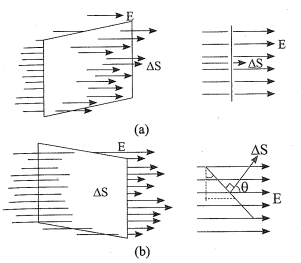
►As shown Fig. (a) electric flux associated with placing the electric field perpendicular to a small planar element of area $\Delta S$ is
$\begin{aligned}
\phi & = E \Delta S \cos \theta \text { (But } \overrightarrow{ E } \| \overrightarrow{\Delta S } \text { So, } \theta=0 \text { ) } \\
\therefore \quad \phi & = E \Delta S \text { (maximum) }
\end{aligned}$
►Now if we tilt the area $\Delta S$ by an angle of $\theta$ then the number of field lines passing through the area segment $\Delta S$ is Fig. (b) will be less than before. In this case the electric flux associated with the plane is found to be
$\phi= E \Delta S \cos \theta$

►If $\theta=90^{\circ}(\overrightarrow{ E } \perp \overrightarrow{\Delta S })$ no field line passes through the plane. As a result, zero electric flux associated with plane
$\phi= E \Delta S \cos 90^{\circ}=0$
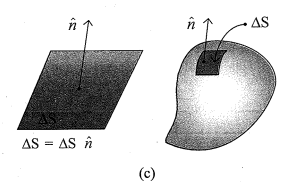
►As shown in Fig. (c), a curved surface is placed in an electric field.
Image
►To obtain the electric flux associated with this curved surface; consider this surface divided into many micro-sections. Each continent is so subtle that each continent can be considered a plane.
►The electric flux associated with any of the microscopic sections is
$\therefore \Delta \phi=\overrightarrow{ E } \cdot \overrightarrow{\Delta S }$
►Now if the total flux is to be obtained similarly the electric fluxes associated with all the subsections are obtained and then summed up. Hence, the total electric flux through the curve
$\therefore \phi=\sum \overrightarrow{ E } \cdot \overrightarrow{\Delta S }$
►Here, the electric field $\vec{E}$ is assumed to be constant for small piece. Now if $\Delta S \rightarrow 0$ is taken then the given sum turns into integral.
$\therefore \phi=\int \overrightarrow{ E } \cdot \overrightarrow{\Delta S }$
►Electric flux is a scalar quantity
Unit $\frac{ Nm ^2}{ C }$ OR Vm
►Dimensional Formula : $M ^1 L^3 T^{-3} A^{-1}$


View full question & answer
Question 113 Marks
Write and explain principle of superposition for stationary electric forces.
Answer
Image
►The mutual electric force between two charges is given by Coulomb's law.
►But if more than two charges are present Super position principle is needed in addition to the Coulomb's law, to find the force exerted on one of the charges by the remaining charges.
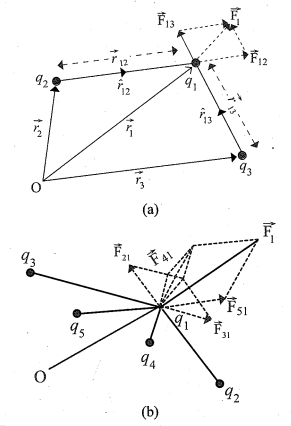
►To better understand the concept, consider a system of three charges $q_1, q_2$ and $q_3$, as shown in Fig. (a). The force on one charge, say $q_1$, due to two
►other charges $q _2, q _3$ can therefore be obtained by performing a vector addition of the forces due to each one of these charges. Thus, if the force on $q _1$ due to $q _2$ is denoted by $F _{12}$.
Thus, $\overrightarrow{ F }_{12}=\frac{1}{4 \pi \varepsilon_0} \frac{q_1 q_2}{r_{12}^2} \hat{r}_{12}$
►In the same way, the force on $q_1$ due to $q_3$, denoted by $\vec{F}_{13}$, is given by
$\overrightarrow{ F }_{13}=\frac{1}{4 \pi \varepsilon_0} \frac{q_1 q_3}{r_{13}^2} \hat{r}_{13}$

►which again is the Coulomb force on $q_1$ due to $q_3$, even though other charge $q_2$ is present.
►Thus the total force $\vec{F}_1$ on $q_1$ due to the two charges $q_2$ and $q_3$ is given as :
$\begin{aligned}
\overrightarrow{ F }_1 & =\overrightarrow{ F }_{12}+\overrightarrow{ F }_{13} \\
& =\frac{1}{4 \pi \varepsilon_0}\left(\frac{q_1 q_2}{r_{12}^2} \hat{r}_{12}+\frac{q_1 q_3}{r_{13}^2} \hat{r}_{13}\right)
\end{aligned}$

►The principle of superposition says that in a system of charges $q_1, q_2, \ldots q_n$, the force on $q_1$ due to $q_2$ is the same as given by Coulomb's law, i.e., it is unaffected by the presence of the other charges $q_3, q_4, \ldots, q_n$

►The total force $\overrightarrow{ F }_1$ on the charge $q_1$, due to all other charges, is then given by the vector sum of the forces $\overrightarrow{ F }_{12}, \overrightarrow{ F }_{13}, \ldots, \overrightarrow{ F }_{1 n}$. i.e.,
$\begin{aligned}
\overrightarrow{ F }_1 & =\overrightarrow{ F }_{12}+\overrightarrow{ F }_{13}+\ldots \ldots \ldots \ldots . .+\overrightarrow{ F }_{1 n} \\
& =\frac{1}{4 \pi \varepsilon_0}\left[\frac{q_1 q_2}{r_{12}^2} \hat{r}_{12}+\frac{q_1 q_3}{r_{13}^2} \hat{r}_{13}+\ldots \ldots+\frac{q_1 q_n}{r_{1 n}^2} \hat{r}_{1 n}\right] \\
& =\frac{q_1}{4 \pi \varepsilon_0} \sum_{i=2}^n \frac{q_i}{r_{1 i}^2} \hat{r}_{1 i}
\end{aligned}$
View full question & answer