Question
Give a brief description of the basic elementary process involved in the photoelectric emission in Einstein’s picture.
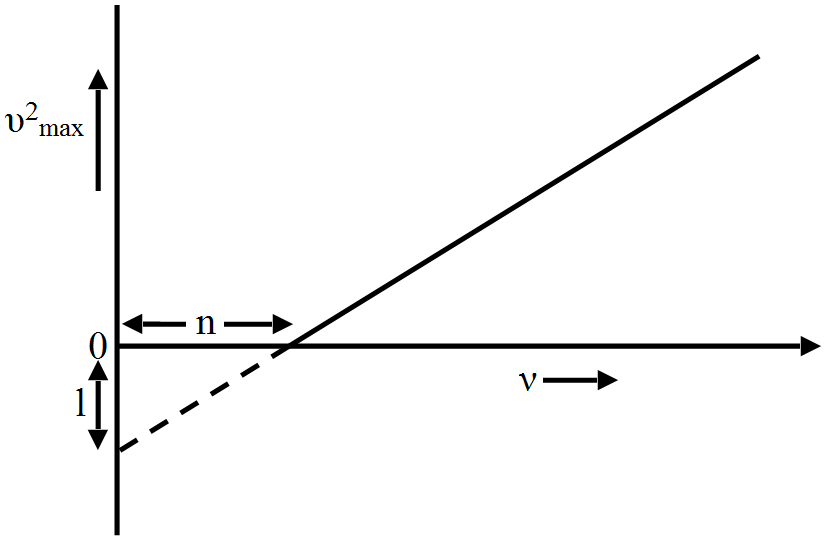
When a photosensitive material is irradiated with the light of frequency v, the maximum speed of electrons is given by $v_{max}.$ A plot of $v_{2max}$​​​​​​​ is found to vary with frequency ν as shown in the figure.
Use Einstein’s photoelectric equation to find the expressions for:
  1. Planck’s constant.
  2. Work function of the given photosensitive material, in terms of the parameters l, n and mass m of the electron.
Answer

  1. Planck’s constant: $\text{h}=\frac{\text{lm}}{2\text{n}}$
  2.  
  • $\nu_1^2$ and $\nu_2^2$ are the velocities of the emitted electrons for radiations of frequencies $v_1 > v$ and $v_2 > v$ respectively. So,
$\text{h}\nu_1=\text{h}\nu+\frac{1}{2}\text{mv}^2_1\dots(\text{i})$
and $\text{h}\nu_2=\text{h}\nu+\frac{1}{2}\text{mv}^2_2\dots(\text{ii})$
From equation (i) and (ii), we get
$\text{h}(\nu_2-\nu_1)=\frac{1}{2}\text{m}(\text{v}^2_2-\text{v}^2_1)$
$\therefore\ \text{h}=\frac{\frac{1}{2}\text{m}(\text{v}^2_2-\text{v}^2_1)}{(\nu_2-\nu_1)}$
Slope of $\text{v}^2_\text{max}$ $v_s$​​​​​​​ frequency graph is,
$\tan\theta=\frac{\text{v}^2_2-\text{v}^2_1}{(\nu_2-\nu_1)}$
$\therefore\ \text{h}=\frac{1}{2}\text{m}.\tan\theta$
From graph $\tan\theta=\frac{1}{\text{n}}$
So, $\text{h}=\frac{1}{2}\text{m}\Big(\frac{\text{l}}{\text{n}}\Big)\dots(\text{iii})$
  • From graph, the work function of the material is,
w = hn ...(iv)
From equations (iii) and (iv), we get
$\text{w}=\frac{1}{2}\text{m}\Big(\frac{\text{l}}{\text{n}}\Big)\times\text{n}=\frac{1}{2}\text{ml}$​​​​​​​

Need a full question paper?

Generate a complete, print-ready paper with questions like this in minutes — across 16+ boards, with answer keys.

Start Generating Free

Similar questions

When a metal plate is exposed to a monochromatic beam of light of wavelength 400nm, a negative potential of 1.1V is needed to stop the photocurrent. Find the threshold wavelength for the metal.
Consider an electron in front of metallic surface at a distance d (treated as an infinite plane surface). Assume the force of attraction by the plate is given as $\frac{1}{2}\frac{\text{q}^2}{4\pi\in_0\text{d}^2}$
Calculate work in taking the charge to an infinite distance from the plate. Taking d = 0.1nm, find the work done in electron volts. [Such a force law is not valid for d < 0.1nm].
Obtain expressions for average current and root mean square current for a complete cycle in ac circuit.###Obtain root mean square value of current for one complete cycle of current $I=I_0 \sin \omega t$. Draw graph between instantaneous value and root mean square value of current for two complete cycles.###Obtain rms value of alternating current for a complete cycle of sinusoidal current.$I = I _0 \sin \omega t .$
The potentiometer wire AB shown in figure. is 50cm long. When AD = 30cm, no deflection occurs in the galvanometer. Find R.
Apply Gauss’s Theorem to find the electric field near a charged conductor.
OR
Show that the electric field at the surface of a charged conductor is $\vec{\text{E}}=\frac{\text{p}}{\in_0}\hat{\text{n}}$ where $\sigma$ is surface charge density and $\hat{\text{n}}$ is a unit vector normal to the surface in the outward direction.
Explain the function of base region of a transistor. Why is this region made thin and lightly doped? Draw a circuit diagram to study the input and output characteristics of n-p-n transistor in a common emitter (CE) configuration. Show these characteristics graphically. Explain how current amplification factor of the transistor is calculated using output characteristics.
When a proton is released from rest in a room, it starts with an initial acceleration $a_0$ towards west. When it is projected towards north with a speed $v_0$, it moves with an initial acceleration $3a_0$ towards west. Find the electric field and the maximum possible magnetic field in the room.
The energy from the sun reaches just outside the earth's atmosphere at a rate of $1400W/m^2.$ The distance between the sun and the earth is $1.5 \times 10^{11}m.$
  1. Calculate the rate at which the sun is losing its mass.
  2. How long will the sun last assuming a constant decay at this rate? The present mass of the sun is $2 \times 10^{80}kg.$
Define power and explain the following points (a) Instantaneous power (b) average power (c) power factor
A parallel-plate capacitor has plate area $100cm^2$ and plate separation 1.0cm. A glass plate (dielectric constant 6.0) of thickness 6.0mm and an ebonite plate (dielectric constant 4.0) are inserted one over the other to fill the space between the plates of the capacitor. Find the new capacitance.