Question
Give a brief explanation about Radioactivity.

Answer

Becquerel discovered radioactivity in 1896 purely by accident.
While studying the fluorescence and phosphorescence of compounds irradiated with visible light, Becquerel observed a phenomenon.
After illuminating some pieces of uranium - potassium sulphate with visible light, he wrapped them in black paper and separated the package from a photographic plate by a piece of silver. When, after several hours of exposure, the photographic plate was developed.
By doing this, blackness appeared on the photographic plate.
This blackness must be due to some radiation emitted from the compound.
Experiments performed subsequently showed that radio activity was a nuclear phenomenon in which an unstable nucleus undergoes a decay. This is referred to as radioactive decay.
Three types of radioactive decay occur in nature.
(i) $\alpha$-decay in which a helium nucleus ${ }_2 He ^4$ ( $\alpha$-particles) is emitted.
(ii) $\beta$-decay in which electrons or positrons are emitted.
(Positron : particles with the same mass as electron, but with a charge exactly opposite to that of electron.)
(iii) $\gamma$-decay in which high energy (hundreds of $k e V$ or more) photons are emitted.

Need a full question paper?

Generate a complete, print-ready paper with questions like this in minutes — across 16+ boards, with answer keys.
Start Generating Free

Similar questions

An ammeter of resistance 0.80 $\Omega$ can measure current up to 1.0 A.
  1. What must be the value of shunt resistane to enable the ammeter to measure current upto 5.0 A?
  2. What is the combined resistance of the ammeter and the shunt?
The electric field E due to a point charge at any point near it is defined as $\text{E} = \DeclareMathOperator*{\median}{\text{lim}} \median_{\text{q}\rightarrow0}\frac{\text{F}}{\text{q}}$ where q is the test charge and F is the force acting on it. What is the physical significance of $\DeclareMathOperator*{\median}{\text{lim}} \median_{\text{q}\rightarrow0}$ in this expression? Draw the electric field lines of a point charge Q when (a) Q>0 and (b) Q<0. 
Find the thermo-emf developed in a copper-silver thermocouple when the junctions are kept at 0°C and 40°C. Use the data in table.
 
Metal with
a
b
lead (Pb)
$\mu\text{V}/^\circ\text{C}$
$\mu\text{V}/^\circ(\text{C})^2$
Aluminium
-0.47
0.003
Bismuth
-43.7
-0·47
Copper
2.76
0·012
Gold
2.90
0.0093
Iron
16.6
-0.030
Nickel
19.1
-0.030
Platinum
-1.79
-0.035
Silver
2.50
0.012
Steel
10.8
-0.016
 
The selling rate of a radioactive isotope is decided by its activity. What will be the second-hand rate of a one month old $\text{ }^{32}\text{P}\big(\text{t}_{\frac{1}{2}}=14.3\text{days}\big)$ source if it was originally purchased for 800 rupees?
A heavy box is kept on a smooth inclined plane and is pushed up by a force F acting parallel to the plane. Does the work done by the force F as the box goes from A to B depend on how fast the box was moving at A and B? Does the work by the force of gravity depend on this?
Define electric flux. Write its S.I. units. A spherical rubber balloon carries a charge that is uniformly distributed over its surface. As the balloon is blown up and increases in size, how does the total electric flux coming out of the surface change? Give reason.
Show that there can be no net charge in a region m which the electric field is uniform at all points.
A parallel beam of light of 500 nm falls on a narrow slit and the resulting diffraction pattern is observed on a screen 1 m away. It is observed that the first minimum is at a distance of 2.5 mm from the centre of the screen. Calculate the width of the slit.
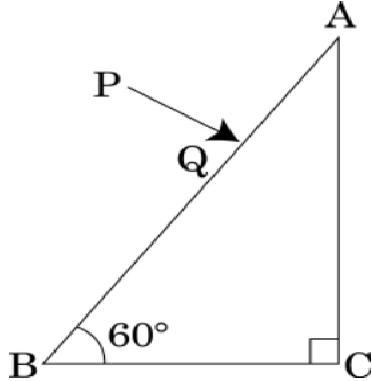
A ray PQ incident normally on the refracting face BA is refracting in the prism BAC made of material of refractive index1.5. Complete the path of ray through the prism. From which face will the ray emerge? Justify your answer.

Explain the difference between electric potential and electrical potential energy and explain the relationship between them.