Question
The electric field E due to a point charge at any point near it is defined as $\text{E} = \DeclareMathOperator*{\median}{\text{lim}} \median_{\text{q}\rightarrow0}\frac{\text{F}}{\text{q}}$ where q is the test charge and F is the force acting on it. What is the physical significance of $\DeclareMathOperator*{\median}{\text{lim}} \median_{\text{q}\rightarrow0}$ in this expression? Draw the electric field lines of a point charge Q when (a) Q>0 and (b) Q<0. 
Answer

Get the step-by-step solution for this question inside the Vidyadip app.

Get the answer in the app

Need a full question paper?

Generate a complete, print-ready paper with questions like this in minutes — across 16+ boards, with answer keys.

Start Generating Free

Similar questions

You are given a low resistance $R_1$, a high resistance $R_2$ and a galvanometer. How will you make such instruments from them which can measure (i) current, (ii) potential difference?
The light emitted in the transition n = 3 to n = 2 in hydrogen is called $\text{H}_\alpha$ light. Find the maximum work function a metal can have so that $\text{H}_\alpha$ light can emit photoelectrons from it.
Derive $D_m=A\left(n_{21}-1\right)$ for thin prism.
Explain why at the surface of a charged conductor, electric field is normal to the surface at each point.
A 1cm object is placed perpendicular to the principal axis of a convex mirror of focal length 7.5cm. Find its distance from the mirror if the image formed is 0.6cm in size.
The capacitance of a parallel plate air capacitor is $8 \mu F$. The distance between its plates is halved and the space between the plates is filled with a medium having dielectric constant 5 . Find the capacitance of the capacitor in the second case.
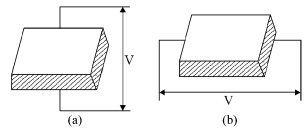
In a given figure, a rectangular object is shown. Its length is I, breadth is 0.5 I and thickness 0.25 I . To measure its resistance, potential difference $V$ is applied in two ways [figure (a) and (b)]. In which arrangement, the resistance of the substance will be more?
Image
If you jump barefooted on a hard surface, your legs get injured. But they are not injured if you jump on a soft surface like sand or pillow. Explain.
Find the maximum angle of refraction when a light ray is refracted from glass $(\mu=1.50)$ to air.
If the radius of the nucleus of $Al ^{27}$ is 3.6 Fermi , then what will be the radius of the $Fe ^{125}$ nucleus?