Question
Give a diagrammatic representation of sub-phylum vertebrata. Write key characters of different classes of Gnathostomata.
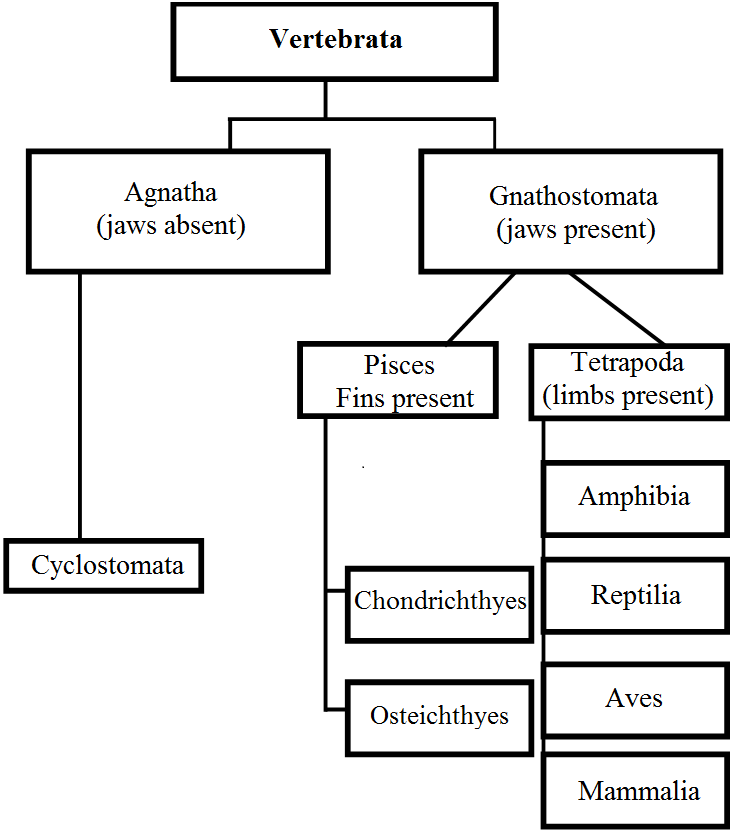
Answer


  1. Class-Cyclostomata: All living members of the class Cyclostomata are ectoparasites on some fishes. They have an elongated body bearing 6-15 pairs of gill slits for respiration. Cyclostomes have a sucking and circular mouth without jaws. Their body is devoid of scales and paired fins.
Cranium and vertebral column are cartilaginous. Circulation is of closed type.
  1. Class-Chondrichthyes: They are marine animals with streamlined body and have cartilaginous endoskeleton. Mouth is located ventrally. Notochord is persistent throughout life. Gill slits are separate and without operculum (gill cover). The skin is tough, containing minute placoid scales. Teeth are modified placoid scales which are backwardly directed. Their jaws are very powerful. These animals are predaceous. Due to the absence of air bladder, they have to swim constantly to avoid sinking.
  2. Class-Osteichthyes: It includes both marine and fresh water fishes with bony endoskeleton. Their body is streamlined. Mouth is mostly terminal. They have four pairs of gills which are covered by an operculum on each side. Skin is covered with cycloid/ ctenoid scales. Air bladder is present which regulates buoyancy.
  3. Class-Amphibia:
  • Unique Characters: As the name indicates (Gr., Amphi : dual, bios, life), amphibians can live in aquatic as well as terrestrial habitats. Most of them have two pairs of limbs. Body is divisible into head and trunk. Tail may be present in some. The amphibian skin is moist (without scales). The eyes have eyelids. A tympanum represents the ear. Alimentary canal, urinary and reproductive tracts open into a common chamber called cloaca which opens to the exterior. Respiration is by gills, lungs and through skin.
  1. Class - Reptilia:
  • Unique Characters: The class name refers to their creeping or crawling mode of locomotion (Latin, repere or reptum, to creep or crawl). They are mostly terrestrial animals and their body is covered by dry and cornified skin, epidermal scales or scutes. They do not have external ear openings. Tympanum represents ear. Limbs, when present, are two pairs.
  1. Class-Aves:
  • Unique Characters: The characteristic features of Aves (birds) are the presence of feathers and most of them can fly except flightless birds (e.g., Ostrich). They possess beak. The forelimbs are modified into wings. The hind limbs generally have scales and are modified for walking, swimming or clasping the tree branches. Skin is dry without glands except the oil gland at the base of the tail.
  • Pneumatic Bones: Endoskeleton is fully ossified (bony) and the long bones are hollow with air cavities (pneumatic). The digestive tract of birds has additional chambers, the crop and gizard.
  1. Class-Mammalia:
  • Unique Characters: The most unique mammalian characteristic is the presence of milk producing glands (mammary glands) by which the young ones are nourished. They have two pairs of limbs, adapted for walking, running, climbing, burrowing, swimming or flying. The skin of mammals is unique in possessing hoe hair. External ears or pinnae are present. Different types of teeth are present in the jaw.

Need a full question paper?

Generate a complete, print-ready paper with questions like this in minutes — across 16+ boards, with answer keys.
Start Generating Free

Similar questions

Comment upon the gametic exchange in earthworm during mating.
What are basis of classification of Animal Kingdom? Give detail on levels of organisation.
Epidermal cells are often modified to perform specialised functions in plants. Name some of them and function they perform.
What are the disorders related to circulation? Describe each.
Draw a picture and describe Meiosis-1 and Meiosis-II
Write short note on forebrain.
The transport of substances through phloem happens in two directions, i.e. from source to sink and from sink to source. This is similar to a dialogue between two persons because of which of the following? What are the benefits of two-way communication for us?
  1. The flow of message happens in from speaker to the listener.
  2. The flow of message happens in two directions; in a dialogue.
  3. The flow of message needs a medium.
  1. Study the given structure carefully and label the parts given as A, B, C, D and E.
  2. Give one major function of each of these.
Complete the following table by filling the blanks marked (A-F) below.
Essential element
Macro or Micro/ Region of requirement
Function
Dificiency
Boron
Micro/ apical leaves and seeds
Elongation of pollen tube
____ (A) ____
____ (B) ____
Micro/ whole plant
Involved in OXi-red reactions
Development of necrotic spots
Phosphorus
____ (C) ____
____ (D) ____
Structed plants
Magnesium
Macro/ growing areas of root and stems
____ (E) ____
____ (F) ____
Mention any three similarities and two differences between facilitated diffusion and active transport of substances in plants. Also draw a neat labelled diagram depicting facilitated diffusion of proteins.