Question
Give a simple experiment to demonstrate the reflection of sound waves.

Answer

Experiment to demonstrate the reflection of sound:
1. Take two identical pipes, as shown in Fig. You can make the pipes using chart paper. The length of the pipes should be sufficiently long as shown.
2. Arrange them on a table near a wall.
3. Keep a clock near the open end of one of the pipes and try to hear the sound of the clock through the other pipe.
4. Adjust the position of the pipes so that you can best hear the sound of the clock.
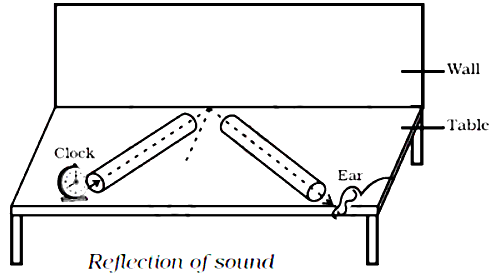
Conclusion: Sound waves pass down the first tube and are reflected from the smooth surface of the wall. After reflection, they enter the second tube and are received by the ear at the other end. If you measure the angle of incidence and angle of reflection, you will notice that they are equal.

Need a full question paper?

Generate a complete, print-ready paper with questions like this in minutes — across 16+ boards, with answer keys.

Start Generating Free

Similar questions

The magnetic flux through a coil having 100 turns decreases from 5 milli weber to zero in 5 second. Calculate the e.m.f. induced in the coil.
$(i) (a)$ Define work and state the mathematical expression for work.
$(b)$ State $\text{CGS}$ and $SI$ unit of work.
$(ii)$ An electric pump is $60 \%$ efficient and is rated $2 HP$ . Calculate the maximum amount of water it can lift through a height of $5 m$ in $40 s .\  [$Take $g =10 ms^{-2}$ and $1 HP =750 W$ ]
$(iii)$ In a hydroelectric power station, $1000 \ kg$ water is allowed to drop through a height of $100 m$ in $1s$ . If the conversion of potential energy to electric energy is $60 \%$, calculate the power output in $kW ($take $g =10 m / s ^2).$
State four ways for the judicious use of energy.
(i) (a) What do you understand by the term electric work?
(b) (i) What part of an electrical appliance is earthed?
(ii) State a relation between electrical power, resistance and potential difference in an electrical circuit.
(iii) (a) What is the function of a switch in an electric circuit?
(b) Why is switch placed in a live wire?
State one advantage of using a.c. over d.c.
 (i) A $200 g$ ball is thrown vertically upward with an initial velocity of $30 ms^{-1}$. Draw a velocity-time graph for the motion of ball.
(ii) How long will the ball take to reach the highest point?
(iii) What will be the kinetic energy of ball, when it returns to the starting point, neglecting the air resistance?
(iv) What will be the potential energy of ball at highest point?
Comment on the statement ‘loudness of sound is a subjective quantity, while intensity is an objective quantity.
A circuit consists of a 1 ohm resistor in series with a parallel arrangement of 6 ohm and 3 ohm resistors. Calculate the total resistance if the circuit. Draw a diagram.
A uniform metre rule rests horizontally on a knife-edge at the 60 cm mark when a mass of 10 gram is suspended from one end. At which end must this mass be suspended? What is the mass of the rule?
 A battery o f e.m.f. 3 Vis connected in series with an ammeter, a $10 \Omega$ coil of wire and with a parallel combination of resistance of $3 \Omega$ and $6 \Omega$. Draw a circuit diagram for the above arrangement. What is the
(a) Resistance of the parallel combination?
(b) Reading on the ammeter?
(c) Potential difference across the $3 \Omega$ resistor?
(d) Current flowing through each resistor?