Questions

[5 Mark Question Answer]

🎯

Test yourself on this topic

7 questions · timed · auto-graded

Question 15 Marks
Distinguish between music and noise.
Answer
Music Noise
1. It is pleasant, smooth and agreeable to the ear. 1. It is harsh, discordant and displeasing to the ear.
2. It is produced by the vibrations which are periodic.. 2. It is produced by an irregular succession of disturbances.
3. All the component waves are similar without any sudden change in their wavelength and amplitude. 3. The component wave changes their character suddenly and they are of short duration..
4. The sound level is low (below 30 dB). 4. The sound level is hiah (above 120 dB).
View full question & answer
Question 25 Marks
Distinguish between longitudinal and transverse waves.
Answer
Longitudinal waves Transverse waves
1. As it travels through a medium, the particles of the medium vibrate to and fro about their mean positions along the direction of propagation of wave.
2. As the wave propagates through the medium, it causes compressions and rarefactions.
3. In case of longitudinal waves, one wavelength contains one compression and one rarefaction.
4. They can travel through all media i.e. solids, liquids and gases.
5. As the longitudinal wave propagates through a medium, there is change in density of the medium.
1. As it travels through a medium, the particles of the medium vibrate perpendicular to the direction of propagation of wave.
2. As the wave propagates through the medium, it produces crests and troughs.
3. In case of transverse waves, one wavelength contains one crest and one trough.
4. They can travel only through solids and on the surface of liquids.
5. As the transverse wave travels through a medium, there is no change in density of the medium.
View full question & answer
Question 35 Marks
What are characteristics of a wave motion?
Answer
Characteristics of wave motion:
1. Wave motion can be produced only in a medium having elasticity and inertia.
2. When energy is given to any part of a medium, disturbance is produced in it by repeated periodic motion of the particles about their equilibrium positions.
3. During wave motion, no matter is transferred. It is only the energy that gets transferred.
4. The velocity of the wave relative to the medium depends only on the nature of the medium and not on the nature or motion of source of disturbance.
5. The velocity of the wave is different from the velocity with which the particles of the medium vibrate about their equilibrium positions.
6. Energy gets transferred from one particle of a medium to the next particle in a fixed interval of time.
7. The energy associated with the wave is the kinetic and potential energy of the matter.
View full question & answer
Question 45 Marks
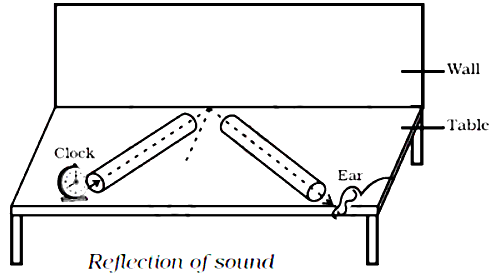
Give a simple experiment to demonstrate the reflection of sound waves.
Answer
Experiment to demonstrate the reflection of sound:
1. Take two identical pipes, as shown in Fig. You can make the pipes using chart paper. The length of the pipes should be sufficiently long as shown.
2. Arrange them on a table near a wall.
3. Keep a clock near the open end of one of the pipes and try to hear the sound of the clock through the other pipe.
4. Adjust the position of the pipes so that you can best hear the sound of the clock.

Conclusion: Sound waves pass down the first tube and are reflected from the smooth surface of the wall. After reflection, they enter the second tube and are received by the ear at the other end. If you measure the angle of incidence and angle of reflection, you will notice that they are equal.
View full question & answer
Question 55 Marks
Give the physical explanation for the difference between musical sounds and noises.
Answer
Sounds can be roughly divided into two categories: (i) music, and (ii) noise.
Regularity, contrivity and rapidity make musical sounds different from a noise. The distinction between music and noise is not very sharp; it is subjective.
Music Noise
1. It is pleasant, smooth and agreeable to the ear. 1. It is harsh, discordant and displeasing to the ear.
2. It is produced by the vibrations which are periodic. 2. It is produced by an irregular succession of disturbances.
3. All the component waves are similar without any sudden change in their wavelength and amplitude 3. The component wave chanqes their character suddenly and they are of short duration..
4. The sound level is low (below 30 dB). 4. The sound level is hiah (above 120 dB).
View full question & answer
Question 65 Marks
Differentiate between the following:
Radio waves and light waves.
Answer
Radio waves Light waves
1. Radio waves are not visible to hum an eye. 1. Light waves are visible to human eye.
2. These waves range from $10^5$ to $10^{-3}$​​​​​​​ meters. 2. These waves range from $10^{-6}$ to $10^{-7}​​​​​​​$ meters.
3. Frequency of radio waves is below $10^7 Hz.$ 3. Frequency of light waves lie in the range $10^{14}$ to $10^{13} Hz.$
4. Its sources are TV and radio transmitters. 4. Its sources are sunlight, white hot bodies.
View full question & answer
Question 75 Marks
Differentiate between the following:
Light and sound waves.
Answer
Light waves Sound waves
1. These are electromagnetic waves. 1. These are mechanical waves.
2. They can travel in vacuum. 2. They re qui re a materia I medium for propagation.
3. The speed of light waves is very high ( $= 3 x 10^8$ m/s in air). 3. The speed of sound waves is low ($ =3 30 $m/s in air).
4. The wavelength of the light waves (visible) is very small, of the order of $10-6 m.$ 4. The wavelength of sound waves is in the range of $10-2$ m to lOm.
5. These waves are transverse. 5. These waves are lonaitud ina I waves.
View full question & answer
[5 Mark Question Answer] - Physics STD 10 Questions - Vidyadip