Question
Give an explanation about electric field lines and explain how they can be drawn.

Answer

Image
►Electric field lines are the pictorial representation of an electric field.
►Electric field lines were first described by a scientist named Michael Faraday.
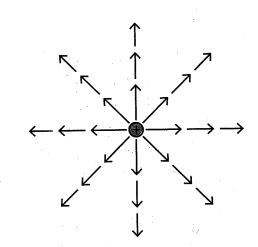
►Let the point charge be placed at the origin. Draw vectors pointing along the direction of the electric field with their lengths proportional to the strength of the field at each point.
►Since the magnitude of electric field at a point decreases inversely as the square of the distance of that point from the charge from $\left( E =\frac{k Q }{r^2}\right)$ the vector gets shorter as one goes away from the origin, always pointing radially outward. Figure shows such a picture.
►In this figure, each arrow indicates the electric field, i.e., the force acting on a unit positive charge, placed at the tail of that arrow.
►Connect the arrows pointing in one direction and the resulting figure represents a field line. We thus get many field lines, all pointing outwards from the point charge.
►The magnitude of the field is represented by the density of field lines. E is strong near the charge, so the density of field lines is more near the charge and the lines are closer.
►Away from the charge, the field gets weaker and the density of field lines is less, resulting in well-separated lines.

Need a full question paper?

Generate a complete, print-ready paper with questions like this in minutes — across 16+ boards, with answer keys.
Start Generating Free

Similar questions

If water in one flask and castor oil in other are violently shaken and kept on a table, which will come to rest earlier?
A sample of $\text{HCl}$ gas is placed in an electric field of $3 \times 10^4 N / C$. The dipole moment of each molecule of $\text{HCl}$ is $6 \times 10^{-30} C \times m$. What will be the maximum torque acting on the molecule?
A parallel beam of light of $500 \ nm$ falls on a narrow slit and the resulting diffraction pattern is observed on a screen $1 \ m$ away. It is observed that the first minimum is at a distance of $2.5 \ mm$ from the centre of the screen. Calculate the width of the slit.
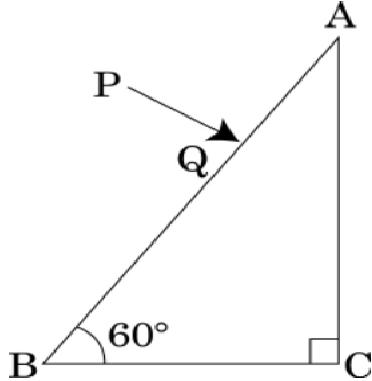
A ray PQ incident normally on the refracting face BA is refracting in the prism BAC made of material of refractive index 1.5. Complete the path of ray through the prism. From which face will the ray emerge? Justify your answer.
A 100\ pF capacitor is charged to a potential difference of $24V.$ It is connected to an uncharged capacitor of capacitance $20pF.$ What will be the new potential difference across the $100pF$ capacitor?
A silver wire has a resistance of 2.1 Ω at 27.5${ }^{\circ} C$, and a resistance of 2.7 Ω at 100 ${ }^{\circ} C$. Determine the temperature coefficient of resistivity of silver.
Heat at the rate of 200W is produced in an X-ray tube operating at 20kV. Find the current in the circuit. Assume that only a small fraction of the kinetic energy of electrons is converted into X-rays.
In a double slit interference experiment, the separation between the slits is $1.0\ mm,$ the wavelength of light used is $5.0 \times 10^{-7}m$ and the distance of the screen from the slits is $1.0m$.
  1. Find the distance of the centre of the first minimum from the centre of the central maximum.
  2. How many bright fringes are formed in one centimeter width on the screen?
A gas is enclosed in a cylindrical vessel fitted with a frictionless piston. The gas is slowly heated for some time. During the process, $10J$ of heat is supplied and the piston is found to move out $10\ cm$. Find the increase in the internal energy of the gas. The area of cross section of the cylinder $= 4\ cm^2$ and the atmospheric pressure $= 100\ kPa.$
Find the dimensions of:
  1. Electric field E,
  2. Magnetic field B and
  3. Magnetic permeability $\mu_0.$
The relevant equations are$\text{F = qE, F = qvB,}$ and $\text{B}=\frac{\mu_0\text{I}}{2\pi\alpha};$
where F is force, q is charge, v is speed, I is current, and a is distance.