Question
Give brief explanation of a semi-conductor diode.

Answer

Image

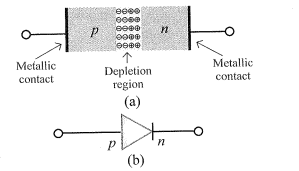
A semiconductor diode is basically a $p-n$ junction with metallic contacts provided at the ends for the application of an external voltage. It is a two terminal device. A $p-n$ junction diode is symbolically represented as shown in fig. (b).
The direction of arrow indicates the conventional direction of current (When the diode is under forward bias.) The equilibrium barrier potential can be altered by an external voltage V across the diode.
The situation of $p-n$ junction diode under equilibrium (without bias) is shown in fig. (a) and (b).

Need a full question paper?

Generate a complete, print-ready paper with questions like this in minutes — across 16+ boards, with answer keys.
Start Generating Free

Similar questions

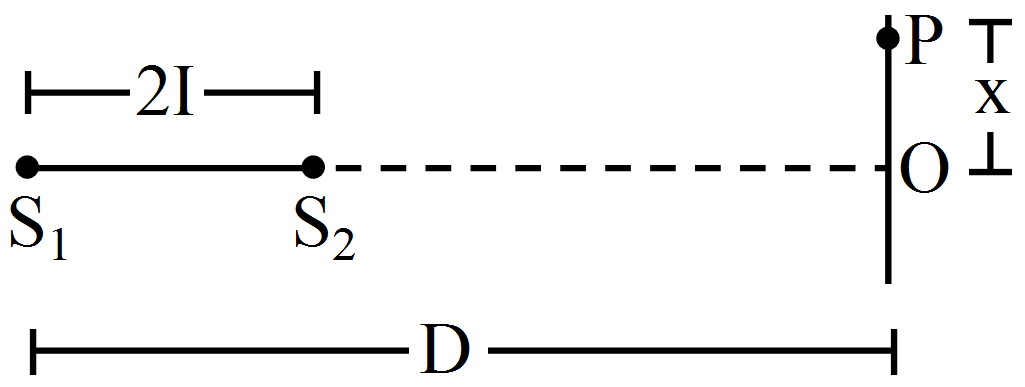
Two coherent narrow slits emitting sound of wavelength $\lambda$ in the same phase are placed parallel to each other at a small separation of $2\lambda.$ The sound is detected by moving a detector on the screen $\sum$ at a distance $\text{D}(>>\lambda)$ from the slit S1 as shown in figure. Find the distance x such that the intensity at P is equal to the intensity at 0.

A proton has spin and magnetic moment just like an electron. Why then its effect is neglected in magnetism of materials?
Explain emf, potential difference and internal resistance of cell and derive the relation between them. (or derive the relation between emf, potential difference and internal resistance of the cell.)
The length of a rod is exactly 1m when measured at rest. What will be its length when it moves at a speed of:
  1. 3 × 10⁵m/s.
  2. 3 × 10⁶m/s.
  3. 3 × 10⁷m/s.
Find the temperature at which the average thermal kinetic energy is equal to the energy needed to take a hydrogen atom from its ground state to n = 3 state. Hydrogen can now emit red light of wavelength 653.1nm. Because of Maxwellian distribution of speeds, a hydrogen sample emits red light at temperatures much lower than that obtained from this problem. Assume that hydrogen molecules dissociate into atoms.
Three capacitors of capacitances 2 pF, 3 pF and 4 pF are connected in parallel.
  1. What is the total capacitance of the combination?
  2. Determine the charge on each capacitor if the combination is connected to a 100 V supply.
Suppose we have 12 protons and 12 neutrons. We can assemble them to form either a :uMg nucleus or two 12C nuclei. In which of the two cases more energy will be liberated?
Two charged particles, having equal charges of 2.0 × 10-5C each, are brought from infinity to within a separation of 10cm. Find the increase in the electric potential energy during the process.
Suppose we have 12 protons and 12 neutrons. We can assemble them to form either a :uMg nucleus or two 12C nuclei. In which of the two cases more energy will be liberated?
There are energy bands in a solid. Do we have really continuous energy variation in a band or do we have very closely spaced but still discrete energy levels?