Question
Give characteristics of electric field lines.

Answer

(i) A tangent at any point on electric field line gives direction of electric field at that point.
(ii) Two electric field lines never intersect each other. If they do so, then there will be two tangents at the point of intersection and hence two directions of electric field at the same point, which is not possible. Hence, two field lines can never cross each other.
(iii) The distribution of electric field lines in any region of field gives intensity of field in that region.
(iv) Field lines of uniform electric field are equidistant and parallel to each other.
(v) Field lines of stationary electric charge do not form closed loops.
$\rightarrow$ In practice, number of field lines passing through any region of field is controlled such that, number of field lines passing through unit area which is normal to field line at that point is proportional to the intensity of the given field.

Need a full question paper?

Generate a complete, print-ready paper with questions like this in minutes — across 16+ boards, with answer keys.
Start Generating Free

Similar questions

In 1959 Lyttleton and Bondi suggested that the expansion of the Universe could be explained if matter carried a net charge. Suppose that the Universe is made up of hydrogen atoms with a number density N, which is maintained a constant. Let the charge on the proton be: ep = -(1 + y)e where e is the electronic charge.
Show that the velocity of expansion is proportional to the distance from the centre.
Distinguish between an intrinsic semiconductor and P-type semiconductor. Give reason, why, a P-type semiconductor crystal is electrically neutral, although$\text{n}_{h}>>\text{n}_{e}$.
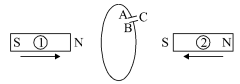
Two bar magnets are moving rapidly towards a metallic loop joined across a capacitor C as shown in the figure. What is the polarity of the capacitor?
Image
What is stationary interference? How can we get, the resultant intensity of super position of waves emanated from the incoherent sources?
A cell whose electromotive force is 2 volt and internal resistance 0.1 is joined with an external resistance of 3,9 . Find the terminal voltage of the cell.
Horizontal component of earth’s magnetic field at a place is $\sqrt{3}$ times its vertical component. What is the value of angle of dip at that place?
If an electron has a wavelength, does it also have a colour?
The minimum deviations suffered by red, yellow and violet beams passing through an equilateral transparent prism are 38.4°, 38.7° and 39.2° respectively. Calculate the dispersive power of the medium.
Find the dimensions of:

  1. Electric field E,
  2. Magnetic field B and
  3. Magnetic permeability $\mu_0.$
The relevant equations are

$\text{F = qE, F = qvB,}$ and $\text{B}=\frac{\mu_0\text{I}}{2\pi\alpha};$

where F is force, q is charge, v is speed, I is current, and a is distance.

Can you ever have a situation in which a light ray goes undeviated through a prism?