A particle is moving 1.5 times as fast as an electron. The ratio of the de-Broglie wavelength of the particle to that of the electron is $1.813 \times 10^{-4}$. Calculate the particle's mass and identify the particle.
View full solution →Question types
Model Paper 2 question types
77 questions across 4 question groups — pick any mix to generate a Physics paper with step-by-step answer keys.
77
Questions
4
Question groups
5
Question types
Sample Questions
Model Paper 2 questions
One sample from each question group in this chapter. Select any group above to see the full set with answer keys.
A plane electromagnetic wave of frequency 52 MHz travels in free space along the x -direction. At a particular point in space and time, $\overrightarrow{ E }=8.4 \hat{k} V / m$. What is $\vec{B}$ at this point ?
View full solution →Draw phasor diagram for $X _{ C }> X _{ L }$ and $X _{ C }< X _{ L }$ and give the disadvantages of this method.
View full solution →A solenoid of length 0.4 m has a radius of 1 cm and is made up of 500 turns. It carries a current of 10 A . What is the magnitude of the magnetic field inside the solenoid?
Draw the nature of the graph of average binding energy per nucleon against atomic mass number and explain its notable points.
A magnetised needle in a uniform magnetic field experiences a torque but no net force. An iron nail near a bar magnet, however, experiences a force of attraction in addition to a torque. Why?
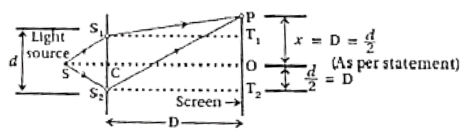
Consider a two slit interference arrangements (See figure), such that the distance of the screen from the slits is half the distance between the slits. Obtain the valus of $D$ in terms of such that the first minima on the screen falls at a distance $D$ from the centre $O$.
View full solution →A $10 \mu F$ capacitor is connected to a $230 \cdot V, 50 Hz$ source. Find the capacitive reactance and the current (rms and peak) in the circuit. If the frequency is doubled what happens to the capacitive reactance and the current ?
View full solution →Explain the forward characteristics of the $p-n$ junction diode by drawing circuit and graph.
View full solution →It is found experimentally that 13.6 eV energy is required to separate a hydrogen atom into a proton and an electron. Compute the orbital radius and the velocity of the electron in a hydrogen atom.
An electron in hydrogen atom revolving in a radius of $5.29 \times 10^{-11} m$ around the nucleus. According to the condition of Bohr's allowed electron orbits, find the principle quantum number corresponds to this orbit.
$\begin{array}{l}
h=6.625 \times 10^{-34} JS, e=1.6 \times 10^{-19} C \\
\varepsilon=8.85 \times 10^{-12} MKS, m=9.1 \times 10^{-31} kg
\end{array}$
Find out conclusion from your answer.
View full solution →$\begin{array}{l}
h=6.625 \times 10^{-34} JS, e=1.6 \times 10^{-19} C \\
\varepsilon=8.85 \times 10^{-12} MKS, m=9.1 \times 10^{-31} kg
\end{array}$
Find out conclusion from your answer.
What is fundamental difference between electric dipole and magnetic dipole.
Obtain the binding energy of the nuclei ${ }_{26}^{56} Fe$ and ${ }_{83}^{209} Bi$ in units of MeV from the following data :
$m\left({ }_{26}^{56} Fe\right)=55.934939 u, m\left({ }_{83}^{209} Bi\right)=208.980388 u$
View full solution →$m\left({ }_{26}^{56} Fe\right)=55.934939 u, m\left({ }_{83}^{209} Bi\right)=208.980388 u$
A beam of light converges at a point $P$. Now a lens is placed in the path of the convergent beam 12 cm from P. At what point does the beam converge if the lens is (a) a convex lens of focal length 20 cm , and (b) a concave lens of focal length 16 cm ?
View full solution →Obtain the relation of phase between instantaneous current and voltage with the help of phase diagram for series LCR circuit.
Current flowing through the ideal diode shown in the circuit is __________ .

- A$0.1$ mA
- B10 mA
- C$0.1$ A
- Dnone of these
What is the type of the semiconductor, for the energy band diagram shown in the figure?
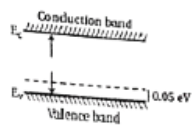
- An-type semiconductor
- Bp-type semiconductor
- CIntrinsic semiconductor
- DBoth and p type semiconductor
Give electronic configuration of silicon.
- A$1 s^1 1 s^2 2 s^2 3 s^2 3 p^2 3 p^6$
- B$1 s^2 1 s^2 3 s^2 2 p ^4 3 s^2 3 p ^2$
- C$1 s^2 2 s^2 2 p^6 3 s^2 3 p^2$
- D$1 s^2 2 s^2 2 p^6 3 s^1 3 p^3$
Which of the following is not a conductor of electricity ?
- APlastic
- BGold
- CSilicon
- DPlatinum
Give the equation which represents law of gauss for magnetism.
- A
- B
- C
- D
Generate a Model Paper 2 paper free
Pick question groups from the list above, set marks and difficulty, and export a branded PDF with step-by-step answer keys. First 3 chapters free — no signup.