Question
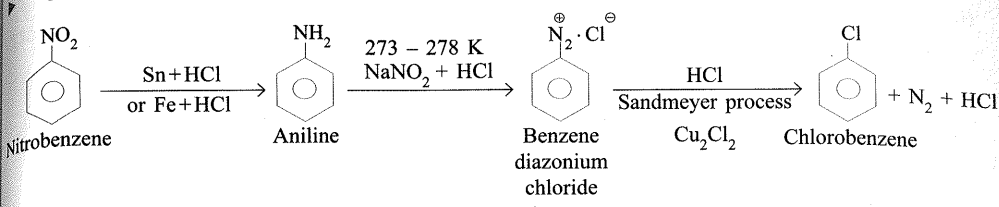
Give conversion in three steps: Nitrobenzene into chlorobenzene.
Generate a complete, print-ready paper with questions like this in minutes — across 16+ boards, with answer keys.
|
|
Column I (Property)
|
|
Column II (Metal)
|
|
(i)
|
An element which can show +8 oxidation state
|
(a)
|
Mn
|
|
(ii)
|
3d block element that can show upto +7 oxidation state
|
(b)
|
Cr
|
|
(iii)
|
3d block element with highest melting point
|
(c)
|
Os
|
|
(d)
|
Fe
|
| Column I (Example) | Column II (Reaction) | ||
| (i) | $\ \ \ \ \ \ \ \ \ \ \ \ \ \text{O}\ \ \ \ \ \ \ \ \ \ \ \ \ \ \ \ \ \ \ \ \ \ \ \ \ \ \ \ \ \ \ \ \ \ \ \ \ \ \ \ \ \ \ \ \ \ \ \ \ \ \ \text{O}\\ \ \ \ \ \ \ \ \ \ \ \ \ \ || \ \ \ \ \ \ \ \ \ \ \ \ \ \ \ \ \ \ \ \ \ \ \ \ \ \ \ \ \ \ \ \ \ \ \ \ \ \ \ \ \ \ \ \ \ \ \ \ \ \ \ \ ||\\\text{CH}_3-\text{C}-\text{Cl}+\text{H}_2\xrightarrow{\text{Pd-C/BaSO}_4}\text{CH}_3-\text{C}-\text{H}$ | (a) | Friedel Crafts acylation |
| (ii) | 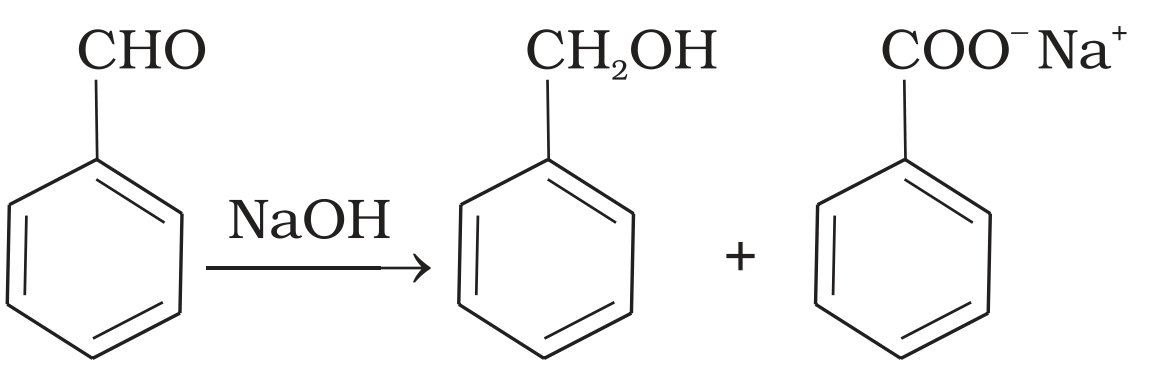 |
(b) | HVZ reaction |
| (iii) | 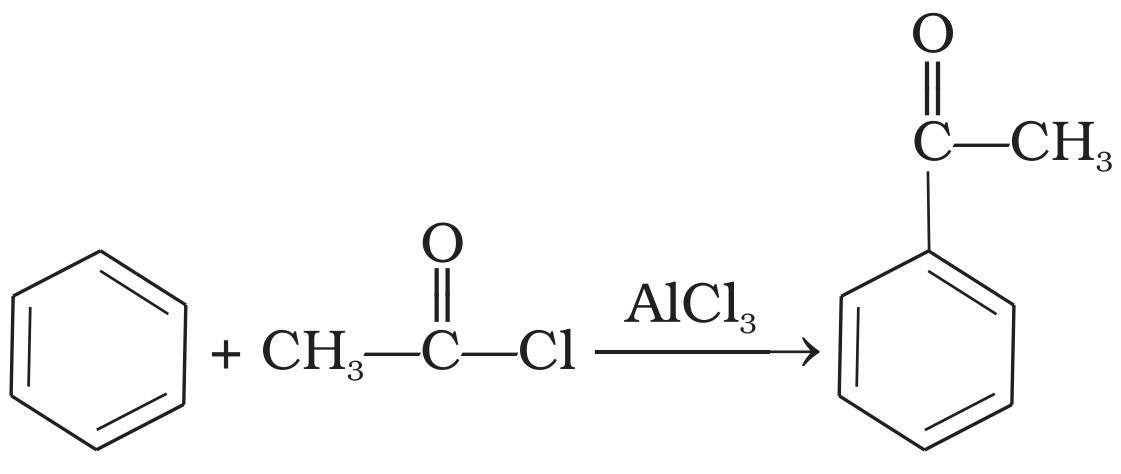 |
(c) | Aldol condensation |
| (iv) | $\text{R}-\text{CH}_2-\text{COOH}\xrightarrow{\text{Br}_2/\text{Red}\ \text{P}}\text{R}-\text{CH}-\text{COOH}\\ \ \ \ \ \ \ \ \ \ \ \ \ \ \ \ \ \ \ \ \ \ \ \ \ \ \ \ \ \ \ \ \ \ \ \ \ \ \ \ \ \ \ \ \ \ \ \ \ \ \ \ \ \ \ \ \ \ \ \ \ \ \ \ \ \ \ \ |\\\ \ \ \ \ \ \ \ \ \ \ \ \ \ \ \ \ \ \ \ \ \ \ \ \ \ \ \ \ \ \ \ \ \ \ \ \ \ \ \ \ \ \ \ \ \ \ \ \ \ \ \ \ \ \ \ \ \ \ \ \ \ \ \ \ \ ^\text{Br}$ | (d) | Cannizaro’s reaction |
| (v) | $\text{CH}_3-\text{CN}\xrightarrow[\text{(ii)}\ \text{H}_2\text{O}/\text{H}^+]{\text{(i)}\ \text{SnCl}_2/\ \text{HCl}}\text{CH}_3\text{CHO}$ | (e) | Rosenmund’s reduction |
| (vi) | $2\text{CH}_3\text{CHO}\xrightarrow{\text{NaOH}}\text{CH}_3-\text{CH}=\text{CH}=\text{CHCHO}$ | (f) | Stephen’s reaction |
| S. No. | $\text{Time/s}$ | $\text{Total pressure/atm}$ |
| $1.$ | $0$ | $0.5$ |
| $2.$ | $100$ | $0.512$ |