Question
Give information about C-O-H bond angle in alcohol, phenol and ether with suitable example.
Answer

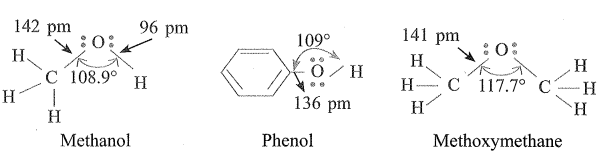
→ In alcohols, the oxygen of -OH group is attached to carbon by a sigma ($\sigma$) bond formed by the overlap of an sp3 hybridised orbital of carbon with sp3 hybridised orbital of oxygen.
→ Figure depicts structural aspects of methanol, phenol and methoxymethane.
Image
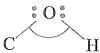
→ The bond angle Imagein alcohols is slightly less than the tetrahedral angle (109°-28').
→ It is due to the repulsion between the unshared electron pairs of oxygen.
→ In phenols, the OH group is attached to sp2 hybridised carbon of an aromatic ring.
→ The carbon-oxygen bond length (136 pm) in phenol is slightly less than that in methanol.
→ This is due to (i) partial double bond character on account of the conjugation of unshared electron pair of oxygen with the aromatic ring and (ii) sp2 hybridised state of carbon to which oxygen is attached.
→ In ethers, the four electron pairs, i.e., the two bond pairs and two lone pairs of electron on oxygen are arranged approximately in a tetrahedral arrangement.
→ The bond angle is slightly greater than the tetrahedral angle due to the repulsive interaction between the two bulky (-R) groups.
→ The C-O bond length (141 pm) is almost the same as in alcohols.

Need a full question paper?

Generate a complete, print-ready paper with questions like this in minutes — across 16+ boards, with answer keys.

Start Generating Free

Similar questions

How would you achieve the following conversions:

  1. Nitrobenzene to aniline.
  2. An alkyl halide to a quaternary ammonium salt.
  3. Aniline to benzonitrile.

Write the chemical equation with reaction conditions in each case.

Assign reasons for the following:
The transition metals and many of their compounds act as good catalysts.
How would you account for the following:
Transition metals sometimes exhibit very low oxidation state such as +1 and 0.
  1. Explain the following giving suitable examples:
  1. Sandmeyer’s reaction.
  2. Coupling reaction of a diazonium salt.
  1. Explain the observed Kb order:

Et2NH>Et3N>EtNH2 in aqueous solution.

An organic compound ‘A’ having molecular formula C3H6 on treatment with aqueous H2SO4 gives ‘B’ which on treatment with HCl/ ZnCl2 gives ‘C’. The compound C on treatment with ethanolic KOH gives back the compound ‘A’. Identify the compounds A, B, C.
  1. Despite having an aldehyde group, glucose does not give 2,4-DNP test. What does this indicate?
  2. Draw the Haworth structure of a-D-(+)-Glucopyranose.
  3. What is the significance of D and (+) here?
Will the elevation in boiling point be same if 0.1mol of sodium chloride or 0.1mol of sugar is dissolved in 1L of water? Explain.
An organic compound ‘A’ (C3H4) on hydration in presence of H2SO4/ HgSO4 gives compound ‘B’ (C3H6O). Compound ‘B’ gives white crystalline product (D) with sodium hydrogensulphite. It gives negative Tollens’ test and positive iodoform’s test. On drastic oxidation ‘B’ gives compound ‘C’ (C2H4O2) along with formic acid. Identify compounds ‘A’, ‘B’ and ‘C’ and explain all the reactions.
Why can we not determine the order of a reaction by taking into consideration the balanced chemical equation?
  1. E0 value for the Mn3+/Mn2+ couple is positive (+ 1.5V) whereas that of Cr3+/Cr2+ is negative (-0.4 V). Why?
  2. Transition metals form coloured compounds. Why?
  3. Complete the following equation:

$\text{2MnO}^{-}_{4}+\text{16H}^{+}+\text{5C}_{2}\text{O}^{2-}_{4}\xrightarrow{\text{ }\ \ \ \ \ \ \ \ \ \ \ \ }$