Question
  1. Write the structural difference between starch and cellulose.
  2. What type of linkage is present in Nucleic acids?
  3. Give one example each for fibrous protein and globular protein.

Answer

  1. Starch - Polymer of$\alpha - \text{D} - $ glucose units/Polymer of $\alpha -\text{ glucose}$ units.
Cellulose–polymer of $\beta - \text{D} - $glucose units/polymer of $\beta-\text{glucose}$ units.
  1. Phosphodiester linkage.
  2. Fibrous protein–Keratin/myosin/collagen. 
Globular protein-haemoglobin/insulin.

Need a full question paper?

Generate a complete, print-ready paper with questions like this in minutes — across 16+ boards, with answer keys.
Start Generating Free

Similar questions

An optically active compound having molecular formula C6H12O6 is found in two isomeric forms (A) and (B) in nature. When (A) and (B) are dissolved in water, they show the following equilibrium.
$(\text{A})\ \ \ \ \rightleftharpoons\ \ \ \ \text{Equilibrium mixture}\ \ \ \ \rightleftharpoons\ \ \ \ \text{(B)}\\ [\alpha]_{\text{D}}=111^\circ\ \ \ \ \ \ \ \ \ \ \ \ \ \ 52.2^\circ\ \ \ \ \ \ \ \ \ \ \ \ \ \ \ \ \ \ \ \ \ \ \ \ \ \ 19.2^\circ$
  1. What are such isomers called?
  2. Can they be called enantiomers? Justify your answer.
  3. Draw the cyclic structure of isomer (A).
What are Carbohydrates? How are they classified?
What happens when :
$(i)$ Acetic acid reacts with chlorine in the presence of red phosphorus?
$(ii)$ Silver acetate reacts with bromine in the presence of inert solvent $\left( CCl _4\right)$ ?
Differentiate between the following:
  1. Amylose and Amylopectin.
  2. Peptide linkage and Glycosidic linkage.
  3. Fibrous proteins and Globular proteins.
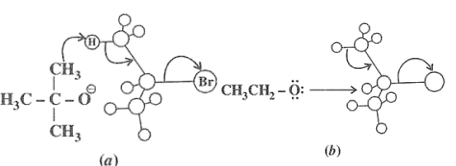
One of the two figures given below represents substitution and the other represents elimination. Indicate which is substitution and which is elimination.
Image
A $10\%$ solution $($by mass$)$ of sucrose in water has freezing point of $269.15 K.$ Calculate the freezing point of $10\%$ glucose in water if freezing point of pure water is $273.15 K.$
Given: $($Molar mass of sucrose $= 342\ g\ mol^{–1})$
$($Molar mass of glucose $= 180\ g\ mol^{–1})$
  1. Explain why an alkylamine is more basic than ammonia.
  2. How would you convert:
  1. Aniline to nitrobenzene.
  2. Aniline to iodobenzene?
Write the Nernst equation and emf of the following cells at $298\ K:$
$Fe(s) | Fe^{2+}(0.001M) || H^+ (1M) | H_2(g)(1\ bar) | Pt(s)$
Explain electrolysis of concentration aqueous solution of $\text{NaCl}$
Answer the following question:$An$ organic compound A having molecular formula $\ce{C_6H_6O}$ gives a characteristic colour with aqueous $\ce{FeCl_3}$ solution. A on treatment with $\ce{CO_2}$ and $\ce{NaOH}$ at $400K$ under pressure gives $B$ which on acidification gives a compound $C.$ The compound $C$ reacts with acetyl chloride to give D which is a popular pain killer. Deduce the structure of $A, B, C$ and $D.$