Question
Give information about the diseases caused by worm in humans.

Answer

Worm like roundworm and wuchereria like filariasis worm(elephantiasis worm) are pathogenic in humans.
(1) Ascariasis
Intestinal parasitic worms (Ascaris lumbricoid) are responsible for this disease.
Spread through:

The eggs of this parasite come out with the faeces of the infected person. It contaminates the soil, water and plants. Its spread in a healthy person is by consuming such contaminated water, vegetables, fruits etc.
Symptoms:

Internal bleeding, muscle pain, fever, anemia and intestinal obstruction.
(2) Elephantasis -Filariasis:
→Pathogens:wuchereria (w.bancrofti &w.malayi)
Spread through:
The pathogen are transmitted to a healthy person through the bite by female mosquito vector (Culex fatigen).
Symptoms:
These worms slowly cause chronic inflammation in the lymphatic vessels of animals and remain in the host for years, hence the disease is called elephantiasis.
Often the genitals are also affected by this disease, causing many deformities.
Need a full question paper?

Generate a complete, print-ready paper with questions like this in minutes — across 16+ boards, with answer keys.

Start Generating Free

Similar questions

Choose any three microbes, from the following which are suited for organic farming which is in great demand these days for various reasons. Mention one application of each one chosen.
Mycorrhiza; Monascus; Anabaena; Rhizobium; Methanobacterium; Trichoderma.
Explain enzyme-replacement therapy to treat adenosine deaminase deficiency. Mention two disadvantages of this procedure.
  1. Differentiate between analogous and homologous structures.
  2. Select and write analogous structures from the list given below:
  1. Wings of butterfly and birds.
  2. Vertebrate hearts.
  3. Tendrils of bougainvillea and cucurbita.
  4. Tubers of sweet potato and potato.
Embryo sacs of some apomictic species appear normal but contain diploid cells. Suggest a suitable explanation for the condition.
Name the kind of organisms which constitute the pioneer community of xerarch and hydrarch successions respectively.
In eukaryotes, explain splicing & tailing (figure is not necessary).
Explain the various steps involved in the production of artificial insulin.
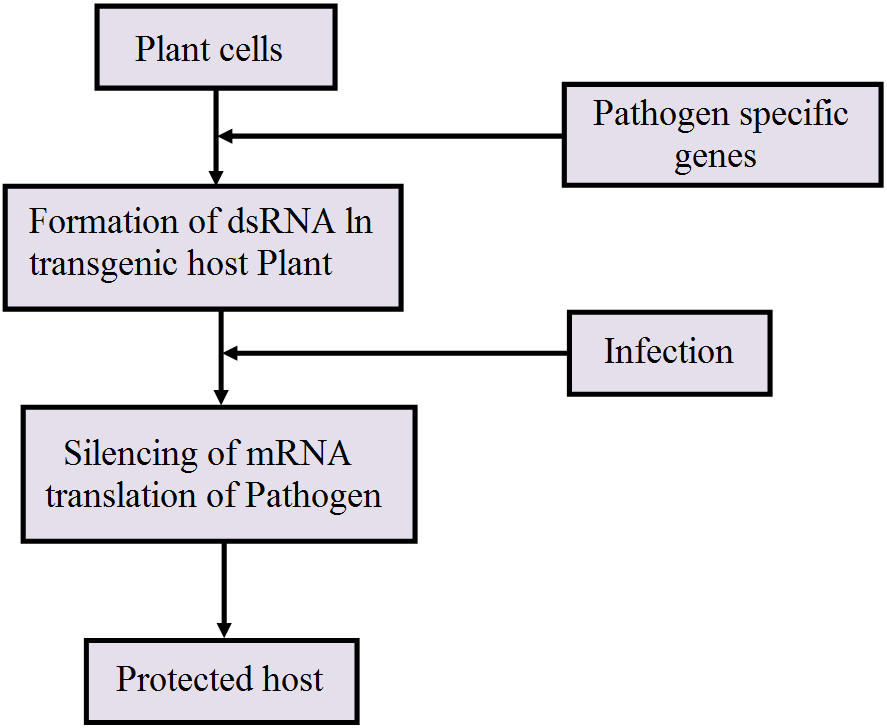
Study the given flow chart and answer:
  1. Name the defence mechanism used.
  2. In which plant it has been done?
  3. Name the pathogen.
  4. Name the vector used in this technique.

What are the misconceptions about the transmission or acquiring AIDS?
Name and explain the technique that helps in separation of DNA fragments for recombinant DNA technology experiments. How can these separated DNA fragments be visualised?

OR

  1. Name the technique used for the separation of DNA fragments.
  2. Write the type of matrix used in this technique.
  3. How is the separated DNA visualised and extracted for use in recombinant DNA technology?