Question
Give its
(i) graphical representation,
(ii) mathematical expression
(iii) significance
Answer

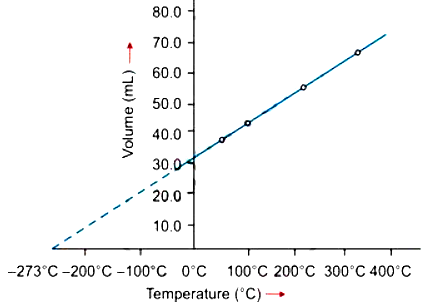
(i) Graphical representation of Charles's law
T vs V: The relationship between the volume and the temperature of a gas can be plotted on a graph. A straight line is obtained.

(ii) Mathematical expression
Let $\mathrm{V}_0$ be the volume of a fixed mass of a gas at $0{ }^{\circ} \mathrm{C}$, and let $\mathrm{V}$ be its volume at temperature $\mathrm{t}^{\circ} \mathrm{C}$ at, constant pressure. then, according to Charles Law
$\begin{aligned} & \mathrm{V}=\mathrm{V}_0+\frac{\mathrm{V}_0}{273} t \text { (when } \mathrm{P} \text { is constant) } \\ & \mathrm{V}=\mathrm{V}_0\left(1+\frac{t}
{273}\right)=\mathrm{V}_0\left(\frac{273+t}{273}\right) \ldots \ldots . .(1) \\ &
\mathrm{V}=\frac{\mathrm{V}_0}{273} \mathrm{~T} \text { where }
\mathrm{T}=273+\mathrm{t}\end{aligned}$
For a given mass of a gas,$\frac{\mathrm{V}_0}{273}=\text { constant }$$\mathrm{V}=\mathrm{k} \times \mathrm{T}$ (where $\mathrm{k}$ is constant)
(iii) Significance of Charles's Law: The volume of a given mass of a gas is directly proportional to its temperature; hence, the density decreases with temperature. This is the reason that
(a) Hot air is filled in balloons used for meteorological purposes. (b) Cable wires contract in winters and expand in summers.

Need a full question paper?

Generate a complete, print-ready paper with questions like this in minutes — across 16+ boards, with answer keys.

Start Generating Free

Similar questions

How do you propose to control:
Carbon monoxide emission
(a) Give only one suitable chemical test to identify the following gases.
  1. Ammonia
  2. Sulphur dioxide
  3. Hydrogen Chloride
  4. Chlorine
  5. Carbon Dioxide
  6. Oxygen
  7. Hydrogen
(b) Select a basic gas mentioned in Q.1 (a). How is the basic nature suspected?(c)Select acidic gases from the gases mentioned in Q.1 (a). How is the acidic nature suspected?
(d) State the gas responsible for bleaching action.
(e)Which gas turn blue cobalt chloride paper light pink?
What is meant by aqueous tension? How is the pressure exerted by a gas corrected to account for aqueous tension?
Why are anode rays also called as 'canal rays'?
Explain Boyle's Law on the basis of the kinetic theory of matter.
Which will have greater volume when the following gases are compared at STP:
  1. $1.2/N_2$ at $25^\circC$ and $748$ mmHg
  2. $1.25/O_2$at STP
Draw diagrams representing the atomic structures of the following:
  1. Sodium atom
  2. Chlorine ion
  3. Carbon atom
  4. Oxygen ion
A gas at 240 K is heated to 127°C. Find the percentage change in the volume of the gas (pressure remaining constant).
Match the following:
Compound Formula
1. Boric acid i. $NaOH$
2. Phosphoric acid ii. $SiO_2$
3. Nitrous acid iii. $Na_2CO_3$
4. Nitric acid iv. $KOH$
5. Sulphurous acid v. $CaCO_3$
6. Sulphuric acid vi. $NaHCO_3$
7. Hydrochloric acid vii. $H_2S$
8. Silica (sand) viii. $H_2O$
9. Caustic soda (sodium hydroxide) ix. $PH_3$
10. Caustic potash (potassium hydroxide) x. $CH_4$
11. Washing soda (sodium carbonate) xi. $NH_3$
12. Baking soda (sodium bicarbonate) xii. $HCl$
13. Lime stone (calcium carbonate) xiii. $H_2SO_3$
14. Water xiv. $HNO_3$
15. Hydrogen sulphide xv. $HNO_2$
16. Ammonia xvi. $H_3BO_3$
17. Phosphine xvii. $H_3PO_4$
18. Methane xviii. $H_2SO_4$
Taking $MgCl _2$ as an electrovalent compound, $CCl _4$ as a covalent compound, give four difference between electrovalent and covalent compounds