Question
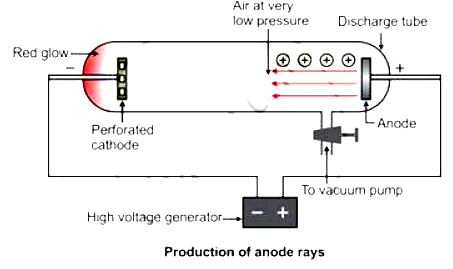
Why are anode rays also called as 'canal rays'?
Answer

When perforated rays were used in the discharge tube, another set of rays travelling in a direction opposite to that of the cathode rays, i.e. from the anode towards the cathode, is seen, as in the figure below. These rays are called canal rays because they passed through the holes or canals in the cathode. These rays were named positive rays or anode rays.

Need a full question paper?

Generate a complete, print-ready paper with questions like this in minutes — across 16+ boards, with answer keys.

Start Generating Free

Similar questions

An element $X$ has $2$ electrons in its $M$ shell, it forms a bond with an element $Y$ which has $7$ electrons in its third orbit.
  1. Write the formula of the compound formed.
  2. Which nearest inert gas electronic configuration will element $X$ and $Y$ acquire.
  3. Show by orbital diagram the formation of the compound between $X$ and $Y.$
An element A atomic number 7 mass numbers 14
B electronic configuration 2,8,8
C electrons 13, neutrons 14
D Protons 18 neutrons 22
E Electronic configuration 2,8,8,1 State Valency of each element An element A atomic number 7 mass numbers 14 B electronic configuration 2,8,8 C electrons 13, neutrons 14 D Protons 18 neutrons 22 E Electronic configuration 2,8,8,1 State (i) Valency of each element (ii) which one is a metal (iii) which is non-metal (iv) which is an inert gas
A gas is to be filled from a tank of capacity 10,000 litres into cylinders each having capacity of 10 litres. The condition of the gas in the tank is as follows:
  1. The pressure inside the tank is 800 mm of Hg.
  2. The temperature inside the tank is −3°C.
When the cylinder is filled, the pressure gauge reads 400 mm of Hg and the temperature is 270 K. Find the number of cylinders required to fill the gas.
Complete the following table and write your observations.
Hydrogen sulphide Ammonia Sulphur dioxide Hydrogen chloride
Shake the gas with red litmus solution
Shake the gas with blue litmus solution
Apply a burning splint to a gas
State the effects of greenhouse gases on the atmosphere.
Match the following:
Compound Formula
1. Boric acid i. $NaOH$
2. Phosphoric acid ii. $SiO_2$
3. Nitrous acid iii. $Na_2CO_3$
4. Nitric acid iv. $KOH$
5. Sulphurous acid v. $CaCO_3$
6. Sulphuric acid vi. $NaHCO_3$
7. Hydrochloric acid vii. $H_2S$
8. Silica (sand) viii. $H_2O$
9. Caustic soda (sodium hydroxide) ix. $PH_3$
10. Caustic potash (potassium hydroxide) x. $CH_4$
11. Washing soda (sodium carbonate) xi. $NH_3$
12. Baking soda (sodium bicarbonate) xii. $HCl$
13. Lime stone (calcium carbonate) xiii. $H_2SO_3$
14. Water xiv. $HNO_3$
15. Hydrogen sulphide xv. $HNO_2$
16. Ammonia xvi. $H_3BO_3$
17. Phosphine xvii. $H_3PO_4$
18. Methane xviii. $H_2SO_4$
A given amount of gas A is confined in a chamber of constant volume. When the chamber is immersed in a bath of melting ice, the pressure of the gas is 100cmHg.
  1. What is the temperature when the pressure is 10cmHg?
  2. What will be the pressure when the chamber is brought to 100°C
Match the atomic numbers 4, 14, 8, 15 and 19 with each of the following:
  1. A solid non-metal of valency 3.
  2. A gas of valency 2.
  3. A metal of valency 1.
  4. A non-metal of valency 4.
Explain the permutit method for softening hard water.
Consider the following elements: Be, Li, Na, Ca, K. Name the elements of (a) same group (b) same period.