Question
Give one example each to show that the rational numbers are closed under addition, subtraction and multiplication. Are rational numbers closed under division? Give two examples in support of your answer.

Answer

We know that rational numbers are closed under addition, subtraction and multiplication. We can understand this from the following examples:
Rational numbers are closed under
Addition
e.g. $\frac{4}{7}+\frac{1}{2}=\frac{8+7}{14}=\frac{15}{14}$ which is a rational number.
Subtraction
e.g. $\frac{4}{7}-\frac{1}{2}=\frac{8-7}{14}=\frac{1}{14}$ which is a rational number.
Multiplication
e.g. $\frac{4}{7} \times \frac{1}{2}=\frac{4}{14}=\frac{2}{7}$ which is a rational number.
But rational numbers are not closed under division. If zero is excluded from the collection of rational numbers, then we can say that rational numbers are closed under division.
Now, we see the examples given below
$\frac{4}{7}+\frac{1}{2}=\frac{4}{7} \times 2=\frac{8}{7}$ which is a rational number.
But $\frac{4}{7}\div0=\frac{4}{7} \times \frac{1}{0}$
which is not defined and so, it is not a rational number.
Also, $\frac{1}{2}\div0=\frac{1}{2} \times \frac{1}{0}$,
which is not defined and also not a rational number.

Need a full question paper?

Generate a complete, print-ready paper with questions like this in minutes — across 16+ boards, with answer keys.
Start Generating Free

Similar questions

Find following product: $(-7\text{xy})\times\big(\frac{1}{4}\text{x}^2\text{yz}\big)$
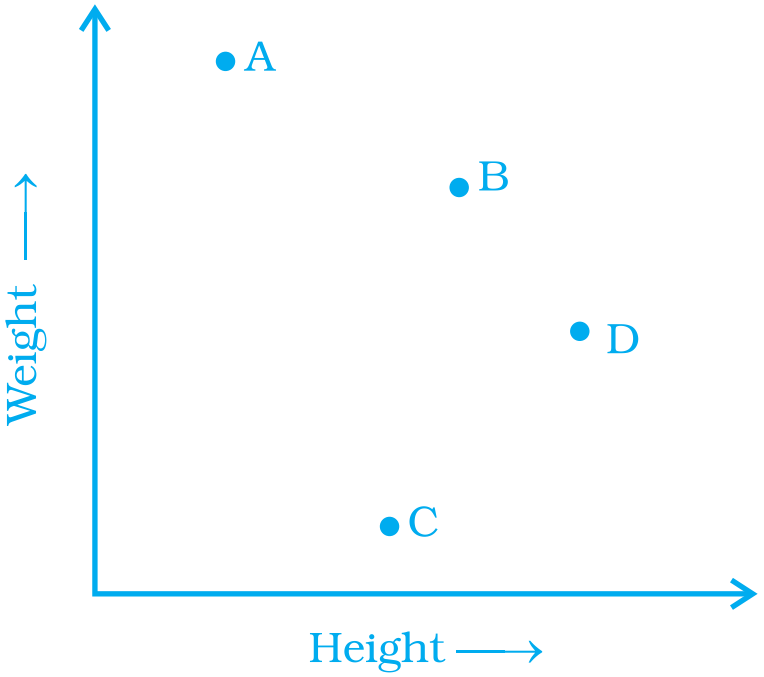
The points on the graph below represent the height and weight of the donkey, dog, crocodile, and ostrich shown in the drawing.

$a.$ What are the two variables represented in the graph?
$b.$ Which point represents each animals? Explain.
A hall has a capacity of $2704$ seats. If the number of rows is equal to the number of seats in each row, then find the number of seats in each row.
A box with a lid is made of wood which is $3\ cm$ thick. Its external length, breadth and height are $56\ cm, 39\ cm$ and $30\ cm$ respectively. Find the capacity of the box. Also find the volume of wood used to make the box.
Verify whether the given statement is true or false: $\frac{-8}{9}\div\frac{-4}{3}=\frac{-4}{3}\div\frac{-8}{9}$
A line l is parallel to line m and a transversal p interesects them at $X, Y$ respectively. Bisectors of interior angles at $X$ and $Y$ interesct at $P$ and $Q.$ Is $PXQY$ a rectangle? Given reason.
Divide the given polynomial by the gliven monomial.
(i) $\left(5 x^2-6 x\right) ÷ 3 x$
(ii) $\left(3 y^8-4 y^6+5 y^4\right) \div y^4$
(iii) $8\left(x^3 y^2 z^2+x^2 y^3 z^2+x^2 y^2 z^3\right) ÷ 4 x^2 y^2 z^2$
(iv) $\left(x^3+2 x^2+3 x\right) ÷ 2 x$
(v) $\left(p^3 q^6-p^6 q^3\right) \div p^3 q^3$
Solve the following equations :
$\frac{2 x}{3}+1=\frac{7 x}{15}+3.$
On what sum will the compound interest at $5\%$ per annum for $2$ years compounded annually be Rs. $164?$
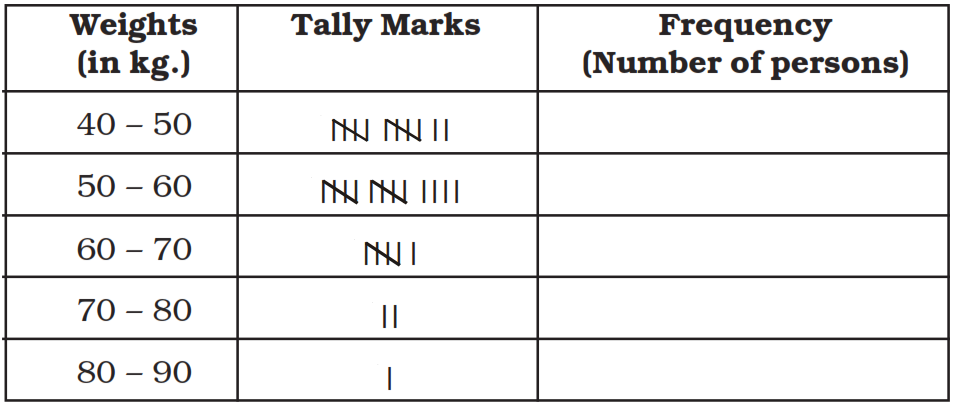
Complete the following table:

Find the total number of persons whose weights are given in the above table.