Question
Give plausible explanation :
Cyclohexanone forms cyanohydrin in good yield but 2, 2, 6-trimethyl cyclohexanone does not.
Answer

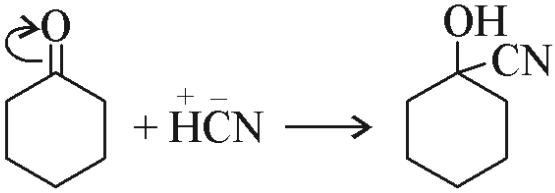
Carbonyl group of cyclohexanone is polar so on this nucleophilic addition of HCN occurs easily and forms cynaohydrin in good yield.
Image
But in case of 2, 2, 6-tri-methyl cylohexanone presence of three methyl groups shows + I effect (electron repelling effect) so polarity of carbonyl group decreases and due to steric hinderance of these three methyl groups the attack of $\overline{ C } N$ (Nucleophilic) becomes difficult. So yield of cyanohydrin fromed by the addition of HCN on this is very Low.

Need a full question paper?

Generate a complete, print-ready paper with questions like this in minutes — across 16+ boards, with answer keys.

Start Generating Free

Similar questions

Explain peroxide effect.
What is the reaction of formic acid with the following :
(i) Concentrated $H _2 SO _4$
(ii) Aqueous $C l _{ 2 }$ (chlorine water)
What is the difference between glucose and starch?
What is meant by 'disproportionation'? Give two examples of disproportionation reaction in aqeuous solution.
(a) Calculate $\Delta G^{0}$ for the reaction
$Zn(s) + Cu^{2+}(aq) \longrightarrow Zn^{2+}(aq) + Cu(s)$.
Given: $E^{0}$ for $Zn^{2+}/Zn = -0.76 V$ and
$E^{0}$ for $Cu^{2+}/Cu = +0.34 V$,
$R = 8.314 J K^{-1} mol^{-1}$,
$F = 96500 C mol^{-1}$.
(b) Give two advantages of fuel cells.
In a reaction between $A$ and $B$, the initial rate of reaction $(r_0)$ was measured for different initial concentrations of $A$ and $B$ as given below:
$A/mol L^{-1}$ $0.20$ $0.20$ $0.40$
$B/mol L^{-1}$ $0.30$ $0.10$ $0.05$
$r_0/mol L^{-1} s^{-1}$ $5.07 \times 10^{-5}$ $5.07 \times 10^{-5}$ $1.43 \times 10^{-4}$
What is the order of the reaction with respect to $A$ and $B?$
Explain the following with an example :
Williamson ether synthesis.
The reaction of alkyl chloride with aquons KOH produces an alcohol, while the reaction with alcoholic КОН produces an alkene. Explain why and write the chemical equations for both reactions
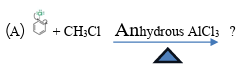
Complete the following chemical reaction
Image
(B) $CH _3 CH _2 Cl + KCN \longrightarrow$ ?
(C) $CH _3- CH = CH _2+ HI \longrightarrow$ ?
(i) Give two methods in which $> C = O$ group is converted into $> C H _2$ group.
(ii) In the purification of aldehydes sodium bi-sulphite is used, why?