Explain : (a) Acetic acid is a weaker acid than formic acid. (b) Carboxylic acids have higher boiling points than aldehydes of comparable molecular mass.
Answer
(a) In acetic acid $\left( CH _3 COOH \right)$, the electron releasing $- CH _3$ group increases the negative charge on the carboxyl group, making loss of proton more difficult. On other hand, formic acid $( HCOOH )$ does not has any electron releasing group, thus removal of proton is easier. Thus acetic acid is weaker acid than formic acid. (b) This is due to more extensive association of carboxylic acid molecules through intermolecular H-bonding. The hydrogen bonds are not borken completely even in vapour phase.
An alkene with molecular formula $C _6 H _2$ on ozonolysis gives two different products. One of these gave a positive iodoform test but does not reduced Tollens' reagent. The other product give a positive Tollens' test but does not give iodoform test. What is the name and formula of alkene and its products?
Answer
One product obtained from ozonolysis of alkene does not react with Tollens' reagent, hence it must be a ketone but gives iodoform test, hence it would be methyl ketone, while the other product reacts with Tollens' reagent, hence it would be an aldehyde since alkene has six carbon atoms, therefore, one product will be acetone and the other will be propionaldehyde. Acetone (methyl ketone) gives iodoform test but propionaldehyde does not give this test.
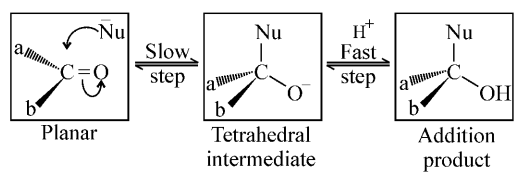
In carbonyl compounds alkoxide ion formed by the attack of nucleophilic in first step is more stable than carbocation formed by the attack of electrophile. So carbonyl compounds shows nucleophilic addition reactions.
(i) Give two methods in which $> C = O$ group is converted into $> C H _2$ group. (ii) In the purification of aldehydes sodium bi-sulphite is used, why?
Answer
(i) $> C = O$ group is converted into $> CH _2$ group in Clemmenson reduction and Wolf-Kishner reduction. (ii) Aldehydes reacts with sodium bi-sulphite $\left( NaHSO _3\right)$ but other impurities not. So white solid formed by the reaction of impure aldehyde with $NaHSO _3$ is hydrolysed and pure aldehyde is obtained.
Electronegativity of fluorine is more than electronegativity of chlorine although acidic strength of chlorobenzoic acid is more than p-fluorobenzoic acid, why?
Answer
Halogen shown both + M and - I effect but atomic size of fluorine and carbon is almost same so + M effect in p-fluorobenzoic acid. is more in comparison to pchlorobenzoic acid. So - F effect becomes less effective due to this reason acidic strength of p -chlorobenzoic acid is more than p-fluorobenzoic acid.
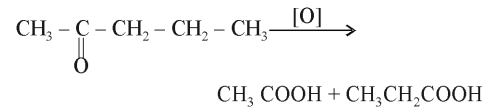
When two different carboxylic acids are obtained by the oxidation of any unsymmetrical ketone then > C = O group goes towards small alkyl group. This is called Popaff's rule.
Why the boiling points of aldehydes and ketones are higher than the hydrocarbons and ethers of comparable molecular masses but lower than alcohols?
Answer
Aldehydes and ketones have high boiling point as compared to hydrocarbons and ethers because of molecular association in aldehydes and ketones due to dipole- dipole interactions. These dipole-dipole interactions are weaker than intermolecular H-bonding. Due to strong H- bonding in alcohols aldehydes and ketones have lower boiling point than alcohols.
How the benzaldehyde and acetaldehyde are differentiated?
Answer
(i) Benzaldehyde $\left( C _6 H _5 CHO \right)$ does not gives iodoform test while acetaldehyde $\left( CH _3 CHO \right)$ gives iodoform test. (ii) $C _6 H _5 CHO$ does not reacts with Fehling solution while Fehling solution is reduced by $CH _3 CHO$.
Although phenoxide ion has more number of resonating structures than carboxylate ion, carboxylic acid is a stronger acid than phenol. Why?
Answer
In phenoxide ion negative charge is delocalised over one oxygen and two less electronegative carbon atom while in carboxylate ion negative charge is delocalised over two electronegative oxygen atoms so delocalisation of negative charge is more in this than phenoxide ion. So resonance stabilisation is more so carboxylic acid is stronger acid than phenol.
Give plausible explanation : During the preparation of esters from a carboxylic acid and an alcohol in the presence of an acid catalyst, the water or the ester should be removed as soon as it is formed.
Answer
Formation of ester by the reaction of carboxylic acid with alcohols reversible so as soon as ester is formed it will react with water and forms acid and alcohol. So equilibrium is established between reactants and products due to this reason water or ester should be removed as soon as it is formed so equilibrium is moved in forward direction and ester is formed in more amount.
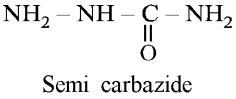
Give plausible explanation : There are two - $NH _2$ groups in semi carbazide. However, only one is involved in the formation of semi-carbazones.
Answer
Out of two $- NH _2$ groups present in semicarbazide only one $- NH _2$ group is involved in the formation of semicarbazone because $- N - H$ bond of $- NH _2$ group near to $> C = O$ group are strong due to resonance while $- N - H$ bond of $- NH _2$ group near to $- NH -$ are weak because there is no resonance in these so they participate in the reaction.
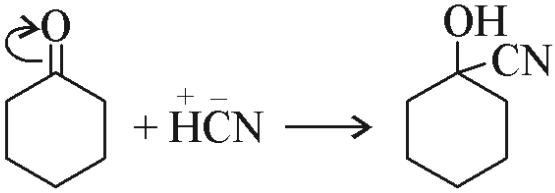
Give plausible explanation : Cyclohexanone forms cyanohydrin in good yield but 2, 2, 6-trimethyl cyclohexanone does not.
Answer
Carbonyl group of cyclohexanone is polar so on this nucleophilic addition of HCN occurs easily and forms cynaohydrin in good yield. But in case of 2, 2, 6-tri-methyl cylohexanone presence of three methyl groups shows + I effect (electron repelling effect) so polarity of carbonyl group decreases and due to steric hinderance of these three methyl groups the attack of $\overline{ C } N$ (Nucleophilic) becomes difficult. So yield of cyanohydrin fromed by the addition of HCN on this is very Low.
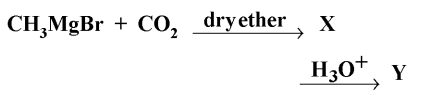
Decarboxylation : When sodium salt of carboxylic acids is heated with sodalime (mixture of $NaOH + CaO$ 3 : 1) then $CO _2$ gas is evolved and hydrocarbons are formed. This reaction is called Decarboxylation.
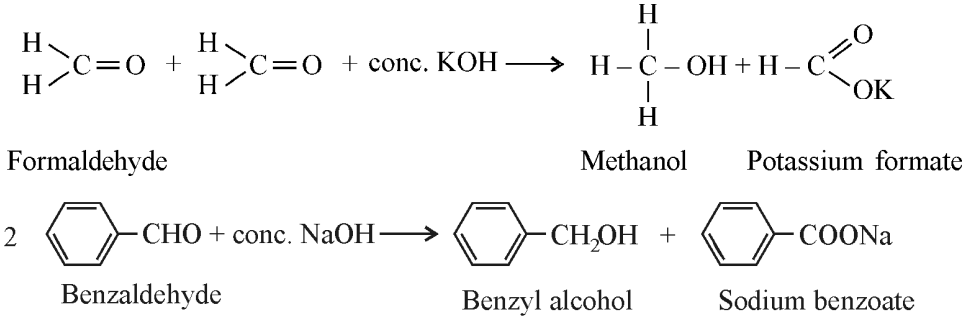
Cannizzaro reaction : Aldehydes without $\alpha$-hydrogenation shows auto oxidation and reduction (Disproportionation) in presence of conc. Alkali $( NaOH$ or KOH $)$. In this reaction one mulecule of aldehyde is reduced in Alcohol while another molecule is oxidised in salt of carboxylic acid.
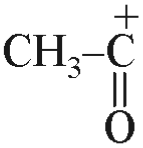
Acetylation : Benzene or substituted benzene reacts with acid chloride in presence of anhydrous aluminium chloride $\left( AlCl _3\right)$ gives corresponding ketones. This is called Friedel-Crafts Acetylation reaction. But the compounds containing active H like alcohol $( ROH )$, Phenol $\left( C _6 H _5 OH \right)$ and Amines $\left( R - NH _2\right)$ reacts with $CH _3 COCl$ without catalyst then $H ^{+}$is replaced by This is called Acetylation reaction.
Give simple chemical terts to distinguish between the pair of compound : Benzoic acid and Ethyl Benzoate
Answer
(1) Benozic acid $\left( C _6 H _5 COOH \right)$ turns Blue Litmus into red due to acidic nature while Ethyl benzoate $\left( C _6 H _5 COC _2 H \right)$ is an ester so this does not react with Blue Litmus. (2) Benzoic acid gives effervescence of $CO _2$ by the reaction with $NaHCO _3$ solution while ethyl benzoate does not react with $NaHCO _3$ solution.
Give simple chemical terts to distinguish between the pair of compound : Phenol and Benozoic acid
Answer
(1) Phenol do not react with $NaHCO _3$ solution while benzoic acid reacts with $NaHCO _3$ solution and gives $CO _2$ gas. $C _6 H _5 COOH + NaHCO _3 \longrightarrow C _6 H _5 COONa + CO _2 \uparrow+ H _2 O$ (2) Phenol gives violet colour with neutral $FeCl _3$ solution while benzoic acid do not gives this test.
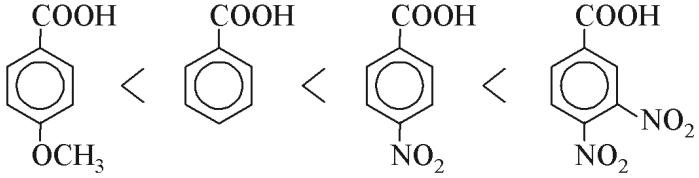
Arrange the compound in increasing order of their property as indicated : Benzoic acid 4-Nitrobenzoic acid, 3,4-Dinitro benzoic acid, 4-Methoxy benozic acid (Acid strength)
Answer
Increasing order of acidic strength for these acids is as follows: 4-methoxy benzoic acid $<$ benzoic acid $<4$-nitro benzoic acid < 3, 4-dinitrobenzoic acid





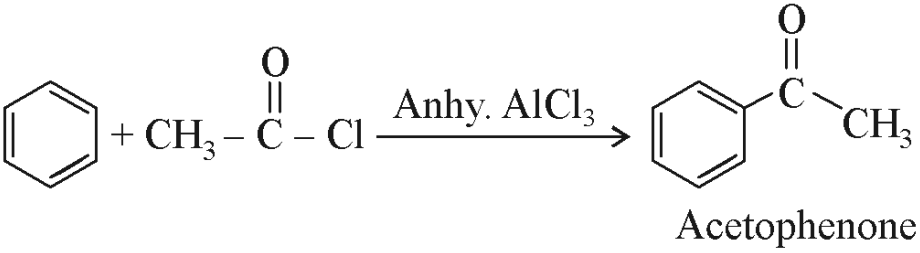
 This is called Acetylation reaction.