Question
Give reasons why acquired characters are not inherited.

Answer

Acquired characters are acquired due to individual’s response to external stimuli. These traits develop because of constant exposure to a certain stimulus and the resultant response by the individual. Let us take the example of a certain cricketer who is an excellent batsman. He could become an excellent batsman because of several reasons. Some of them could be; his keen interest in the game, timely support from his family and friends, proper coaching at the right age and timely selection in the cricket team. All the cricketing ability could be acquired by him because of the way he responded to all the challenges and opportunity. But this does not mean that the son of this cricketer would become an excellent cricketer; because cricketing ability is not an inheritable character.
In fact, acquired characters just alter the phenotype of an individual. It has no effect on genotype. A character can only be inheritable when it changes the genotype of individual. Hence, acquired characters are not inherited.
Need a full question paper?

Generate a complete, print-ready paper with questions like this in minutes — across 16+ boards, with answer keys.

Start Generating Free

Similar questions

"A convex lens can form a magnified erect as well as magnified inverted image of an object placed in front of it." Draw ray diagram to justify this statement stating the position of the object with respect to the lens in each case.
An object of height 4 cm is placed at a distance of 20 cm from a concave lens of focal length 10 cm. Use lens formula to determine the position of the image formed.
The partially digested food coming from the stomach of a person enters a long and narrow organ A in his body. The organ A receives the secretion of two glands: liver and pancreas. Liver secretes a greenish - yellow liquid B which is normally stored in the organ C. Pancreas secretes pancreatic juice which contains three digestive enzymes D, E and F. The intestinal juice completes the process of digestion of food. The inner wall of organ A has millions of tiny finger - like projections G which help in the rapid absorption of digested food into blood stream. The undigested part of food then passes into wider tube H which absorbs most of the water from undigested food. The last part of tube H called I stores this undigested food (or waste) for some time. The undigested food is then passed out though opening J as faeces in the process known as K.
  1. Name the organ A.
  2. Name liquid B and organ C.
  3. What are the digestive enzymes D, E and F?
  4. Name the projections G present on the inner wall of organ A.
  5. Name Tube H, Part I, Opening J and Process K.
What are the environmental consequences of using fossil fuels? Suggest the steps to minimise the pollution caused by various sources of energy including non-conventional sources of energy.
The descriptions of five kinds of images are given below:
  1. Diminished and virtual.
  2. Enlarged and real.
  3. Enlarged and erect.
  4. Real and inverted.
  5. Virtual and the same size.
Which one of these describes the image formed:
  1. On the retina of the eye?
  2. By a magnifying glass?
  3. By a convex driving mirror on a car?
  4. By a plane mirror?
  5. on the screen of a slide projector?

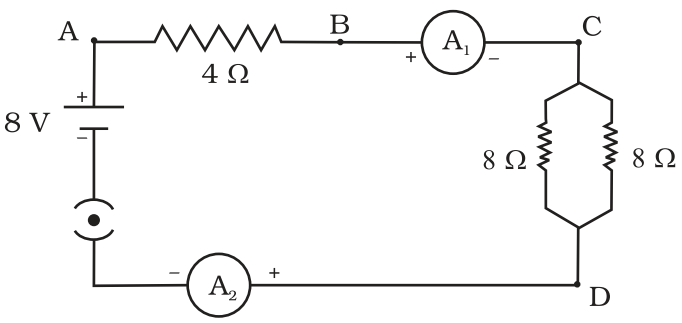
Find out the following in the electric circuit given in Figure.
  1. Effective resistance of two 8Ω resistors in the combination.
  2. Current flowing through 4Ω resistor.
  3. Potential difference across 4Ω resistance.
  4. Power dissipated in 4Ω resistor.
  5. Difference in ammeter readings, if any.
An organism X having breathing organs A lives on land. When organism X goes under water, it cannot survive for a long time unless carrying an oxygen cylinder. On the other hand, the organism Y having breathing organs B always lives in water and if taken out of water, it dies after a short while. A third organism Z having breathing organs C and D which lives on the banks of ponds, lakes and rivers can survive on land as well as in water equally well.
  1. What could organism X be? Name the breathing organs A.
  2. What could organism Y be? Name the breathing organs B.
  3. What could organism Z be? Name the breathing organs C and D.
  4. Out of X, Y and Z, which organism is.
  1. Amphibian,
  2. Aquatic,
  3. Terrestrial?
How do Mendel’s experiments show that traits are inherited independently?
Explain the principle of dialysis with the help of a labelled diagram.
Arrange the following elements in the increasing order of their metallic character Mg, Ca, K, Ge, Ga.
What constitutes the central and peripheral nervous systems? How are the components of central nervous system protected?