Question
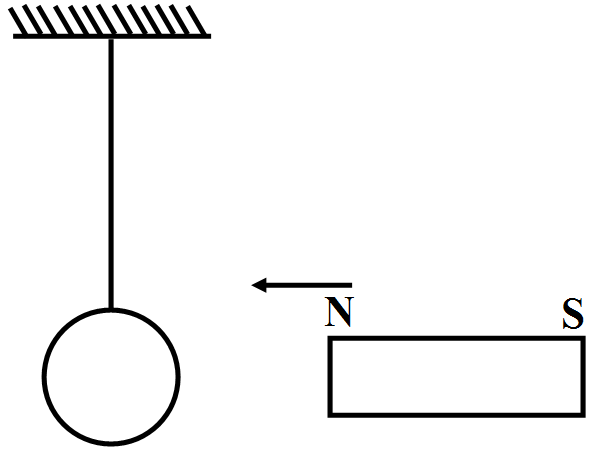
Give the direction in which induced current flows in the wire loop, when the magnet moves towards the loop as shown.

Answer

The current induced in the coil will oppose the approach of magnet, so this nearer face of the coil will act as North Pole, therefore on viewing from the magnet side the current in the coil will be anticlockwise.

Need a full question paper?

Generate a complete, print-ready paper with questions like this in minutes — across 16+ boards, with answer keys.
Start Generating Free

Similar questions

Write an expression for intensity of magnetisation field due to a small bar magnet of magnetic moment $\overrightarrow{ M }$ at a distance $r$ on its non-axial side.
What kind of value is $m$ for an inverted (and real) image formed by a convex or concave lens?
On what does the color dispersion power of a prism depend?
A barometer tube reads 76cm of mercury. If the tube is gradually inclined keeping the open end immersed in the mercury reservoir, will the length of mercury column be 76cm, more than 76cm or less than 76cm?
Does the positive or negative electric potential depend on the nature of the test charge? explain.
A converging lens of focal length 12cm and a diverging mirror of focal length 7.5cm are placed 5.0cm apart with their principal axes coinciding. Where should an object be placed so that its image falls on itself?
What will be the relationship between the mass loss $\Delta M$ of a nucleus and its binding energy ( E )?
Voltage across the ends of inductor, capacitor and resistor in a series LCR circuit is 20 V, 20 V and 40 V respectively. What is the phase difeerence between the current and applied voltage in the circuit?
Two wires of equal length are bent in the form of two loops. One of the loops is square shaped whereas the other loop is circular. These are suspended in a uniform magnetic field and the same current is passed through them. Which loop will experience greater torque? Give reasons.
To measure the magnetic moment of a bar magnet, one may use:
  1. A tangent galvanometer.
  2. A deflection galvanometer if the earth's horizontal field is known.
  3. An oscillation magnetometer if the earth's horizontal field is known.
  4. Both deflection and oscillation magnetometer if the earth's horizontal field is not known.