Question
Give the limitations of octet rule:

Answer

Limitations of octet rule:
$i.$ Octet rule does not explain stability of some molecules.
The octet rule is based on the inert behaviour of noble gases, which have their octet complete i.e., have eight electrons in their valence shell. It is very useful to explain the structures and stability of organic molecules. However, there are many molecules whose existence cannot be explained by the octet theory. The central atoms in these molecules does not have eight electrons in their valence shell, and yet they are stable.
Such molecules can be categorized as having:
$a.$ Incomplete octet
$b.$ Expanded octet
$c.$ Odd electrons
$a.$ Molecules with incomplete octet: e.g. $BF_3, BeCl_2, LiCl$
In these covalent molecules, the atoms $B, Be$ and $Li$ have less than eight electrons in their valence shell but these molecules are stable.
$Li \ in \ LiCl$ has only two electrons, $Be$  in $BeCl_2$ has four electrons while $B$ in $BF_3$ has six electrons in the valence shell.
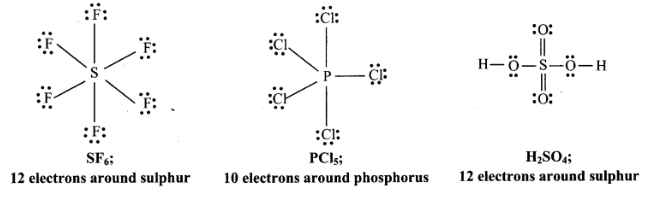
$b.$ Molecules with expanded octet: Some molecules like $SF_6, PCl_5, H_2SO_4$ have more than eight electrons around the central atom.
Image
$c.$ Odd electron molecules:
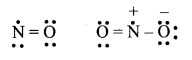
Some molecules like $NO ($nitric oxide$)$ and  $NO_2 ($nitrogen dioxide$)$ do not obey the octet rule. These molecules, have odd number of valence electrons.
Image
$ii.$ The observed shape and geometry of a molecule, cannot be explained, by the octet rule.
$iii.$ Octet rule fails to explain the difference in energies of molecules, though all the covalent bonds are formed in an identical manner, that is, by sharing a pair of electrons. The rule fails to explain the differences in reactivities of different molecules.
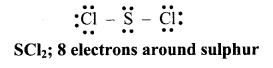
Note: Sulphur also forms many compounds in which octet rule is obeyed. For example, in sulphur dichloride, the sulphur atom has eight electrons around it.
Image

Need a full question paper?

Generate a complete, print-ready paper with questions like this in minutes — across 16+ boards, with answer keys.

Start Generating Free

Similar questions

Describe the shape of $3d$ orbitals.
Balance the following redox equation by oxidation number method. The reactions occur in acidic medium.
$i. \  H _2 O _{2( aq )}+ Cr _2 O _{7( aq )}^{2-} \longrightarrow O _{2( g )}+ Cr _{( mq )}^{3+}$
$ii. \  A g (s)+ N O _{3(\text { (mq) }}^{-} \longrightarrow A g _{(\text {(qq) }}^{+}+ N O _{2( g )}$
$iii. \  Sn _{(\text {(qq) }}^{2+}+ IO _{\text {(teq) }}^{-} \longrightarrow Sn _{( aq )}^{4+}+ I _{(\text {(aq) })}^{-}$
$iv. \  MnO _{4(\text { (q) })}^{-}+ IO _{3(\text { ave }}^{-} \longrightarrow MnO _{2( s )}+ IO _{4( mq )}^{-}$
$v. \  N O _{3( qq )}^{-}+ SO _{2( qq )} \longrightarrow SO _{4( sq )}^{2-}+ NO _{2( g )}$
Explain briefly the results of Bohr’s theory for hydrogen atom.
Calculate the number of atoms in each of the following.
i. 52 moles of Argon (Ar)
ii. 52 u of Helium (He)
iii. 52 g of Helium (He)
Give a brief description of the principle of fractional crystallization.
Explain the formation of an acetylene molecule on the basis of hybridization.
Arrange the following bonds in decreasing order of bond strength $: C-N, C=N, C≡N$
What is carbocation? Explain with the help of an example and comment on the stability of carbocation.
Explain chain isomerism in alkanes with two suitable examples.
In a chemical laboratory, Priyal was asked to isolate an organic compound from its aqueous solution. She added ethyl acetate to the given sample, separated the organic layer and kept it for evaporation. At the end of her practical, Priyal found few crystals in the beaker which she kept for evaporation. Answer the following questions:
i. In the above passage, which method was used by Priyal for separation? State its principle.
ii. Why do you think the organic compound dissolved in ethyl acetate?
iii. Illustrate the method of separation used in the passage with an example.