Questions

Answer the following questions in detail.

Take a timed test

21 questions · self-marked practice — reveal the answer and mark yourself.

Question 16 Marks
Explain the formation of $BeCl_2.$
Answer
Formation of $\mathrm{BeCl}_2$ :
$i. \mathrm{BeCl}_2$ molecule has one $\mathrm{Be}$ atom and two chlorine atoms.
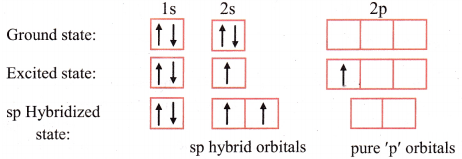
$ii.$ Electronic configuration of $\mathrm{Be}$ is $1 s^2 2 s^2 2 \mathrm{p}_{\mathrm{z}}^0$. Electronic configuration of beryllium:
Image
$iii.$ The $2s \ and \ 2p_z$ orbitals undergo $sp$ hybridization to form two $sp$ hybrid orbitals oriented at $180^\circ$ with each other. $2p_z$ orbitals of two chlorine atoms overlap with the sp hybrid orbitals to form two $sp-p \ \sigma$ bonds.
$Cl – Be – Cl$ bond angle is $180^\circ.$ The geometry of the molecule is linear.
Diagram:

Image
View full question & answer
Question 26 Marks
Explain Fajan’s rule with suitable examples.
Answer
Fajan’s rule:
$i.$ Smaller the size of the cation and larger the size of the anion, greater is the covalent character of the ionic bond. For example$, Li^+ Cl^–$ is more covalent than $Na^+Cl.$ Similarly$, Li^+I^–$ is more covalent than $Li^+Cl^–.$
$ii.$ Greater the charge on cation, more is covalent character of the ionic bond. For example, covalent character of $AlCl_3, MgCl_2$ and $NaCl$ decreases in the following order $Al^{3+}(Cl^–)_3 > Mg^{2+}(Cl^–)_2 > Na^+ Cl^–$
$iii.$ A cation with the outer electronic configuration of the $s^2p^6d^{10}$ type possesses greater polarising power compared to the cation having the same size and same charge but having outer electronic configuration of $s^2p^6$ type.
This is because d electrons of the $s^2p^6d^{10}$ shell screen nuclear charge less effectively compared to $s$ and $p$ electrons of $s^2p^6$ shell. Hence, the effective nuclear charge in a cation having $s^2p^6d^{10}$ configuration is greater than that of the one having $s^2p^6$ configuration. For example$: Cu^+Cl^–$ is more covalent than $Na^+Cl^–.$ Here,
$(Cu^+ = 1s^2 2s^2 2p^6 3s^2 3p^6 3d^{10}; Na^+ = 1s^2 2s^2 2p^6)$
View full question & answer
Question 36 Marks
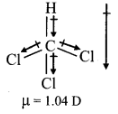
$CHCl_3$ is polar Explain.
Answer
In $CHCl_3,$ the dipoles are not equal and do not cancel each other. Hence, $CHCl_3$ is polar with a non$-$zero dipole moment.
Image
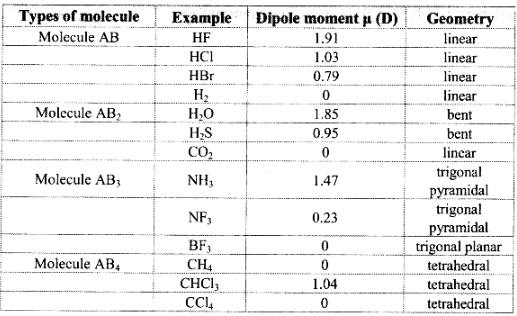
Note: Dipole moments and geometry of some molecules are given in the following table:
Image
View full question & answer
Question 46 Marks
Explain how polarity (ionic character) is developed in a covalent bond.
Answer
i. Covalent bonds are formed between two atoms of the same or different elements.
ii. When a covalent bond is formed between atoms of same element such as H-H, F-F, Cl-Cl, etc., the shared pair of electrons is attracted equally to both atoms and is situated midway between two atoms. Such covalent bond is termed as nonpolar covalent bond.
iii. When a covalent bond is formed between two atoms of different elements that have different electronegativities, the shared electron pair does not remain at the centre. The electron pair is pulled towards the more electronegative atom resulting in the separation of charges. This give rise to dipole. The more electronegative atom acquires a partial -ve charge and the other atom gets a partial +ve charge. Such a bond is called as polar covalent bond. The examples of polar molecules include HF, HC1, etc.
$\begin{array}{cc}{ }^{8+} \mathrm{H}-\mathrm{F}^{3-} & \mathrm{H}-\mathrm{F} \\ & \text { Polar covalent bond }\end{array}$
Fluorine is more electronegative than hydrogen, therefore, the shared electron pair is more attracted towards fluorine and the atoms acquire partial +ve and -ve charges, respectively.
iv. Polarity of the covalent bond increases as the difference in the electronegativity between the bonded atoms increases. When the difference in electronegativities of combining atom is about 1.7, ionic percentage in the covalent bond is 50%.
View full question & answer
Question 56 Marks
Arrange the following bonds in decreasing order of bond strength $: C-N, C=N, C≡N$
Answer
$C≡N > C=N > C-N$
Note: Average bond lengths for some single, double and triple bonds:
Type of bond Covalent bond length $(pm)$
$O-H$ $96$
$C-H$ $107$
$N-O$ $136$
$C-O$ $143$
$C-N$ $143$
$C-C$ $154$
$C=C$ $121$
$N=O$ $122$
$C=C$ $133$
$C=N$ $138$
$C≡N$ $116$
$C≡C$ $120$
 
Type of bond Covalent bond length $(pm)$
$H_2(H-H)$ $74$
$F_2(F-F)$ $144$
$Cl_2(Cl-Cl)$ $199$
$Br_2(Br-Br)$ $228$
$I_2(I-I)$ $267$
$N_2(N≡N)$ $109$
$O_2(O-O)$ $121$
$HF (H-F)$ $92$
$HCl (H-Cl)$ $127$
$HBr (H-Br)$ $141$
$HI (H-I)$ $160$
View full question & answer
Question 66 Marks
Explain the formation of the following molecules on the basis of $\text{MOT.}$ Also find the bond order.
$i. H_{2 } \ \ \ ii. Li_{2 } \ \ \ iii. N_{2 } \ \ \  iv. O_{2 } \ \ \ v. F_2$
Answer
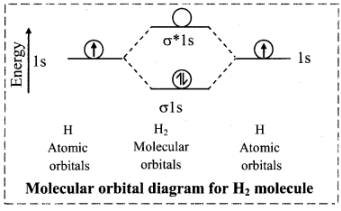
$i.$ Hydrogen molecule $(H_2):$
Image
$a.$ Hydrogen atom $(Z=1)$ has electronic configuration as $1 s^1$.
$b.$ Hydrogen atom contains one electron, hence hydrogen molecule which is diatomic contains two electrons.
$c.$ Linear combination of two $1 \mathrm{~s}$ atomic orbitals gives rise to two molecular orbitals $\sigma 1 \mathrm{~s}$ and  $\sigma^* 1 \mathrm{~s}$.
$d.$ The two electrons from the hydrogen atoms occupy the $\sigma 1 \mathrm{~s}$ molecular orbital and $\sigma^* 1 \mathrm{~s}$ remains vacant.
$e.$ Thus, electronic configuration of $\mathrm{H}_2$ molecule is $\sigma 1 s^2$.
$f.$ Since, no unpaired electron is present in hydrogen molecule, it is diamagnetic.
$g.$ There are no electrons in the antibonding molecular orbital ( $\sigma^* 1 \mathrm{~s}$ ).
$h.$ The bond order of $\mathrm{H}_2$ molecule is Bond order $=\frac{\mathrm{N}_{\mathrm{b}}-\mathrm{N}_{\mathrm{a}}}{2}=\frac{2-0}{2}=1$
Thus, a single covalent bond is present between two hydrogen atoms.
$[$Note: The bond length is $74 \ \mathrm{pm}$ and the bond dissociation energy is $438 \mathrm{~kJ} \mathrm{~mol}^{-1}.]$
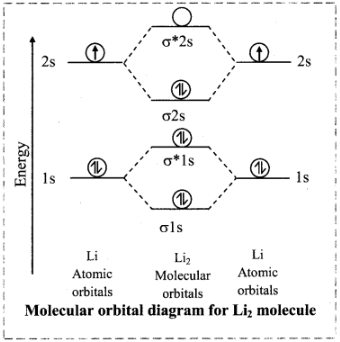
$ii.$ Lithium molecule $(Li_2):$
Image
$a.$ Lithium atom $(Z=3)$ has electronic configuration as $1 s^2 2 s^1$.
$b.$ Lithium atom has $3$ electrons, hence $\mathrm{Li}_2$ molecule has $6$ electrons.
$c.$ Linear combination of four atomic orbitals gives rise to four molecular orbitals namely $\sigma 1 s, \sigma^* 1 s, \sigma 2 S$ and $\sigma^* 2 s$.
$d.$ The electronic configuration of $\mathrm{Li}_2$ molecule is $(\sigma 1 \mathrm{~s})^2\left(\sigma^{\star} 1 s\right)^2(\sigma 2 \mathrm{~s})^2$.
$e.$ Since no unpaired electron is present in lithium molecule, it is diamagnetic.
$f.$ Bond order of $\mathrm{Li}_2$ molecule
$=\frac{\mathrm{N}_{\mathrm{b}}-\mathrm{N}_{\mathrm{a}}}{2}=\frac{4-2}{2}=1$
Thus, a single covalent bond is present between two $\mathrm{Li}$ atoms. Hence, $L \mathrm{Li}_2$ is a stable molecule.
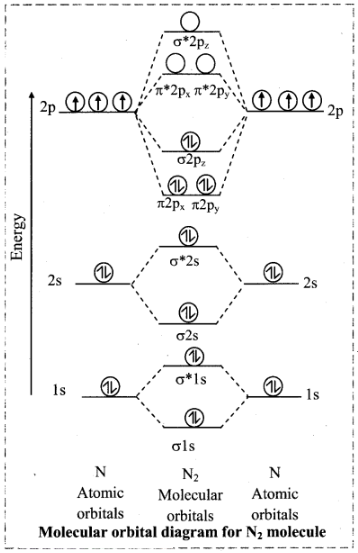
$iii.$ Nitrogen molecule $(N_2):$
Image
$a.$ Nitrogen atom $(Z=7)$ has electronic configuration as $1 s^2 2 s^2 2 p^3$.
$b.$ Nitrogen atom contains $7$ electrons, hence nitrogen molecule contains $14$ electrons.
$c.$ Linear combination of atomic orbitals gives rise to different molecular orbitals.
$d.$ The electronic configuration of $\mathrm{N}_2$ molecule is
$N_2:(\sigma 1 s)^2\left(\sigma^* 1 s\right)^2(\sigma 2 s)^2\left(\sigma^* 2 s\right)^2\left(\pi 2 p_x\right)^2\left(\pi 2 p_y\right)^2\left(\sigma 2 p_z\right)^2$
$e.$ Since $\mathrm{N}_2$ molecule does not have unpaired electron, it is diamagnetic.
$f.$ Bond order of $\mathrm{N}_2$ molecule
$=\frac{\mathrm{N}_{\mathrm{b}}-\mathrm{N}_{\mathrm{a}}}{2}=\frac{10-4}{2}=3$
Thus, there are three bonds in $\mathrm{N}_2$ molecule.
View full question & answer
Question 76 Marks
Explain the formation of an acetylene molecule on the basis of hybridization.
Answer
Formation of acetylene (ethyne) molecule on the basis of sp hybridization:
i. Acetylene molecule $\left(\mathrm{C}_2 \mathrm{H}_2\right)$ has two carbon atoms and two hydrogen atoms.
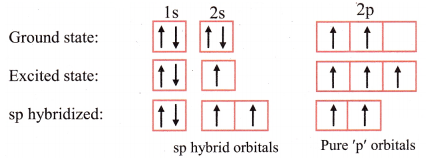
ii. The ground state electronic configuration of $C(Z=6)$ is $1 s^2 2 s^2 2 p_x^1 2 p_y^1 2 p_z^0$. Electronic configuration of carbon:

Image

iii. Each carbon atom undergoes sp hybridization. One s and one p orbitals mix and recast to give two sp hybrid orbitals arranged at 180° to each other.
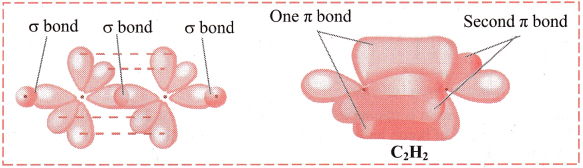
iv. Out of the two sp hybrid orbitals of carbon atom, one overlaps axially with s orbital of hydrogen while the other sp hybrid orbital overlaps with sp hybrid orbital of other carbon atom to form the sp-sp σ bond. The C H σ bond is formed by sp-s overlap.
v. The remaining two unhybridized p orbitals overlap laterally to form two p-p π bonds. So, there are three bonds between the two carbon atoms: one C-C σ bond (sp-sp) overlap, two C-C π bonds (p-p) overlap. There are two sp-s σ bonds in acetylene (one between each C and H).
vi. Each H-C-C bond angle in ethyne molecule is 180°. All the four atoms in ethyne molecule are in a straight line. The geometry of acetylene molecule is linear. Diagram:
Image
View full question & answer
Question 86 Marks
Explain the formation of boron trifluoride on the basis of hybridization.
Answer
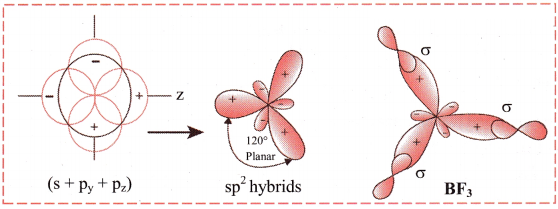
Formation of boron trifluoride on the basis of $\mathrm{sp}^2$ hybridization:
$i.$ Boron trifluoride $\left(\mathrm{BF}_3\right)$ has one boron atom and three fluorine atoms.
$ii.$ Observed valency of boron in $\mathrm{BF}_3$ molecule is three and its geometry is trigonal planar. This can be explained on the basis of $\mathrm{sp}^2$ hybridization.
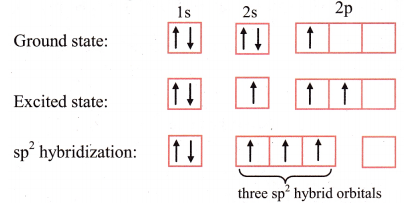
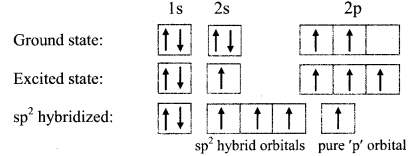
$iii.$ The ground state electronic configuration of $B(Z=5) \ is \ 1 s^2 \ 2 s^2 \ 2 p_x^1 \ 2 p_y^0 \ 2 \mathrm{p}_{\mathrm{z}}^0$.
Electronic configuration of boron:
Image
$iv.$ One electron from $2s$ orbital of boron atom is uncoupled and promoted to vacant $2p_y$ orbital.
$v.$ The three orbitals i.e. $2s, 2p_x$ of and $2p_y$ of boron undergoes $sp^2$ hybridization to form three $sp^2$ hybrid orbitals of equivalent energy, which are oriented along the three comers of an equilateral triangle making an angle of $120^\circ.$
$vi.$ Each $sp^2$ hybrid orbital of boron atom having unpaired electron overlaps axially with half$-$filled $2p_z$ orbital of fluorine atom containing electron
with opposite spin to form three $B-F$ sigma bonds by $sp^2-p$ type of overlap.
$vii.$ Each $F-B-F$ bond angle in $BF_3$ molecule is $120^\circ.$ The geometry of $BF_3$ molecule is trigonal planar.
Diagram:
Image
View full question & answer
Question 96 Marks
Explain the formation of an ethene molecule on the basis of hybridization.
Answer
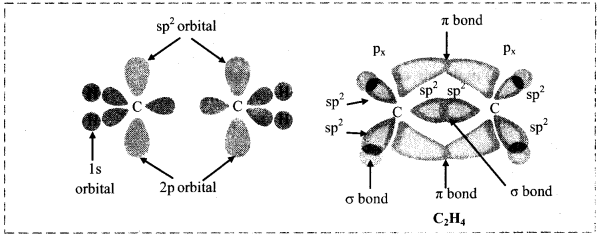
Formation of an ethene $($ethylene$)$ molecule on the basis of $\mathrm{sp}^2$ hybridization:
$i.$ Ethene molecule $\left(\mathrm{C}_2 \mathrm{H}_4\right)$ has two carbon atoms and four hydrogen atoms.
$ii.$ The ground state electronic configuration of $C(Z=6) \ is \ 1 s^2 \ 2 s^2 \ 2 \mathrm{p}_{\mathrm{x}}^1 \ 2 \mathrm{p}_{\mathrm{y}}^1 \ 2 \mathrm{p}_{\mathrm{z}}^0$.
Electronic configuration of carbon:
Image
$iii.$ One electron from $2s$ orbital of each carbon atom is excited to the $2p_z$ orbital. Then each carbon atom undergoes $sp^2$ hybridization.
$iv.$ One $’s \ ’$ orbital and two $‘p \ ’$ orbitals on carbon hybridize to form three $sp^2$ hybrid orbitals of equal energy and symmetry.
$v.$ Two $sp^2$ hybrid orbitals overlap axially two $‘s \ ’$ orbitals of hydrogen to form $sp^2-s \sigma$ bond. The unhybridized $‘p \ ’$ orbitals on the two carbon atoms overlap laterally to form $a\pi$ bond. Thus, the $C_2H_4$ molecule has four $sp^2-s \sigma$ bonds, one $sp^2-sp^2 \sigma$ bond and one $p-p \pi$ bond.
$vi.$ Each $H-C-H \ and \ H-C-C$ bond angle in ethene molecule is $120^\circ.$ All the six atoms in ethene $($ethylene$)$ molecule are in one plane. Geometry of the molecule at each carbon atom is trigonal planar.
Image
View full question & answer
Question 106 Marks
Explain the formation of water $(H_2O)$ molecule on the basis of hybridization.
Answer
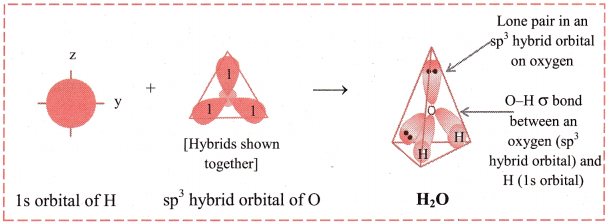
Formation of water $\left(\mathrm{H}_2 \mathrm{O}\right)$ molecule on the basis of $\mathrm{sp}^3$ hybridization:
$i.$ Water molecule $\left(\mathrm{H}_2 \mathrm{O}\right)$ has one oxygen atom and two hydrogen atoms.
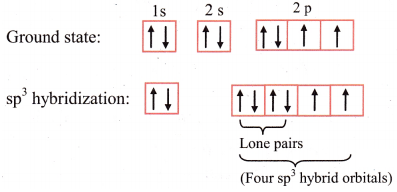
$ii.$ The ground state electronic configuration of oxygen $(Z=8)$ is $1 s^2 2 s^2 2 p_x^2$
$2 \mathrm{p}_{\mathrm{y}}^1 2 \mathrm{p}_{\mathrm{z}}^1$.
Electronic configuration of oxygen:
Image
$iii.$ The ground state electronic configuration explains the observed valency of oxygen in $H_2O$ molecule which is $2.$
$iv.$ The $2s, 2p_x, 2p_y \ and \ 2p_z$ orbitals of oxygen atom mix and recast to form four $sp^3$ hybrid orbitals of equivalent energy. These orbitals are tetrahedrally oriented in space. Two of the $sp$ hybrid orbitals contain lone pair of electrons.
$v.$ Two half$-$filled $sp^3$ hybrid orbitals of $O$ atom overlap axially with half$-$filled $1s$ orbitals of two different hydrogen atoms to fonn two $O-H (sp^3-s)$ sigma covalent bonds.
$vi.$ Since, there are two lone pairs of electrons in two of the $sp^3$ hybrid orbitals of oxygen, there is repulsion between lone pair and bonding pair of electrons. As a result, the $H-O-H$ bond angle is reduced from regular tetrahedral angle $109^\circ 28′ \ to \ 104^\circ 35′.$ The geometry of $H_2O$ molecule is angular or $V$ shaped.
Diagram:
Image
View full question & answer
Question 116 Marks
Explain the formation of an ammonia molecule on the basis of hybridization.
Answer
Formation of an ammonia $\left(\mathrm{NH}_3\right)$ molecule on the basis of $\mathrm{sp}^3$ hybridization:
$i.$ Ammonia molecule $\left(\mathrm{NH}_3\right)$ has one nitrogen atom and three hydrogen atoms.
$ii.$ The ground state electronic configuration of nitrogen $(Z=7) \ is \ 1 s^2 \ 2 s^2 \ 2 p_{\mathrm{x}}^1 \
2 \mathrm{p}_{\mathrm{y}}^1 \ 2 \mathrm{p}_{\mathrm{z}}^1$
Electronic configuration of nitrogen:
Image
$iii.$ The ground state electronic configuration explains the observed valency of nitrogen in $NH_3$ which is three.
$iv.$ The $2s, 2p_x, 2p_y \ and \ 2p_z$ orbitals of nitrogen atom mix and recast to form four $sp^3$ hybrid orbitals of equivalent energy. These orbitals are tetrahedrally oriented in space. One of the $sp^3$ hybrid orbital contains a lone pair of electrons.
$v.$ Three half$-$filled $sp^3$ hybrid orbitals of $N$ atom overlap axially with half$-$filled $1s$ orbital of three different hydrogen atoms to form three $N-H (sp^3-s)$ sigma covalent bonds.
$vi.$ Since, there is one lone pair of electrons in one of the $sp^3$ hybrid orbitals of nitrogen, there is repulsion between lone pair and bonding pair of electrons. As a result, the $H-N-H$ bond angle is reduced from regular tetrahedral angle $109^\circ 28′ \ to \ 107^\circ 18′.$ Geometry of $NH_3$ molecule is pyramidal or distorted tetrahedral.
View full question & answer
Question 126 Marks
Explain with diagrams $: i. sp^3$ hybridization  $ii. sp^2$ hybridization  $iii. sp$ hybridization
Answer
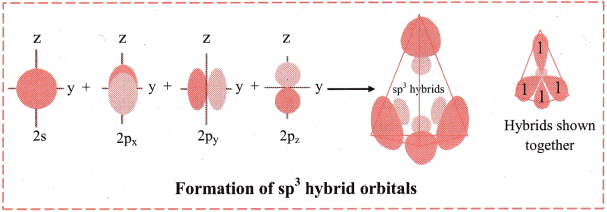
$i. sp^3$ hybridization:
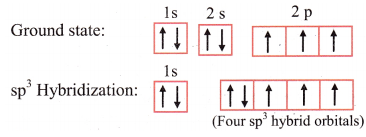
In this type, one $s$ and three $p$ orbitals having comparable energy mix and recast to form four $sp^3$ hybrid orbitals, $‘s \ ’$ orbital is spherically symmetrical while the $p_x, p_y, p_z,$ orbitals have two lobes and are directed along $x, y \ and \ z$ axes, respectively.
The four $sp^3$ hybrid orbitals formed are equivalent in energy and shape. They have one large lobe and one small lobe. They are at an angle of $109^\circ 28′$ with each other in space and point towards the comers of a tetrahedron. $CH_4, NH_3, H_2O$ are examples where the orbitals on central atom undergo $sp^3$ hybridization.
Diagram:
Image
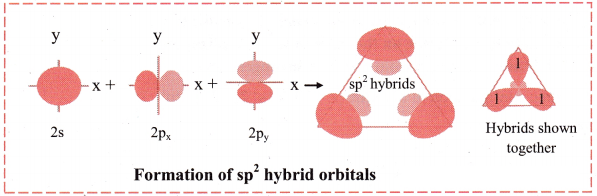
$ii. sp^2$ hybridization:
This hybridization involves the mixing of one $s$ and two $p$ orbitals to give three $sp^2$ hybrid orbitals of same energy and shape. The three orbitals are maximum apart and oriented at an angle of $120^\circ$ and are in one plane. The third $p$ orbital does not participate in hybridization and remains at right angles to the plane of the $sp^2$ hybrid orbitals. $BF_3, C_2H_4$ molecules are examples of $sp^2$ hybridization.
Diagram:
Image
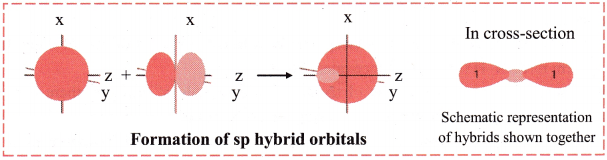
$iii. sp$ hybridization:
In this type, one $s$ and one $p$ orbital undergo mixing and recasting to form two $sp$ hybrid orbitals of same energy and shape. The two hybrid orbitals are placed at an angle of $180^\circ.$ Other two $p$ orbitals do not participate in hybridization and are at right angles to the hybrid orbitals. For example, $BeCl_2$ and acetylene molecule $(HC ≡ CH).$
Diagram:
Image
View full question & answer
Question 136 Marks
Explain with example $: i. s-s \ \sigma$ overlap  $ii. p-p \ \sigma$ overlap  $iii. s-p \ \sigma$ overlap
Answer
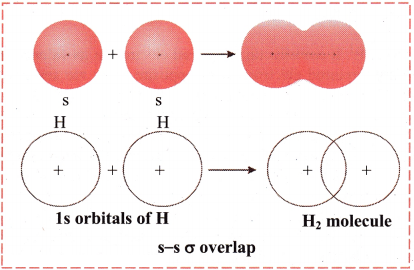
$i. s-s \ \sigma$ overlap:
$a.$ The overlap between two half$-$filled s orbitals of two different atoms containing unpaired electrons with opposite spins is called $s-s$ overlap.
e.g. Formation of $H_2$ molecule by $s-s$ overlap:
Hydrogen atom $(Z = 1)$ has electronic configuration $: 1s^1.$ The $1s^1$ orbitals of two hydrogen atoms overlap along the internuclear axis to form a $\sigma$ bond between the atoms in $H_2$ molecule.
$b.$ Diagram:
Image
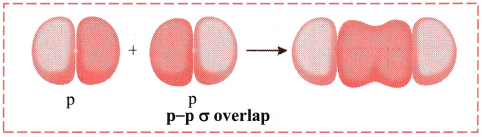
$ii. p-p \ \sigma$ overlap:
$a.$ This type of overlap takes place when two $p$ orbitals from different atoms overlap along the internuclear axis.
e.g. Formation of $F_2$ molecule by $p-p$ overlap:
Fluorine atom $(Z = 9)$ has electronic configuration $1s^2 \ 2s^2 \ 2p2x \ 2p2y \ 2p1z.$
During the formation of $F_2$ molecule, half$-$filled $2p_z$ orbital of one $F$ atom overlaps with similar half$-$filled $2p_z$ orbital containing electron with opposite spin of another $F$ atom axially and a $p-p \ \sigma$ bond is formed.
$b.$ Diagram:
Image
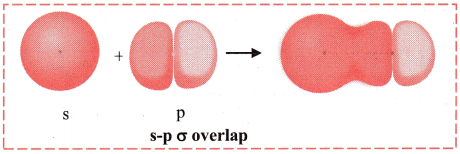
$iii. s-p \ \sigma$ overlap:
$a.$ In this type of overlap one half filled s orbital of one atom and one half filled
$p$ orbital of another orbital overlap along the internuclear axis.
e.g. Formation of $HF$ molecule by $s-p$ overlap:
Hydrogen atom $(Z=1)$ has electronic configuration $: 1 s^1$ and fluorine atom $(Z=9)$ has electronic configuration $1 s^2 \ 2 s^2 \ 2 p_x^2 \ 2 p_y^2 \ 2 p_z^1$.
During the formation of $HF$ molecule, half$-$filled $1 \mathrm{~s}$ orbital of hydrogen atom overlaps coaxially with half$-$filled $2 p_z$ orbital of fluorine atom with opposite electron spin and an $s-p \ \sigma$ bond is formed.
$b.$ Diagram:
Image
View full question & answer
Question 146 Marks
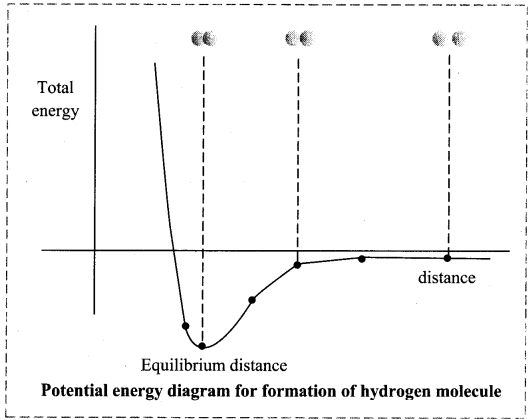
Explain the formation of hydrogen molecule with the help of potential energy curve.### Explain the formation of $H_2$ on the basis of $\text{VBT.}$
Answer
Formation of $H_2$ on the basis of $\text{VBT:}$
  • Hydrogen atom has electronic configuration $1s^1.$ It contains one unpaired electron in its valence shell.
  • When the two hydrogen atoms containing unpaired electrons with opposite spins are separated by a large distance, they can neither attract nor repel each other $($there are no interactions between them$).$ The energy of the system is the sum of the potential energies of the two atoms which is arbitrarily taken as zero.
  • When the two atoms approach each other, attractive and repulsive forces begin to operate on them. Experimentally, it has been found that during formation of hydrogen molecule, the magnitude of the newly developed attractive forces contributes more than the newly developed repulsive forces. As a result, the potential energy of the system begins to decrease.
  • As the atoms come closer to one another the energy of the system decreases. The overlap of the atomic orbitals increases only up to a certain distance between the two nuclei, where the attractive and repulsive forces balance each other and the system attains minimum energy. At this stage, a stable bond is formed between the two atoms.
  • If the distance between the two atoms is decreased further, the repulsive forces exceed the attractive forces and the energy of the system increases and stability decreases.
  • When two hydrogen atoms with electrons having parallel spin approach each other, the potential energy of the system increases and bond formation does not take placeImage
View full question & answer
Question 156 Marks
Write the postulates of Valence Bond Theory.
Answer
Postulates of Valence Bond Theory:
  • A covalent bond is formed when the half-filled valence orbital of one atom overlaps with the half-filled valence orbital of another atom.
  • The electrons in the half-filled valence orbitals must have opposite spins.
  • During bond formation, the half-filled orbitals overlap and the opposite spins of the electrons get neutralized. The increased electron density decreases the nuclear repulsion and energy is released during overlapping of the orbitals.
  • Greater the extent of overlap, stronger is the bond formed. However, complete overlap of orbitals does not take place due to intemuclear repulsions.
  • If an atom possesses more than one unpaired-electrons, then it can form more than one bond. So, number of bonds formed will be equal to the number of half-filled orbitals in the valence shell i.e., number of unpaired electrons.
  • The distance at which the attractive and repulsive forces balance each other is the equilibrium distance between the nuclei of the bonded atoms. At this distance, the total energy of the two bonded atoms is minimum and stability of the molecule is maximum.
  • Electrons which are paired in the valence shell cannot participate in bond formation. However, in an atom if there is one or more vacant orbital present then these electrons can unpair and participate in bond formation provided the energies of the filled and vacant orbitals differ slightly from each other.
  • During bond formation, the ‘s’ orbital which is spherical can overlap in any direction. The ‘p’ orbitals can overlap only in the x, y or z directions. Similarly, ‘d’ and ‘f orbitals are oriented in certain directions in space and overlap only in these directions. Thus, the covalent bond is directional in nature.
Note: In order to explain the covalent bonding, Heitler and London developed the valence bond theory on the basis of wave mechanics. This theory was further extended by Pauling and Slater.
View full question & answer
Question 166 Marks
Give the rules of VSEPR Theory.
Answer
Rules of VSEPR Theory:
i. Electron pairs arrange themselves in such a way that repulsion between them is minimum.
ii. The molecule acquires minimum energy and maximum stability.
iii. Lone pair of electrons also contribute in determining the shape of the molecule.
iv. Repulsion of other electron pairs by the lone pair (L.P.) stronger than that of bonding pair (B.P.).
Trend for repulsion between electron pair is as follows:
L.P. – L.P. > L.P. – B.P. > B.P. – B.P.
Lone pair-Lone pair repulsion is maximum because this electron pair is under the influence of only one nucleus while the bonded pair is shared between two nuclei.
Thus, the number of lone pair and bonded pair of electrons decide the shape of the molecules. Molecules having no lone pair of electrons have a regular geometry.

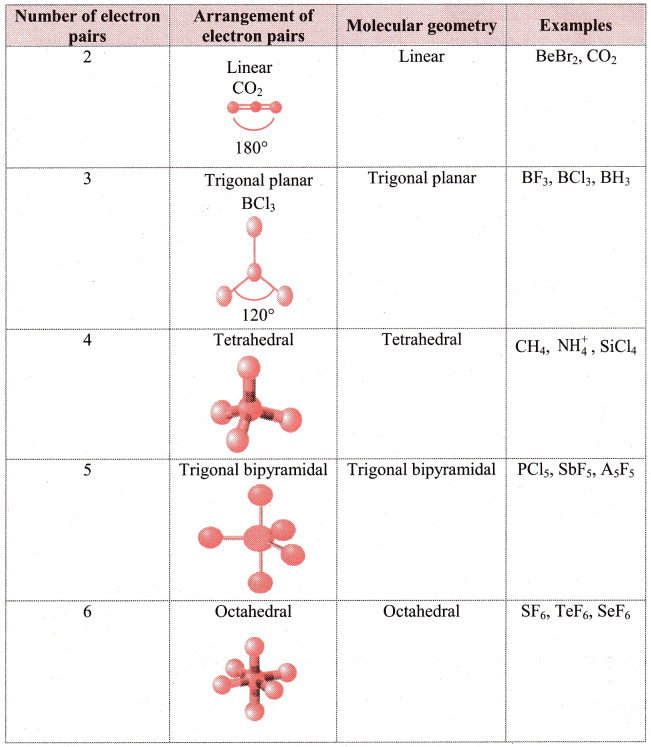
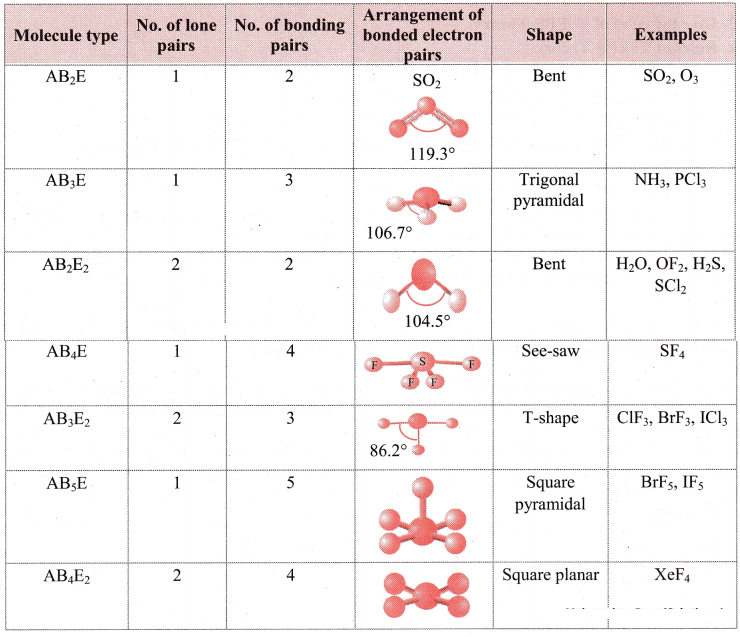
Note:
i. Electron pair geometry: The arrangement of electrons around the central atom is called as electron pair geometry. These electron pairs may be shared in a covalent bond or they may be lone pairs.
ii. Geometry of some molecules (having no lone pair of electrons):
Image

iii. Geometry of some molecules (having one or more lone pairs of electrons):
Image
View full question & answer
Question 176 Marks
Give the limitations of octet rule:
Answer
Limitations of octet rule:
$i.$ Octet rule does not explain stability of some molecules.
The octet rule is based on the inert behaviour of noble gases, which have their octet complete i.e., have eight electrons in their valence shell. It is very useful to explain the structures and stability of organic molecules. However, there are many molecules whose existence cannot be explained by the octet theory. The central atoms in these molecules does not have eight electrons in their valence shell, and yet they are stable.
Such molecules can be categorized as having:
$a.$ Incomplete octet
$b.$ Expanded octet
$c.$ Odd electrons
$a.$ Molecules with incomplete octet: e.g. $BF_3, BeCl_2, LiCl$
In these covalent molecules, the atoms $B, Be$ and $Li$ have less than eight electrons in their valence shell but these molecules are stable.
$Li \ in \ LiCl$ has only two electrons, $Be$  in $BeCl_2$ has four electrons while $B$ in $BF_3$ has six electrons in the valence shell.
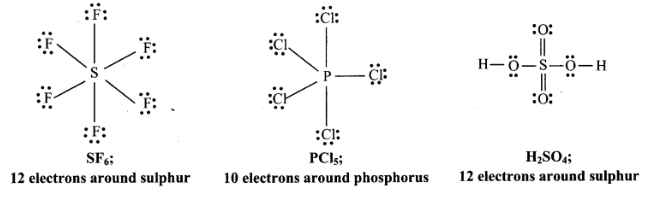
$b.$ Molecules with expanded octet: Some molecules like $SF_6, PCl_5, H_2SO_4$ have more than eight electrons around the central atom.
Image
$c.$ Odd electron molecules:
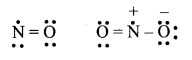
Some molecules like $NO ($nitric oxide$)$ and  $NO_2 ($nitrogen dioxide$)$ do not obey the octet rule. These molecules, have odd number of valence electrons.
Image
$ii.$ The observed shape and geometry of a molecule, cannot be explained, by the octet rule.
$iii.$ Octet rule fails to explain the difference in energies of molecules, though all the covalent bonds are formed in an identical manner, that is, by sharing a pair of electrons. The rule fails to explain the differences in reactivities of different molecules.
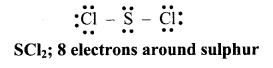
Note: Sulphur also forms many compounds in which octet rule is obeyed. For example, in sulphur dichloride, the sulphur atom has eight electrons around it.
Image
View full question & answer
Question 186 Marks
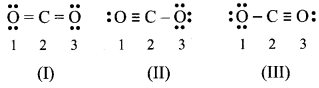
$CO_2$ can be represented by following three structures:
Image
Calculate the formal charge on each atom in all the three structures of $CO_2$ molecule. Identify the structure with lowest energy.
Answer
Formal charges on atoms labelled as $1, 2, 3$ are calculated as shown below:
Structure $(I):$
Number of atom Total number of electrons in free atom $(V.E.)$ Total number of non-bonding electrons $(N.E.)$ Total number of shared electrons in bond $(B.E.)$ Formal charge
$\text { F.C } =(\text { V.E. })-(\text { N.E.) })-\frac{1}{2} \text { (B.E. })$
$1$ $6$ $4$ $4$ $F.C =6-4-\frac{1}{2}(4)=0$
$2$ $4$ $0$ $8$ $F.C =4-0-\frac{1}{2}(8)=0$
$3$ $6$ $4$ $4$ $F.C =6-4-\frac{1}{2}(4)=0$
Structure $(II):$
Number of atom Total number of electrons in free atom $(V.E.)$ Total number of non-bonding electrons $(Ν.Ε.)$ Total number of shared electrons in bond $(B.E.)$ Formal charge
$\text { F. } C=(\text { V.E. })-(\text { N.E. })-\frac{1}{2} \text { (B.E. })$
$1$ $6$ $2$ $6$ $F.C =6-2-\frac{1}{2}(6)=+1$
$2$ $4$ $0$ $8$ $F.C =4-0-\frac{1}{2}(8)=0$
$3$ $6$ $6$ $2$ $F.C =6-6-\frac{1}{2}(2)=-1$
Structure $(III):$
Number of atom Total number of electrons in free atom $(V.E.)$ Total number of non-bonding electrons $(Ν.Ε.)$ Total number of shared electrons in bond $(B.E.)$ Formal charge
$\text { F. } C=(\text { V.E. })-(\text { N.E. })-\frac{1}{2} \text { (B.E. })$
$1$ $6$ $6$ $2$ $F.C =6-6-\frac{1}{2}(2)=-1$
$2$ $4$ $0$ $8$ $F.C =4-0-\frac{1}{2}(8)=0$
$3$ $6$ $2$ $6$ $F.C =6-2-\frac{1}{2}(6)=+1$
While determining the best Lewis structure per molecule, the structure is chosen such that the formal charge is as close to zero as possible. The structure having the lowest formal charge has the lowest energy.
In structure $(I),$ the formal charge on each atom is $0$ while in structures $(II)$ and $(III)$ formal charge on carbon is $0$ while oxygens have formal charge $-1 \ or \ +1.$ Hence, the possible structure with the lowest energy will be structure $(I).$ Thus, formal charges help in the selection of the lowest energy structure from a number of possible Lewis structures for a given species.
View full question & answer
Question 196 Marks
Explain the calculation of the formal charge on oxygen atoms in case of $O_3 ($ozone$)$ molecule.
Answer
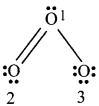
$i.$ Lewis dot structure of $O_3 ($ozone$)$ molecule is:
Image
Three oxygen atoms are present in the $O_3$ molecule and are labelled as $1, 2$ and $3.$
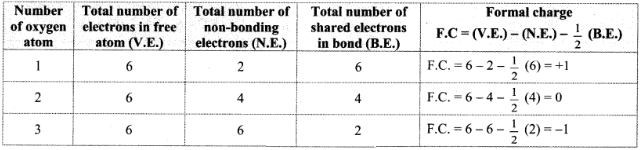
$ii.$ Formal charges on oxygen atoms labelled as $1, 2, 3$ are calculated as shown below:
Image$iii.$ On the basis of the formal charge values, $O_3$ is shown as
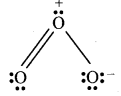
Image$[$Note: Indicating the charges on the atoms in the Lewis structure helps in keeping track of the valence electrons in the molecule. Formal charges help in the selection of the lowest energy structure from a number of possible Lewis structures for a given species.$]$
View full question & answer
Question 206 Marks
Distinguish between ionic bond and covalent bond.
Answer
Ionic bond:
$1.$It is formed by the transfer of electrons from one atom to another.
$2.$It is formed by the transfer of electrons from one atom to another.
$3.$In this, oppositely charged ions are formed.
$4.$There are no multiple ionic bonds.
$5.$This bond usually exists between metal and non$-$metal atoms.
e.g. $NaCl, CaCl_2$
Covalent bond:
$1.$It is formed by sharing of electrons.
$2.$Atoms are held together due to shared pair of electrons.
$3.$In this, oppositely charged ions are not formed.
$4.$Covalent bonds may be single or double or triple bonds.
$5.$This bond usually exists between non$-$metal atoms.
e.g. $H_2, Cl_2$
View full question & answer
Question 216 Marks
Explain the types of covalent bond with suitable examples.
Answer
The three types of covalent bonds are as follows.
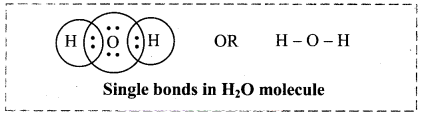
$i.$ Single bond: When two combining atoms share one electron pair, the covalent bond between them is called single bond.
Single bond is observed in number of molecules.
e.g. $H_2, Cl_2,$ water molecule, etc.
Image
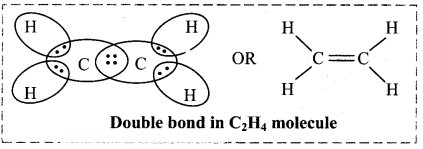
$ii.$ Double bond: When two combining atoms share two pairs of electrons, the covalent bond between them is called a double bond, e.g. Double bond is present in $C_2H_4$ molecule
Image
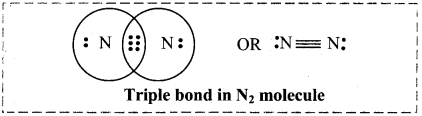
$iii.$ Triple bond: When two combining atoms share three pairs of electrons, the covalent bond between them is called a triple bond, e.g. Triple bond is present in $N_2$ molecule.
Image
Note: Formation of covalent bonds in $CO_2, CCl_4 \ and \ C_2H_2:$
Image
View full question & answer