Question
Give the structural differences between saturated and unsaturated hydrocarbons with two examples, each.

Answer

Saturated hydrocarbons or alkanes contain either C—C or C—H bonds in their molecules. These are represented by the general formula CnH2n + 2 For example,

$\ \ \ \ \ \ \ \ \text{H}\ \ \ \ \ \text{H}\\\ \ \ \ \ \ \ \ \ |\ \ \ \ \ \ \ |\\\text{H}-\text{C}-\text{C}-\text{H}\\\ \ \ \ \ \ \ \ \ |\ \ \ \ \ \ \ |\\\ \ \ \ \ \ \ \ \text{H}\ \ \ \ \ \text{H}\\\ \ \ \ \ \ \ \ \text{Ethane}$  $\ \ \ \ \ \ \ \text{H}\ \ \ \ \ \text{H}\ \ \ \ \ \text{H}\\\ \ \ \ \ \ \ \ |\ \ \ \ \ \ \ |\ \ \ \ \ \ \ |\\\text{H}-\text{C}-\text{C}-\text{C}-\text{H}\\\ \ \ \ \ \ \ \ \ |\ \ \ \ \ \ |\ \ \ \ \ \ \ |\\\ \ \ \ \ \ \ \ \text{H}\ \ \ \ \text{H}\ \ \ \ \ \ \text{H}\\\ \ \ \ \ \ \ \ \ \ \text{Propane}$

Unsaturated hydrocarbons contain either atleast one >C = C< bond or triple —C ≡ C— bond in their molecules. These may be either alkenes or alkynes in nature. The general formula of alkenes is CnH2n while that of alkynes is CnH2n - 2 for example,

$\ \ \ \ \ \ \ \ \text{H}\ \ \ \ \ \text{H}\\\ \ \ \ \ \ \ \ \ |\ \ \ \ \ \ \ |\\\text{H}-\text{C}=\text{C}-\text{H}\\\ \ \ \ \text{Ethene}$  $\ \ \ \ \ \ \ \ \text{H}\\\ \ \ \ \ \ \ \ \ |\\\text{H}-\text{C}-\text{C}=\text{C}-\text{H}\\\ \ \ \ \ \ \ \ \ |\ \ \ \ \ \ \ |\ \ \ \ \ \ \ |\\\ \ \ \ \ \ \ \ \text{H}\ \ \ \ \ \text{H}\ \ \ \ \ \ \text{H}\\\ \ \ \ \ \ \ \ \text{Propene}$  $\text{H}-\text{C}\equiv\text{C}-\text{H}\\\ \ \ \ \ \ \text{Ethyne}$  $\ \ \ \ \ \ \ \ \text{H}\\\ \ \ \ \ \ \ \ \ |\\\text{H}-\text{C}-\text{C}\equiv\text{C}-\text{H}\\\ \ \ \ \ \ \ \ \ |\\\ \ \ \ \ \ \ \ \text{H}\\\ \ \ \ \text{Propyne}$

Need a full question paper?

Generate a complete, print-ready paper with questions like this in minutes — across 16+ boards, with answer keys.
Start Generating Free

Similar questions

An organic compound A with molecular form C4H8O2 on alkaline hydrolysis gives two compound B and C. C on acidification with dil. HCl gives D. Oxidation of B with K2Cr2O7/ H2SO4 also gives D. Identify A, B, C and D and explain all the reactions involved.
When a black metal compound XO is heated with a colourless gas Y2, then metal X and another compound Y2O are formed. Metal X is red-brown in colour which does not react with dilute acids at all. Gas Y2 can be prepared by the action of a dilute acid on any active metal. The compound Y2O is a liquid at room temperature which can turn anhydrous copper sulphate blue.
  1. What do you think is metal X?
  2. What could be gas Y2?
  3. What is compound XO?
  4. What is compound Y2O?
  5. Write the chemical equation of the reaction which takes place on heating XO with Y2.
  6. What type of chemical reaction is illustrated in the above equation?
i. Name a commercially important carbon compound having functional group - OH and write its molecular formula.
ii. Write chemical equation to show its reaction with
1. Sodium metal
2. Excess conc. sulphuric acid
3. Ethanoic acid in the presence of an acid catalyst
4. Acidified potassium dichromate
iii. Also write the name of the product formed in each case.
An element X which is a yellow solid at room temperature shows catenation and allotropy. X forms two oxides which are also formed during the thermal decomposition of ferrous sulphate crystals and are the major air pollutants.
  1. Identify the element X.
  2. Write the electronic configuration of X.
  3. Write the balanced chemical equation for the thermal decomposition of ferrous sulphate crystals?
  4. What would be the nature (acidic/ basic) of oxides formed?
  5. Locate the position of the element in the Modern Periodic Table.
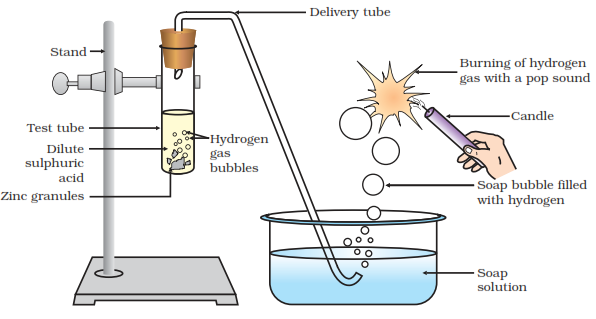
In the following schematic diagram for the preparation of hydrogen gas as shown in Figure, what would happen if following changes are made?

  1. In place of zinc granules, same amount of zinc dust is taken in the test tube.
  2. Instead of dilute sulphuric acid, dilute hydrochloric acid is taken.
  3. In place of zinc, copper turnings are taken.
  4. Sodium hydroxide is taken in place of dilute sulphuric acid and the tube is heated.
Consider the following organic compounds:
CH3OH, C2H5OH, CH3COCH3, CH3COOH, C2H5COOH, C4H9COOC2H5, CH4, C2H6, CH3CHO, HCHO
Out of these compounds:
  1. Which compound is most likely to be sweet-smelling?
  2. Which compound on treatment with conc. H2SO4 at 170°C forms an alkene?
  3. Which compound on repeated chlorination forms chloroform?
  4. Which compound is added to alcohol to denature it?
  5. Which compound is a constituent of vinegar?
  6. Which compound is used to sterilise wounds and syringes?
State the reason why carbon can neither form $\text{C}^{4+}$ cations nor $\text{C}^{4-}$ anions, but forms covalent compounds. Also state reasons to explain why covalent compounds:
  1. Are bad conductors of electricity?
  2. Have low melting and boiling points?
The white solid compound A decomposes quite rapidly on heating in the presence of a black substance X to form a solid compound B and a gas C. When an aqueous solution of compound B is reacted with silver nitrate solution, then a white precipitate of silver chloride is obtained along with potassium nitrate solution. Gas C does not burn itself but helps burn other things.
  1. What is compound A?
  2. What is compound B?
  3. What is gas C?
  4. What do you think is the black substance X? What is its function?
  5. What is the general name of substances like X?
What is meant by refining of a metals? Name the most widely used method of refining impure metals produced by various reduction processes. Describe with the help of a labelled diagram how this method may be used for refining of copper.
You are given the following molecular formulae of some hydrocarbons:
C5H8; C7H14; C6H6; C5H10; C7H12; C6H12
  1. Which formula represent cyclohexane as well as hexene?
  2. Which formula represents benzene?
  3. Which three formulae represent open chain unsaturated hydrocarbons having double bonds?
  4. Which two formulae represent unsaturated hydrocarbons having triple bonds?
  5. Which three formulae can represent cyclic hydrocarbons?