Question types

Carbon and its Compounds question types

147 questions across 10 question groups — pick any mix to generate a Science paper with step-by-step answer keys.

147
Questions
10
Question groups
5
Question types
Sample Questions

Carbon and its Compounds questions

One sample from each question group in this chapter. Select any group above to see the full set with answer keys.

Q 1M.C.Q1 Mark
Which of the following are correct structural isomers of butane?
  • A
    $1$ and $3$
  • B
    $2$ and $4$
  • $1$ and $2$
  • D
    $3$ and $4$

Answer: C.

View full solution
Q 2M.C.Q1 Mark
$\text{CH}_3\text{CH}_2\text{OH}\xrightarrow[\text{Heat}]{\text{Alkaline KMnO}_4}\text{CH}_3\text{COOH}$In the above given reaction, alkaline $KMnO_4$ acts as:
  • A
    Reducing agent.
  • Oxidising agent.
  • C
    Catalyst.
  • D
    Dehydrating agent.

Answer: B.

View full solution
Q 3M.C.Q1 Mark
The name of the compound $\text{CH}_3-\text{CH}_2-\text{CHO}$ is:
  • Propanal.
  • B
    Propanone.
  • C
    Ethanol.
  • D
    Ethanal.

Answer: A.

View full solution
Q 4M.C.Q1 Mark
In the soap micelles:
  • The ionic end of soap is on the surface of the cluster while the carbon chain is in the interior of the cluster.
  • B
    Ionic end of soap is in the interior of the cluster and the carbon chain is out of the cluster.
  • C
    Both ionic end and carbon chain are in the interior of the cluster.
  • D
    Both ionic end and carbon chain are on the exterior of the cluster.

Answer: A.

View full solution
Q 5M.C.Q1 Mark
The heteroatoms present in $\text{CH}_3-\text{CH}_2-\text{O}-\text{CH}_2-\text{CH}_2\text{Cl}$ are :
  1. Oxygen.
  2. Carbon.
  3. Hydrogen.
  4. Chlorine.
  • A
    $1$ and $2$
  • B
    $2$ and $3$
  • C
    $3$ and $4$
  • $1$ and $4$

Answer: D.

View full solution
Which of the following statements are usually correct for carbon compounds? These:
  1. Are good conductors of electricity.
  2. Are poor conductors of electricity.
  3. Have strong forces of attraction between their molecules.
  4. Do not have strong forces of attraction between their molecules.
  1. 1 and 3
  2. 2 and 3
  3. 1 and 4
  4. 2 and 4
View full solution
Which of the following represents saponification reaction?

  1. $\text{CH}_3\text{COOHNa}+\text{NaOH}\xrightarrow{\text{CaO}}\text{CH}_4+\text{Na}_2\text{CO}_3$

  2. $2\text{CH}_3\text{COOH}+\text{C}_2\text{H}_5\text{OH}\xrightarrow{\text{H}_2\text{SO}_4}\text{CH}_3\text{COOC}_2\text{H}_5+\text{H}_2\text{O}$

  3. 2CH3COOH + 2Na → 2CH3COONa + H2

  4. CH3COOC2H5 + NaOH → CH3COONa + C2H5OH

View full solution
Which of the following is not a straight chain hydrocarbon?

  1. $\text{H}_3\text{C}-\text{CH}_2-\text{CH}_2-\text{CH}_2-\text{CH}_2\\ \ \ \ \ \ \ \ \ \ \ \ \ \ \ \ \ \ \ \ \ \ \ \ \ \ \ \ \ \ \ \ \ \ \ \ \ \ \ \ \ \ \ \ \ \ \ \ \ \ \ \ |\ \\ \ \ \ \ \ \ \ \ \ \ \ \ \ \ \ \ \ \ \ \ \ \ \ \ \ \ \ \ \ \ \ \ \ \ \ \ \ \ \ \ \ \ \ \ \ \ \ \ \ \ \text{CH}_3$

  2. $\text{H}_3\text{C}-\text{CH}_2-\text{CH}_2-\text{CH}_2-\text{CH}_2-\text{CH}_3$

  3. $\ \ \ \ \ \text{CH}_3\\ \ \ \ \ \ \ |\\\text{H}_2\text{C}-\text{H}_2\text{C}-\text{H}_2\text{C}-\text{CH}_2\\ \ \ \ \ \ \ \ \ \ \ \ \ \ \ \ \ \ \ \ \ \ \ \ \ \ \ \ \ \ \ \ \ \ \ \ \ \ \ |\\ \ \ \ \ \ \ \ \ \ \ \ \ \ \ \ \ \ \ \ \ \ \ \ \ \ \ \ \ \ \ \ \ \ \ \ \ \ \text{CH}_3$
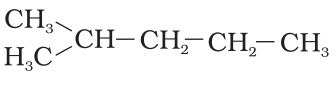
  4.  

View full solution
Write the names of the following compound.$\ \ \ \ \ \ \ \ \text{H}\ \ \ \ \ \text{H}\ \ \ \ \ \text{H}\ \ \ \ \text{H}\ \ \ \ \ \text{O}\\ \ \ \ \ \ \ \ \ \ |\ \ \ \ \ \ |\ \ \ \ \ \ \ |\ \ \ \ \ \ \ |\ \ \ \ \ \ ||\\\text{H}-\text{C}-\text{C}-\text{C}-\text{C}-\text{C}-\text{OH}\\\ \ \ \ \ \ \ \ \ |\ \ \ \ \ \ \ |\ \ \ \ \ \ |\ \ \ \ \ \ \ |\\\ \ \ \ \ \ \ \ \text{H}\ \ \ \ \ \text{H}\ \ \ \ \ \text{H}\ \ \ \ \ \text{H}$
View full solution
Identify and name the functional groups present in the following compound.$ \ \ \ \ \ \ \ \ \text{H}\ \ \ \ \ \text{H}\ \ \ \ \ \text{H}\\ \ \ \ \ \ \ \ \ \ |\ \ \ \ \ \ |\ \ \ \ \ \ \ |\\\text{H}-\text{C}-\text{C}-\text{C}-\text{OH}\\\ \ \ \ \ \ \ \ \ |\ \ \ \ \ \ \ |\ \ \ \ \ \ |\\\ \ \ \ \ \ \ \ \text{H}\ \ \ \ \ \text{H}\ \ \ \ \ \text{H}$
View full solution
Write the names of the following compound.$\ \ \ \ \ \ \ \ \text{H}\ \ \ \ \ \text{H}\ \ \ \ \ \text{H}\ \ \ \ \text{H}\ \ \ \ \ \text{H}\\ \ \ \ \ \ \ \ \ \ |\ \ \ \ \ \ |\ \ \ \ \ \ \ |\ \ \ \ \ \ \ |\ \ \ \ \ \ |\\\text{H}-\text{C}-\text{C}-\text{C}-\text{C}-\text{C}-\text{OH}\\\ \ \ \ \ \ \ \ \ |\ \ \ \ \ \ |\ \ \ \ \ \ \ |\ \ \ \ \ \ \ |\ \ \ \ \ \ |\\\ \ \ \ \ \ \ \ \text{H}\ \ \ \ \ \text{H}\ \ \ \ \ \text{H}\ \ \ \ \ \text{H}\ \ \ \ \text{H}$
View full solution
Write the names of the following compound.

$\ \ \ \ \ \ \ \ \text{H}\ \ \ \ \ \text{H}\ \ \ \ \ \text{H}\ \ \ \ \text{H}\ \ \ \ \ \text{O}\\ \ \ \ \ \ \ \ \ \ |\ \ \ \ \ \ |\ \ \ \ \ \ \ |\ \ \ \ \ \ \ |\ \ \ \ \ \ ||\\\text{H}-\text{C}-\text{C}-\text{C}-\text{C}-\text{C}-\text{OH}\\\ \ \ \ \ \ \ \ \ |\ \ \ \ \ \ \ |\ \ \ \ \ \ |\ \ \ \ \ \ \ |\\\ \ \ \ \ \ \ \ \text{H}\ \ \ \ \ \text{H}\ \ \ \ \ \text{H}\ \ \ \ \ \text{H}$

View full solution
Write the names of the following compound.

$\ \ \ \ \ \ \ \ \text{H}\ \ \ \ \ \text{H}\ \ \ \ \ \text{H}\ \ \ \ \text{H}\ \ \ \ \ \text{H}\ \ \ \ \ \text{H}\ \ \ \ \ \text{H}\\\ \ \ \ \ \ \ \ \ |\ \ \ \ \ \ |\ \ \ \ \ \ \ |\ \ \ \ \ \ |\ \ \ \ \ \ \ |\ \ \ \ \ \ \ |\ \ \ \ \ \ \ |\\\text{H}-\text{C}-\text{C}-\text{C}-\text{C}-\text{C}-\text{C}-\text{C}=\text{O}\\\ \ \ \ \ \ \ \ \ |\ \ \ \ \ \ |\ \ \ \ \ \ \ |\ \ \ \ \ \ \ |\ \ \ \ \ \ |\ \ \ \ \ \ \ |\\\ \ \ \ \ \ \ \ \text{H}\ \ \ \ \text{H}\ \ \ \ \ \ \text{H}\ \ \ \ \ \text{H}\ \ \ \ \text{H}\ \ \ \ \ \text{H}$

View full solution
Write the names of the following compound.

$\ \ \ \ \ \ \ \ \text{H}\ \ \ \ \ \text{H}\ \ \ \ \ \text{H}\ \ \ \ \text{H}\ \ \ \ \ \text{H}\\ \ \ \ \ \ \ \ \ \ |\ \ \ \ \ \ |\ \ \ \ \ \ \ |\ \ \ \ \ \ \ |\ \ \ \ \ \ |\\\text{H}-\text{C}-\text{C}-\text{C}-\text{C}-\text{C}-\text{OH}\\\ \ \ \ \ \ \ \ \ |\ \ \ \ \ \ |\ \ \ \ \ \ \ |\ \ \ \ \ \ \ |\ \ \ \ \ \ |\\\ \ \ \ \ \ \ \ \text{H}\ \ \ \ \ \text{H}\ \ \ \ \ \text{H}\ \ \ \ \ \text{H}\ \ \ \ \text{H}$

View full solution
Write the names of the following compound.

$\ \ \ \ \ \ \ \ \text{H}\ \ \ \ \ \text{H}\ \ \ \ \ \\\ \ \ \ \ \ \ \ \ |\ \ \ \ \ \ |\ \ \ \ \ \ \ \\\text{H}-\text{C}-\text{C}-\text{C}\equiv\text{C}-\text{H}\\ \ \ \ \ \ \ \ \ \ |\ \ \ \ \ \ |\\ \ \ \ \ \ \ \ \ \text{H}\ \ \ \ \ \text{H}$

View full solution
Carbon, Group (14) element in the Periodic Table, is known to form compounds with many elements.
Write an example of a compound formed with,
  1. Chlorine (Group 17 of Periodic Table)
  2. Oxgygen (Group 16 of Periodic Table)
View full solution
Ethene is formed when ethanol at 443K is heated with excess of concentrated sulphuric acid. What is the role of sulphuric acid in this reaction? Write the balanced chemical equation of this reaction.
View full solution
Unsaturated hydrocarbons contain multiple bonds between the two C-atoms and show addition reactions. Give the test to distinguish ethane from ethene.
View full solution
Ethene is formed when ethanol at 443K is heated with excess of concentrated sulphuric acid. What is the role of sulphuric acid in this reaction? Write the balanced chemical equation of this reaction.
View full solution

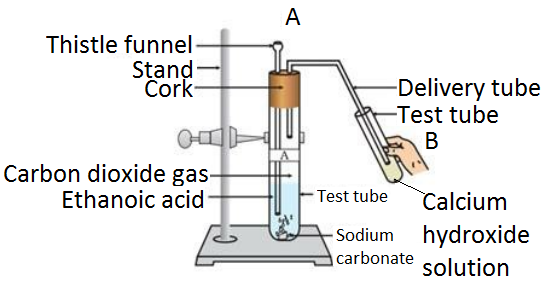
Look at Figure and answer the following questions:
  1. What change would you observe in the calcium hydroxide solution taken in tube B?
  2. Write the reaction involved in test tubes A and B respectively.
  3. If ethanol is given instead of ethanoic acid, would you expect the same change?
  4. How can a solution of lime water be prepared in the laboratory?
View full solution

Generate a Carbon and its Compounds paper free

Pick question groups from the list above, set marks and difficulty, and export a branded PDF with step-by-step answer keys. First 3 chapters free — no signup.

Download App