Question
Give the uses of Carbon dioxide.

Answer

Uses of Carbon dioxide are:
  • $CO _2$ is used to make aerated drinks
  • Solid carbon dioxide is used in cold storage and also to keep milk and milk products and frozen substances cool during transport. It is also used for getting special effects of a mist in dramas and movies.
  •  $CO _2$ obtained by chemical reaction or kept under pressure is used in fire extinguishers.
  •  Liquified $CO _2$ is used to remove caffeine from coffee.
  • Liquid $CO _2$ is used as solvent in modern eco-friendly dry cleaning.
  • Plants use $CO _2$ in air for photosynthesis.

Need a full question paper?

Generate a complete, print-ready paper with questions like this in minutes — across 16+ boards, with answer keys.
Start Generating Free

Similar questions

Give the uses of radioactive isotopes in ceramic articles.
The total energy of an object falling freely towards the ground …
Sometimes, you may notice a black powder or white discs floating on the pickle or murabba, when a jar is opened after a long time. What exactly is this? Why are such food items not good to eat?
An electric pump has $2$ kW power. How much water will the pump lift every minute to a height of $10\ m$?
(Ans : $1224.5\ kg$)
explain the statement : Fuse used in electrical circuit can save electrical objects from damage.
What are the important substances that we use in day to day life? For what purposes do we use them?
How is first aid provided to victims of disasters who are injured ?
:Fit a bent tube in a rubber cork. Take some lime water in a test tube and keep it handy. Take some baking soda in another test tube and add some lemon juice to it. Immediately fit the bent tube over it. Insert its other end into the lime water. Note down your observations of both the test tubes. Repeat the procedure using washing soda, vinegar and dilute HC1 properly. What do you see?
A current of 0.24 A flows through a conductor when a potential difference of 24 V is applied between its two ends. What is its resistance?
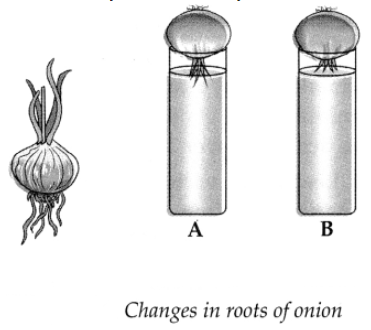
As shown in the figure, place an onion on each gas jar in such a way that its base (roots) will remain dipped in water. Measure and record the length of the roots of both onions on the first, second and third day. On the fourth day, cut off 1 cm of the roots of the onion in flask B Measure the length of the roots of both onions for the next five days and record your observations in the following table.

Image
Length (cm)Day 1Day 2Day 3Day 4Day 5
Flask A
Flask B