Questions

Answer the following question.

Take a timed test

21 questions · self-marked practice — reveal the answer and mark yourself.

Question 13 Marks
What is allotropy?
Answer
  • Allotropy – Some elements occur in nature in more than one form.
  • The chemical properties of these different forms are the same but their physical properties are different.
  • This property of elements is called allotropy.
View full question & answer
Question 23 Marks
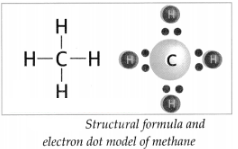
How is methane formed? Give structural formula and electron dot model of methane.
Answer
  • Atomic number of carbon is $6$. The electronic configuration of carbon is $(2, 4)$. The valency of carbon is $4$.
  • Carbon atom can form four covalent bonds with other carbon atoms or atoms of different elements.
  • When a carbon atom shares one electron each with four hydrogen atoms and forms four C-H bonds, a methane $(CH_4)$ molecule is formed.
Image
View full question & answer
Question 33 Marks
Give the uses of methane.
Answer
  • Methane in the form of natural gas is used in industries such as fabric mills, paper mills, food processing industry, petrol purification.
  • Being the smallest hydrocarbon, the proportion of $CO_2$​​​​​​​ released in the combustion of methane is small and, therefore, it is used as a domestic fuel.
  • Methane is used for production of organic compounds such as ethanol, methyl chloride, methylene chloride and acetylene.
View full question & answer
Question 43 Marks
Give the physical properties of methane.
Answer
  • Melting point of methane is (-182.5 °C).
  • Boiling point of methane is (-161.5 °C).
  • It is a colourless gas.
  • The density of liquid methane is less than that of water.
  • Methane is sparingly soluble in water. It is highly soluble in organic solvents like gasoline, ether and alcohol.
  • Methane is in gaseous state at room temperature.
View full question & answer
Question 53 Marks
Give the occurrence of methane.
Answer
  • Methane occurs in natural gas to the extent of 87%.
  • Decomposition of organic matter in the absence of air (anaerobic) produces methane.
  • Methane is present in biogas.
  • Methane is found in coal mines.
  • Methane is found at the surface of marshy places which is why it is also called marsh gas.
  • On heating a mixture of hydrogen and carbon monoxide gases at 300 °C in the presence of nickel (catalyst), methane gas is formed.
  • Fractional distillation of natural gas gives methane in pure form.
View full question & answer
Question 63 Marks
Give the uses of Carbon dioxide.
Answer
Uses of Carbon dioxide are:
  • $CO _2$ is used to make aerated drinks
  • Solid carbon dioxide is used in cold storage and also to keep milk and milk products and frozen substances cool during transport. It is also used for getting special effects of a mist in dramas and movies.
  •  $CO _2$ obtained by chemical reaction or kept under pressure is used in fire extinguishers.
  •  Liquified $CO _2$ is used to remove caffeine from coffee.
  • Liquid $CO _2$ is used as solvent in modern eco-friendly dry cleaning.
  • Plants use $CO _2$ in air for photosynthesis.
View full question & answer
Question 73 Marks
Give the physical and chemical properties of carbon dioxide.
Answer
Physical properties of carbon dioxide are:

  • It is an odourless gas.
  • It is a colourless gas.

Chemical properties of carbon dioxide are:

  • It is non-combustible and does not support combustion.
  • It turns lime water milky.
  • It is fairly soluble in water and dissolves in water forming carbonic acid.
  • It turns blue litmus red indicating it is acidic in nature.
  • The colour of universal indicator turns orange/ yellow in C02 indicating its pH value between 4 and 6, i.e. acidic in nature.
View full question & answer
Question 83 Marks
What are unsaturated hydrocarbons? Give examples.
Answer
  • Some hydrocarbons have a multiple bond between two carbon atoms.
  • A multiple bond can be a double bond or a triple bond.
  • Hydrocarbons having at least one multiple bond are called unsaturated hydrocarbons.
  • For example, ethene $(H_2C = CH_2)$, ethyne $(HC = CH)$, propene $(CH_3– CH = CH_2)$, propyne $(CH_3– C = CH).$
View full question & answer
Question 93 Marks
What are saturated hydrocarbons? Give examples.
Answer
  • The hydrocarbons having only single bonds between carbon atoms are called saturated hydrocarbons.
  • For example, ethane $(C_2H_6)$ which is $(CH_3 – CH_3)$, propane $(C_3H_8)$ which is $(CH_3 – CH_2 – CH_3)$.
View full question & answer
Question 103 Marks
Give the properties of covalent compounds.
Answer

  • Covalent compounds have low melting points and boiling points.
  • Generally they are insoluble in water and soluble in organic solvents.
  • They are poor conductors of heat and electricity.
View full question & answer
Question 113 Marks
Name the types of coal and give the differences in them.
Answer
Points of differencesPeatLigniteBitumi-nousAnthracite
(1)Formation step numberFirstSecondThirdLast
(2)Carbon contentLessthan60%60%to70%70%to90%about95%
(3)Heat producedLowest of all the restMore than peat but less than bituminousMore than lignite but less than anthraciteHighest of all the rest
View full question & answer
Question 123 Marks
Give the uses of Coke.
Answer
  • Used as domestic fuel.
  • Coke is used as a reducing agent.
  • Coke is used in production of water gas $(CO + H_2)$ and producer gas $(CO + H_2 + CO_2 + N_2)$
View full question & answer
Question 133 Marks
What is Coal?
Answer
  • Coal is a fossil fuel. It contains carbon, hydrogen and oxygen.
  • It also contains nitrogen, phosphorus and sulphur.
  • It occurs in the solid state. It is of four types – peat, lignite, bituminous and anthracite.
View full question & answer
Question 143 Marks
Give the uses of graphite.
Answer
  • Graphite is used for making lubricants.
  • Graphite is used for making carbon electrodes.
  • Graphite is used in pencils for writing.
  • Graphite is used in paints and polish.
  • Graphite is used in arc lamps which gives a very bright light.
View full question & answer
Question 153 Marks
Give the properties of graphite.
Answer
  • Graphite found in nature is black, soft, brittle and slippery.
  • Inside each layer of graphite, free electrons move continuously within the entire layer. That is why graphite is a good conductor of electricity.
  • Due to the layered structure graphite can be used for writing on paper.
  • The density of graphite is 1.9 to 2.3 g/cm3.
  • Graphite does not dissolve in most solvents.
View full question & answer
Question 163 Marks
With neat diagram explain the structure of graphite?
Answer
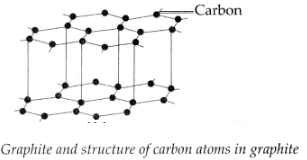
  • Every carbon atom in graphite is bonded to three other carbon atoms in such a way that a hexagonal layered structure is formed.
  • A graphite crystal is made of many sheets or layers of carbon atoms.
  • These layers slip over each other on applying pressure.
  • One layer of graphite is called graphene.
  •  
Image
View full question & answer
Question 173 Marks
With neat diagram explain the structure of diamond.
Answer
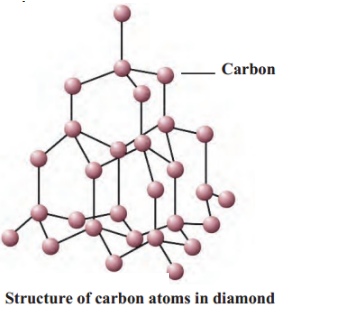
  • In diamond, every carbon atom is bonded to four neighbouring atoms by covalent bonds.
  • Therefore, diamond has a tetragonal three dimensional structure which makes it very hard.
  •  
Image
View full question & answer
Question 183 Marks
What was the contribution of chemist Wohier in organic chemistry?
Answer
  • The German chemist Wohier synthesized an organic compound urca from an inorganic compound ammonium cyanate,
  • Ever since then, many organic compounds have been made from inorganic compounds.
  • Carbon was found to he the main element in all these compounds.
  • Hence, organic chemistry is also referred to as chem is try of carbon corn pounds.
View full question & answer
Question 193 Marks
Write the uses of the diamond.
Answer
  • Diamonds are used in glass cutting and rock drilling machines.
  • Diamonds are used in ornaments.
  • Diamond knives are used in the eye surgery.
  • Diamond dust is used for polishing other diamonds.
  • Diamond is used to make windows giving protection from radiation in space and in artificial satellites.
View full question & answer
Question 203 Marks
In which compound forms does carbon occur?
Answer
  • Carbon dioxide and in the form of carbonates such as calcium carbonate, marble, calamine $(ZnCO_3).$
  • Fossil fuel – coal, petroleum, natural gas.
  • Carbonaceous nutrients – carbohydrates, proteins, fats.
  • Natural fibres – cotton, wool, silk.
  • Hydrocarbons – compound of carbon and hydrogen.
View full question & answer
Question 213 Marks
Why are carbon and its compounds used as fuels?
Answer
(i) The name ‘carbon’ is derived from Latin word ‘carbo’meaning coal. In the earth’s crust, carbon is present to an extent of approximately $0.27$% in the form of carbonate, coal and petroleum. One of the non-crystalline and amorphous form of carbon is coal. Coal is a fossil fuel.(ii) Peat, lignite, bituminous and anthracite are the four types of coal in the increasing order of their carbon content and heat produced respectively. Charcoal and coke are the other amorphous forms of carbon used as fuel.
(iii) Compounds of carbon such as hydrocarbons consist of carbon and hydrogen and they are easily combustible. For example, methane $(CH_4)$ which occurs in natural gas is highly inflammable. It bums by reacting with oxygen to give a bluish flame. In this reaction, $213$ Kcal/mol of heat is given out. Methane bums completely.
Chemical reaction:
$CH_4 + 2O_2 → CO_2 + 2H_2O + Heat$
(iv) Thus when hydrocarbons are burnt in air, large amount of heat is evolved with formation of carbon dioxide $(CO_2)$ and water $(H_2O)$. Due to evolution of heat on combustion, carbon and its compounds are used as fuels.
View full question & answer