Question
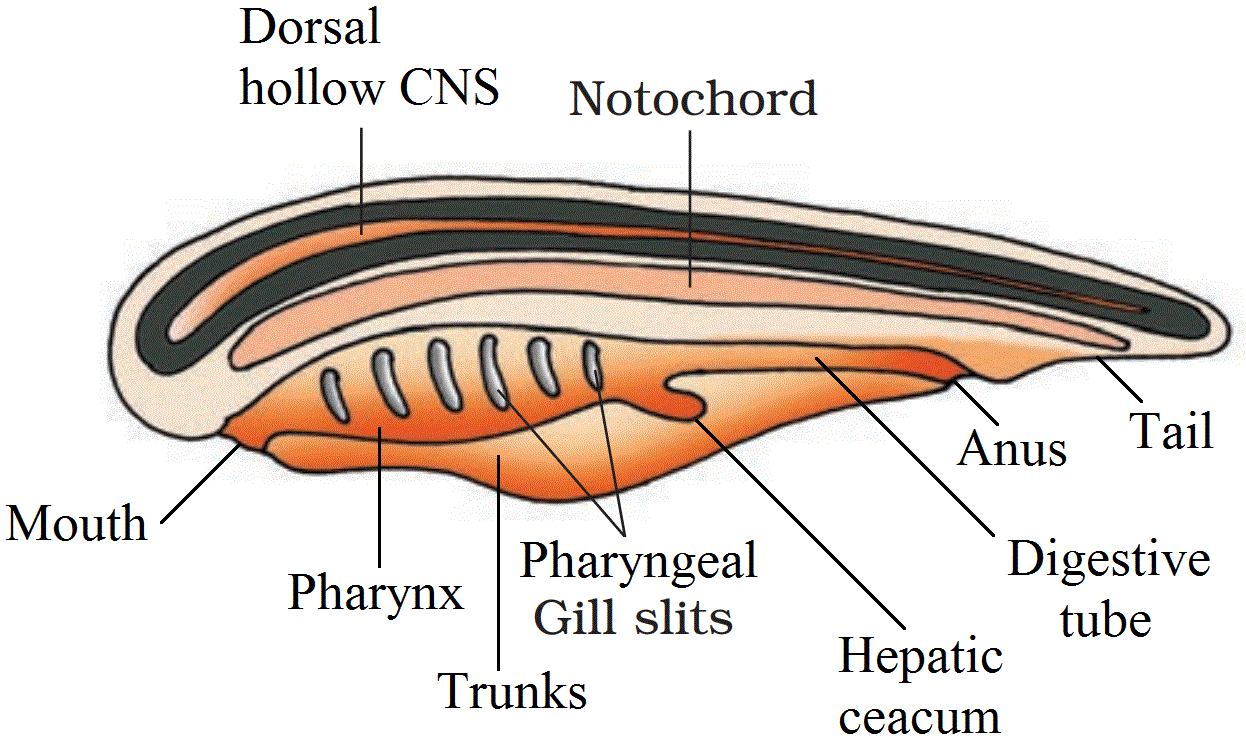
Give three major differences between chordates and non-chordates and draw a schematic sketch of a chordate showing those features.

Answer

The major differences between Chordates and Non-chordates are as follows:
 
Chordates
Non-Chordates
1.
A notochord is present at some stage in the life cycle of a chordate.
Notochord is not present at any stage in the Life cycle of a non-chordate.
2.
Gill-slits are present in the pharynx either in embryo or in adult organism.
Pharyngeal gill slits are absent.
3.
Tail is present at some stage in the life of the chordate.
Tail is absent in non-chordates.
4.
Heart is ventrally located.
Heart (if present) is dorsally located,
5.
Central nervous system is dorsal and hollow in chordates.
Central nervous system in non-chordates is solid and ventrally located.
Schematic sketch illustrating important characters of chordates is shown below:

Need a full question paper?

Generate a complete, print-ready paper with questions like this in minutes — across 16+ boards, with answer keys.
Start Generating Free

Similar questions

Describe the cross section of an isobilateral leaf by making a labeled diagram.
Explain absorption of food in the small intestine.
Which features make mammals as most successful and dominant animals?
Write a detailed note on the regulation of respiration.
Write three specific characteristics of the phylum Annelida and name the four phyla in which the larval stage is found during development.
What are the important events and end products of the light reaction?
Minerals absorbed by the roots travel up the xylem. How do they reach the parts where they are needed most? Do all the parts of the plant get the same amount of the mineral.
Lakshita was studying endocrine system for her unit test. She was confused how hormones produce their effects on the target tissue. She read many times, but still did not understand the process. She asked the same to her neighbour Stuti, a biology teacher in a school. Stuti explained her about the hormone receptor complex through diagrams and flowcharts.
  1. Name the two types of receptors.
  2. Why do different hormones use different types of receptors?
  3. What are second messengers? Give two examples?
  4. What values reflect from Lakshita's character?
In the figure given below, the black line (upper) indicates action spectrum for photosynthesis and the lighter line (lower) indicates the absorption spectrum of chlorophyll a, answer the following:
  1. What does the action spectrum indicate? How can we plot an action spectrum? Explain with an example.
  2. How can we derive an absorption spectrum for any substance?
  3. If chlorophyll a is responsible for light reaction of photosynthesis, why do the action spectrum and absorption spectrum not overlap?
Distinguish between families Fabaceae, Solanaceae, Liliaceae on the basis of gynoecium characteristics (with figures). Also write economic importance of any one of the above family.