Question
Lakshita was studying endocrine system for her unit test. She was confused how hormones produce their effects on the target tissue. She read many times, but still did not understand the process. She asked the same to her neighbour Stuti, a biology teacher in a school. Stuti explained her about the hormone receptor complex through diagrams and flowcharts.
  1. Name the two types of receptors.
  2. Why do different hormones use different types of receptors?
  3. What are second messengers? Give two examples?
  4. What values reflect from Lakshita's character?
Answer

  1. Two types of receptors are:
  1. Membrane bound extracellular receptors.
  2. Intracellular receptors.
  1. The hormones which cannot enter the target cell, need membrane bound (extracellular) receptors and the hormones which can enter the target cell, need intracellular (mostly nuclear) receptors.
  2. Second messengers are those chemicals, which are generated in the target cells, by those hormones which cannot enter the cells, to bring about the biochemical changes, e.g., Inositol Triphosphate ($\mathrm{IP}_{3}$) Eyclic Adenosine Monophosphate (CAMP).
  3. Lakshita is worried about her studies and has capability to understand things in a better and scientific way, she takes initiative to solve the problem so has problem solving skills.

Need a full question paper?

Generate a complete, print-ready paper with questions like this in minutes — across 16+ boards, with answer keys.

Start Generating Free

Similar questions

Describe modifications of stem with suitable examples.
Plants show temporary and permanent wilting. Differentiate between the two. Do any of them indicate the water status of the soil?
What is oxidative phosphorylation?
Lichen is usually cited as an example of ‘symbiosis’ in plants where an algal and a fungal species live together for their mutual benefit. Which of the following will happen if algal and fungal partners are separated from each other?
  1. Both will survive and grow normally and independent from each other.
  2. Both will die.
  3. Algal component will survive while the fungal component will die.
  4. Fungal component will survive while algal partner will die.
Based on your answer how do you justify this association as symbiosis.
Calcium ion concentration in blood affects muscle contraction. Does it lead to tetany in certain cases? How will you correlate fluctuation in blood calcium with tetany?
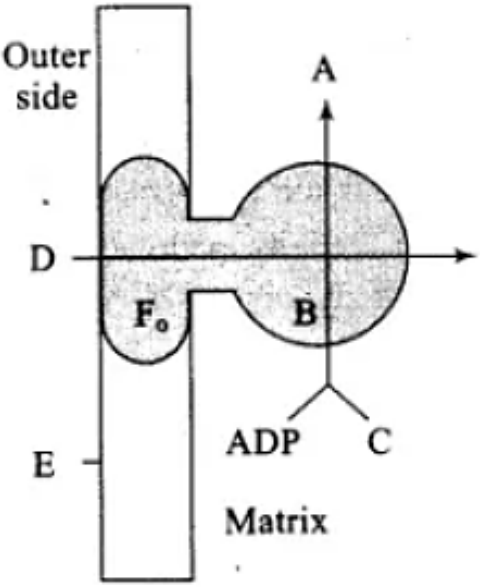
Given below is a diagram showing $ATP$ synthesis during aerobic respiration, replace the symbols $A, B, C, D$ and $E$ by appropriate terms given in the box.

Image
$F1,$ Particle, $Pi, 2H^+$, Inner mitochondrial membrane, $ATP$, $Fo$ particle, $ADP$
Oxygen is critical for aerobic respiration. Explain its role with respect to ETS.
Name the two important enzymes of $\mathrm{C}_2$ and $\mathrm{C}_4$ pathway, respectively? What important role do they play in fixing $\mathrm{CO}_2$ ?
Make a labelled diagram of horse fish (Hippocampus). Write a note on Chondrichthyes and Osteichthyes.
What is amphibian? Describe its main symptoms. Write the biological names of the following-(i) Toad, (ii) Frog, (iii) Tree frog, (iv) Limbless amphibian.