Question
  1. Give three points of difference between lanthanoids and actinoids.
  2. Give reason and select one atom$/$ion which will exhibit asked property:
  1. $Sc^{3+}$ or $Cr^{3+} ($Exhibit diamagnetic behaviour$).$
  2. $Cr$ or $Cu ($High melting and boiling point$).$
Answer

  1.  
S. No.
Lanthanoids
Actinoids
$1.$
Most of them are not radioactive.
All are radioactive.
$2.$
Don’t show a wide range of oxidation state.
Show a wide range of oxidation states.
$3.$
Most of their ions are colourless.
Most of their ions are coloured.
  1.  
  1. $Sc^{+3},$ because of absence of unpaired electron.
  2. $Cr,$ because of presence of strong intermetallic bonding than $Cu.$

Need a full question paper?

Generate a complete, print-ready paper with questions like this in minutes — across 16+ boards, with answer keys.

Start Generating Free

Similar questions

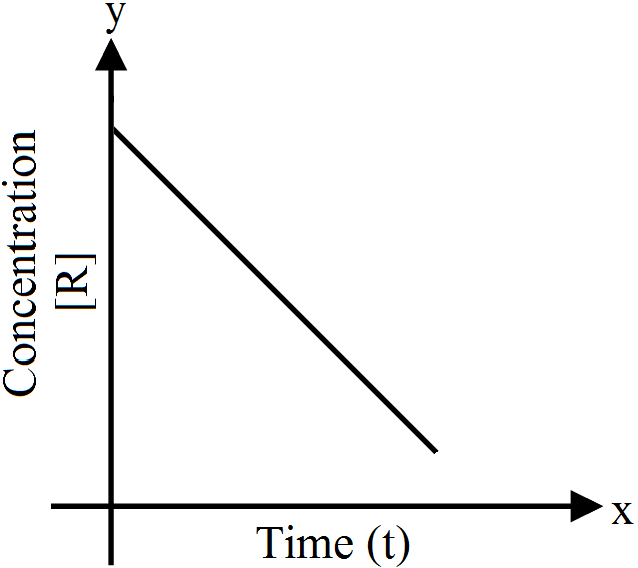
Consider the reaction $\text{R}\xrightarrow{\ \ \text{k}\ \ } \text{P}.$ The change in concentration of $R$ with time is shown in the following plot:
  1. Predict the order of the reaction.
  2. Derive the expression for the time required for the completion of the reaction.
  3. What does the slope of the above line indicate?
At $291K$, the molar conductivities at infinite dilution of $NH_4Cl, NaOH$ and $NaCl$ are $129.8, 217.4$ and $108.9S \ cm^2 mol^{-1}$ respectively. If the molar conductivity of a centinormal solution of $NH_4OH$ is $9.33S \ cm^2 mol^{-1},$ what is the percentage dissociation of $NH_4OH$ at this dilution? Also calculate the dissociation constant of $NH_4OH.$
Give different examples of nucleophilic addition reactions of carbonyl compounds.
Assign reasons for the following:
  1. The enthalpies of atomisation of transition elements are high.
  2. The transition metals and many of their compounds act as good catalyst.
  3. From element to element the actinoid contraction is greater than the lanthanoid contraction.
  4. The $E^0$ value for the $Mn^{3+}/Mn^{2+}$ couple is much more positive than that for $Cr^{3+}/Cr^{2+}.$
  5. Scandium $(Z = 21)$ does not exhibit variable oxidation states and yet it is regarded as a transition element.
i. Give reasons :
a. Although $- \ce{NH2}$ group is o/p directing in electrophilic substitution reactions, yet aniline, on nitration gives good yield of $m-$nitroaniline.
b. $(\ce{CH 3)2NH}$ is more basic than $(\ce{CH3)3N}$ in an aqueous solution.
c. Ammonolysis of alkyl halides is not a good method to prepare pure primary amines.
ii. Distinguish between the following:
a. $\ce{CH 3 CH 2 NH 2}$ and $(\ce{CH 3 CH 2)2NH}$
b. Aniline and $\ce{CH3NH2}$
  1. A blackish brown coloured solid $‘A’$ when fused with alkali metal hydroxides in presence of air, produces a dark green coloured compound $‘B’$, which on electrolytic oxidation in alkaline medium gives a dark purple coloured compound $C.$ Identify $A, B$ and $C$ and write the reactions involved.
  2. What happens when an acidic solution of the green compound $(B)$ is allowed to stand for some time? Give the equation involved. What is this type of reaction called?
Explain the stability of the highest oxidation states of the 3d series.
i. Write one chemical reaction for each
a. Carbylamine reaction
b. Acetylation reaction
ii. Write structure of N,N-ethylmethylethanamide
Write short notes on the following :
(i) Kolbe's electrolytic reaction
(ii) Hell-Volhard-Zelinsky reaction
(iii) Esterification reaction
(iv) Decarboxylation reaction(v) Hunds-Diecker reaction
Explain the relationship between basicity and structure of amines.