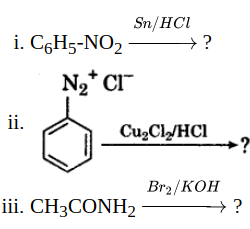
Question
Explain the relationship between basicity and structure of amines.

Answer

SELF

Need a full question paper?

Generate a complete, print-ready paper with questions like this in minutes — across 16+ boards, with answer keys.

Start Generating Free

Similar questions

  1. Describe the general trends in the following properties of the first series of the transition elements:
  1. Stability of +2 oxidation state.
  2. Formation of oxometal ions.
  1. Assign reason for each of the following:
  1. Transition elements exhibit variable oxidation states.
  2. Transition metal ions are usually coloured.
Explain the following :
(i) Fermentation
(ii) Dehydration
(iii) Hydrogen bonding in alcohols.
Mention the type of compounds formed when small atoms like H, C and N get trapped inside the crystal lattice of transition metals. Also give physical and chemical characteristics of these compounds.
Explain primary, secondary and tertiary structure of proteins with diagram.
Match the items given in Column I with the type of solutions given in Column II.
 
Column I
 
Column II
i.
Soda water
a.
A solution of gas in solid.
ii.
Sugar solution
b.
A solution of gas in gas.
iii.
German silver
c.
A solution of solid in liquid.
iv.
Air
d.
A solution of solid in solid.
v.
Hydrogen gas in palladium
e.
A solution of gas in liquid.
 
 
f.
A solution of liquid in solid.
How would you distinguish among primary, secondary and tertiary alcohols?
From the rate expression for the following reactions, determine their order of reaction and the dimensions of the rate constants.
(i) $3 NO ( g ) \rightarrow N _2 O ( g ) ; \quad$ Rate $= k [ NO ]^2$
(ii) $\begin{array}{r} H _2 O _2( aq )+3 I ^{-}( aq )+2 H ^{+} \rightarrow 2 H _2 O ( l )+ I _3^{-} ; \text {Rate }= k \left[ H _2 O _2 \mid\left[ I ^{-}\right]\right.\end{array}$
(iii) $\begin{aligned} CH _3 CHO ( g ) \rightarrow CH _4(g)+ CO ( g ) ; \text { Rate }= k \left[ CH _3 CHO \right]^{3 / 2}\end{aligned}$
(iv) $\begin{aligned} C _2 H _5 Cl ( g ) \rightarrow C _2 H _4(g) & + HCl ( g ) \ \text { Rate }= k \left[ C _2 H _5 Cl \right]\end{aligned}$
Answer the following questions:
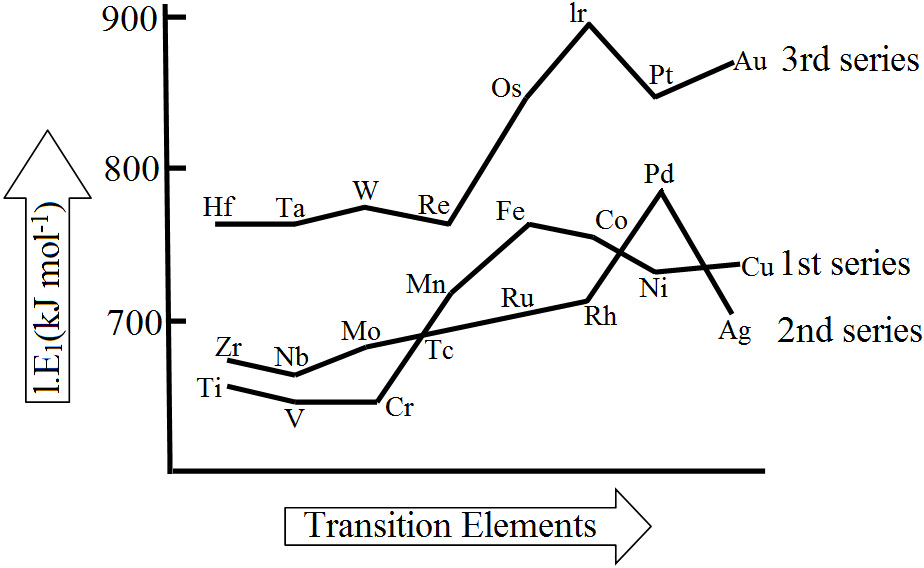
  1. The figure given alongside illustrates the first ionization enthalpies of first, second and third series of transition elements. Answer the question that follows:
  2. Which series amongst the first, second and third series of transition elements have the highest first ionization enthalpy and why?
  3. Separation of lanthanoid elements is difficult. Explain.
  4. $Sm^{2+}, Eu^{2+}$ and $Yb^{2+}$ ions in solutions are good reducing agents but an aqueous solution of $Ce^{4+}$ is a good oxidising agent. Why?
  1. The elements of $3d$ transition series are given as:
$\ce{Sc Ti V Cr Mn Fe Co Ni Cu Zn}$
Answer the following:
  1. Which element has the highest $m.p.$ and why?
  2. Which element is a strong oxidising agent in $+3$ oxidation state and why?
  3. Which element is soft and why?
  1. Write the equations involved in the preparation of Potassium dichromate from Sodium chromate $(Na_2CrO_4).$
Write major product(s) in the following reaction .
Image