Question
Give three points of differences between inductive effect and resonance effect.

Answer

Inductive effect vs Resonance effect.
Inductive effect Resonance effect
Based on electronegativity. Based on Conjugation.
Electron moves via sigma bonds. Electron moves via pi bonds or lone pairs.
It involves displacement of only $\sigma$ electrons and hence occurs only in saturated compounds. It involves delocalization of $\pi$ (pi) or n lone pairs of electrons and hence occurs in unsaturated and conjugated systems.
During inductive effect the electron pair is only slightly displaced towards the more electronegative atom and hence only partial positive and negative charges appear. During resonance effect, the electron pair I completely transferred and hence full positive and negative charges appear.
Inductive effect are transmitted over short distance over short distances in saturated carbon chains and the magnitude of the effect decreases rapidly as distance from the heteroatom increases. The effects almost become negligible beyond three carbon atoms from the heteroatom. The resonance effect is transmitted all along the length of the conjugated system without suffering much change in magnitude.
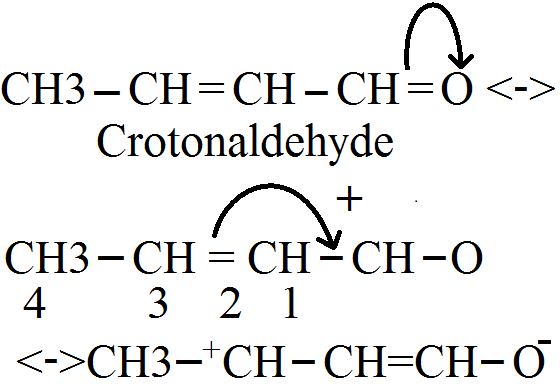
$\mathrm{C}_3$ in crotonaldehyde is almost as positive as $\mathrm{C}_1$.
Distance short range. Distance may be long range.

Need a full question paper?

Generate a complete, print-ready paper with questions like this in minutes — across 16+ boards, with answer keys.

Start Generating Free

Similar questions

Three students, Manish, Ramesh and Rajni were determining the extra elements present in an organic compound given by their teacher. They prepared the Lassaigne’s extract (L.E.) independently by the fusion of the compound with sodium metal. Then they added solid $\mathrm{FeSO}_4$ and dilute sulphuric acid to a part of Lassaigne’s extract. Manish and Rajni obtained prussian blue colour but Ramesh got red colour. Ramesh repeated the test with the same Lassaigne’s extract, but again got red colour only. They were surprised and went to their teacher and told him about their observation. Teacher asked them to think over the reason for this. Can you help them by giving the reason for this observation. Also, write the chemical equations to explain the formation of compounds of different colours.
Justify the position of hydrogen in the periodic table on the basis of its electronic configuration.
Explain the formation of a chemical bond.
What are significant figures? State rules to determine it.
A liquid with high boiling point decomposes on simple distillation but it can be steam distilled for its purification. Explain how is it possible?
Note: Consider structures I to VII and answer the questions:
  1. $\text{CH}_3-\text{CH}_2-\text{CH}_2-\text{CH}_2-\text{OH}$
  2. $\text{CH}_3-\text{CH}_2-\text{CH}-\text{CH}_3\\\ \ \ \ \ \ \ \ \ \ \ \ \ \ \ \ \ \ \ \ \ \ \ \ \ \ |\\\ \ \ \ \ \ \ \ \ \ \ \ \ \ \ \ \ \ \ \ \ \ \ \ \ \text{OH}$
  3. $\ \ \ \ \ \ \ \ \ \ \ \ \text{CH}_3\\\ \ \ \ \ \ \ \ \ \ \ \ \ |\\\text{CH}_3-\text{C}-\text{CH}_3\\\ \ \ \ \ \ \ \ \ \ \ \ \ |\\\ \ \ \ \ \ \ \ \ \ \ \ \text{OH}$
  4. $\text{CH}_3-\text{CH}-\text{CH}_2-\text{OH}\\\ \ \ \ \ \ \ \ \ \ \ \ \ \ \ \ \ \ \ \ \ \ \ \ |\\\ \ \ \ \ \ \ \ \ \ \ \ \ \ \ \ \ \ \ \ \ \ \ \text{CH}_3$
  5. $\text{CH}_3-\text{CH}_2-\text{O}-\text{CH}_2-\text{CH}_3$
  6. $\text{CH}_3-\text{O}-\text{CH}_2-\text{CH}_2-\text{CH}_3$
  7. $\text{CH}_3-\text{O}-\text{CH}-\text{CH}_3\\\ \ \ \ \ \ \ \ \ \ \ \ \ \ \ \ \ \ \ \ \ \ |\\\ \ \ \ \ \ \ \ \ \ \ \ \ \ \ \ \ \ \ \ \ \text{CH}_3$
Which of the above compounds form pairs of metamers?
Calculate the enthalpy change for the process$\text{CCI}_4(\text{g})\xrightarrow{ \ \ \ \ \ }\text{C}(\text{g})+4\text{CI}(\text{g})$
and calculate bond enthalpy of $C – Cl$ in $CCl_4$(g).$\Delta_\text{vap}\text{H}^\ominus(\text{CCI}_4)=30.5\text{kJ} \ \text{mol}^{-1}.$
$\Delta_\text{f}\text{H}^\ominus(\text{CCI}_4)=-135.5\text{kJ} \ \text{mol}^{-1}.$
$\Delta_\text{a}\text{H}^\ominus(\text{C})=-715.0\text{kJ} \ \text{mol}^{-1},$ where $\Delta_\text{a}\text{H}^\ominus$ is enthalpy of atomisation
$\Delta_\text{a}\text{H}^\ominus(\text{CI}_2)=242\text{kJ} \ \text{mol}^{-1}$
Derive the formula to find the ionization constant of weak acids and bases and how will you obtain the value of [H] to find their pH?
Prove that solubility of salts of weak acids increases by decreasing the pH.
Calculate the pH of a solution formed by mixing equal volumes of two solutions A and B of a strong acid having pH = 6 and pH = 4 respectively.