Question
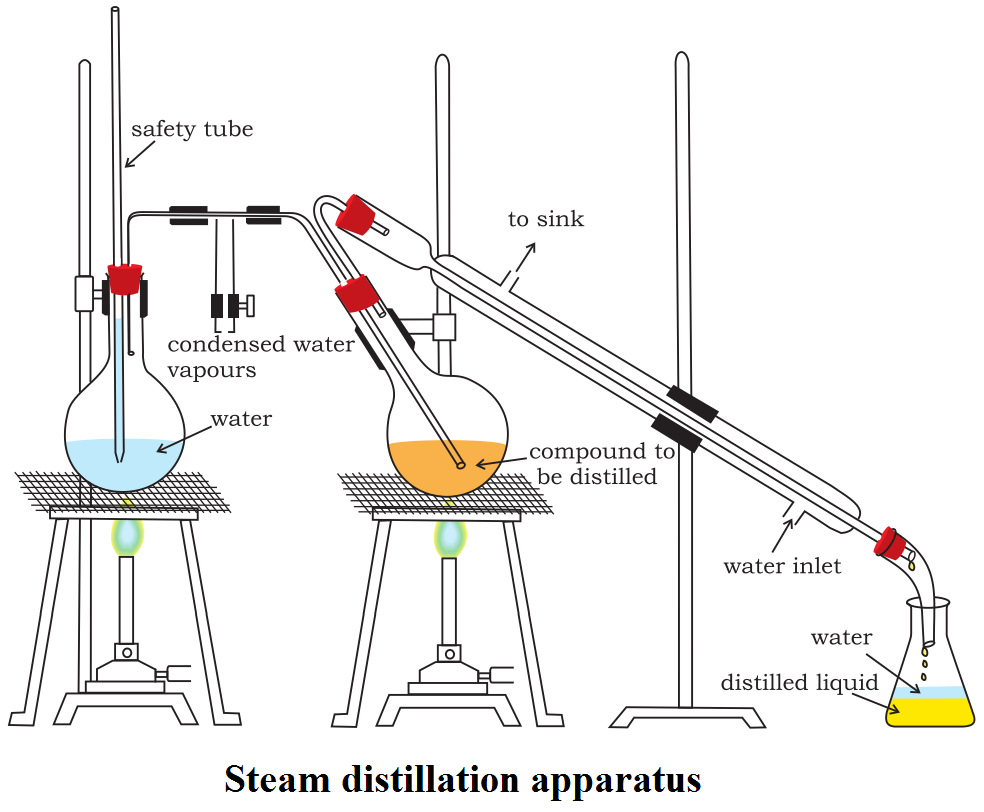
A liquid with high boiling point decomposes on simple distillation but it can be steam distilled for its purification. Explain how is it possible?
Answer

Steam distillation: This type of distillation is essentially a co-distillation with water and is carried out when a solid or liquid, practically insoluble in water, is volatile with steam, possess a vapour pressure of about 10-15 mm of mercury but the impurities are non-volatile. The principle of steam distillation is based on Dalton’s law of partial pressures. Let $p_1$ and $p_2$ be the vapour pressures of water vapour and the organic liquid at the distillation temperature. The liquid boils when total pressure is equal to the atmospheric pressure p, i.e.,
$p=p_1+p_2$ or $p_2=p-p_1$

This process is used in the purification of compounds such as chlorotoluenes, aniline and nitrobenzene. It is also employed in the isolation of essential oils from flowers.

Need a full question paper?

Generate a complete, print-ready paper with questions like this in minutes — across 16+ boards, with answer keys.
Start Generating Free

Similar questions

Each first element of a group differs in properties with other members of group. Explain the statement with reason.
or
In second period there is a difference between properties of elements. Why?
  1. Why is HF liquid but HCl, HBr, Hl are gases?
  2. Why is o-nitrophenol steam volatile whereas p-nitrophenol is not steam volatile?
  1. Arrange the following in decreasing order of their bond angle: $H_2O, NH_3, H_2S$
  2. Sketch the bond moments and resultant dipole moment of the following molecule:
$H_2O, NH_3, NF_3$ and $PCl_5$​​​​​​​
  1. Draw shape of the following molecules on the basis of VSEPR theory:
$XeF_4$ and $SF_4$​​​​​​​. (At. No. of Xe = 54, At. No. of S = 16)
The pH of milk, black coffee, tomato juice, lemon juice, and egg white are $6.8,5.0,4.2,2.2$ and 7.8 respectively. Calculate corresponding hydrogen ion concentration in each.
Balance the following equations in basic medium by ion-electron method and oxidation number methods and identify the oxidising agent and the reducing agent.$N_2H_4(l) + ClO_3^-(aq) \rightarrow NO(g) + Cl^-(g)$
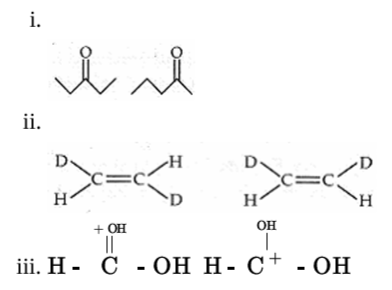
1. What is the relationship between the members of following pairs of structures? Are they structural or geometrical isomers or resonance contributors?
Image
2. A sample of 0.50 g of an organic compound was treated according to Kjeldahl's method. The ammonia evolved was absorbed in 50 mL of $0.5 M H _2 SO _4$. The residual acid required 60 mL of 0.5 M solution of NaOH for neutralisation. Find the percentage composition of nitrogen in the compound.
Equal volumes of $0.002M$ solutions of sodium iodate and cupric chlorate are mixed together. Will it lead to precipitation of copper iodate? (For cupric iodate $K_{sp} = 7.4 \times 10^{–8}$).
  1. The energy associated with Bohr's first orbit is $-2.18 \times 10^{-18}J atom^{-1}$. What is the energy associated with fifth orbit?
  2. The work function for Caesium atom is $1.9 eV$.
Calculate the threshold wavelength.
[Given: $1 eV = 1.6 × 10⁻¹⁹J$]
  1. How many subshells are associated with $n = 4$?
i. A discharge tube containing oxygen gas at $35^{\circ} C$ is evacuated till the pressure is $5 \times 10^{-2} mm$. If the volume of discharge tube is 4.5 litres. Calculate the number of oxygen molecules still present in the tube.
$\left(R=0.0821 L \text {-atm } mol^{-1} K^{-1}\right) .$
ii. Name the two processes that can be used to liquefy gases.
iii. What type of intermolecular forces are as follows:
a. Noble gases.
b. Water
What do you understand by the term “non-stoichiometric hydrides”? Do you expect this type of the hydrides to be formed by alkali metals? Justify your answer.
What are biodegradable and non-biodegradable pollutants?