Question
Give two examples each of:
  1. Group 1 elements.
  2. Group 17 elements.
  3. Group 18 elements.

Answer

  1. Group 1: Lithium and Sodium.
  2. Group 17: Fluorine and Chlorine.
  3. Group 18: Neon and Argon.

Need a full question paper?

Generate a complete, print-ready paper with questions like this in minutes — across 16+ boards, with answer keys.
Start Generating Free

Similar questions

The atomic number of an element ‘X’ is 19.
  1. Write its electronic configuration.
  2. To which period of the Modern Periodic Table does it belong and what is its valency?
  3. If ‘X’ burns in oxygen to form its oxide, what will be its nature – acidic, basic or neutral?
  4. Write balanced chemical equation for the reaction when this oxide is dissolved in water.
An element X from group 2 of the periodic table reacts with an element Y from group 17 to form a compound.
  1. What is the nature of the compound formed?
  2. State whether the compound formed will conduct electricity or not.
  3. Give the formula of the compound formed.
  4. What is the valency of element X?
  5. How many electrons are there in the outermost shell of an atom of element Y?
What is meant by human circulatory system? Name the organs of the circulatory system in humans.
Explain with an example how traits get expressed.
State the various steps involved in the process of photosynthesis.
Unsaturated hydrocarbons contain multiple bonds between the two C-atoms and show addition reactions. Give the test to distinguish ethane from ethene.
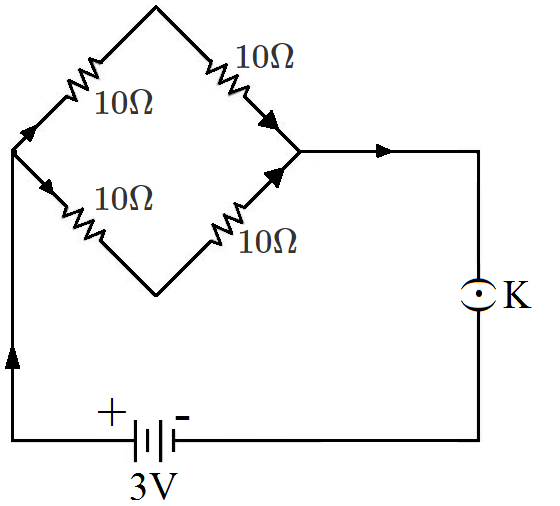
Find the current drawn from the battery by network of four resistors shown in the figure?
The three elements A, B and C with similar properties have atomic masses X, Y and Z respectively. The mass of Y is approximately equal to the average mass of X and Z. What is such an arrangement of elements called as? Give one example of such a set of elements.
$i$. A wire of resistance $2$ has been connected to a source of $50 V$ as its two ends. What is the current flowing through the wire?
$ii.$  An electric refrigerator rated $400 W$ operates $8$ hour/day. What is the cost of the energy to operate it for $30$
days at $₹ 3.00 \ \text{per kWh}$ ?
An object is kept at a distance of 18 cm, 20 cm and 30 cm, from a lens of power+5D. (i) In which case or cases would you get a magnified image? (ii) Which of the magnified image can we get on a screen? (b) List two widely used applications of a convex lens.