Question
Explain with an example how traits get expressed.

Answer


The gene which decides the appearance of an organism even in the presence of an alternative gene is known as a dominant gene. The trait expressed is known as a dominant trait.
  • The dominant gene is represented by a capital letter.
  • The gene which decides the appearance of an organism only in the presence of another identical gene is called a recessive gene. The trait expressed is known as a recessive trait.
  • The recessive gene is represented by a small letter.
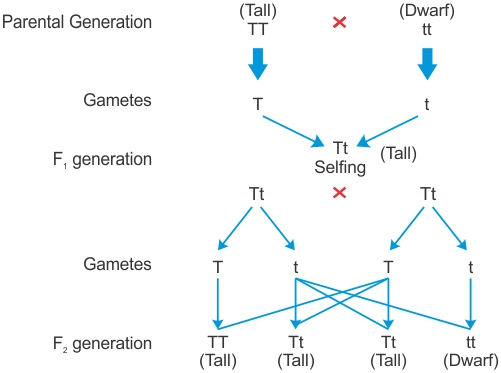
  • For example, Pure tall (TT) pea plant was crossed with dwarf (tt) plant.

Phenotypic Ratio: 3 : 1
Genotypic Ratio: 1 : 2 : 1
- $F_1$ Generation: All plants obtained were heterozygous tall $(T t)$. Plants from $F_1$ generation were self-pollinated to obtain $F_2$ generation.
- $F _2$ Generation: One homozygous tall plant $( TT )$, two heterozygous tall plants ( Tt ) and one homozygous dwarf plant ( tt ) were obtained.

Need a full question paper?

Generate a complete, print-ready paper with questions like this in minutes — across 16+ boards, with answer keys.
Start Generating Free

Similar questions

Of the three metals X, Y and Z. X reacts with cold water, Y with hot water and Z with steam only. Identify X, Y and Z and also arrange them in order of increasing reactivity.
Carbon cannot reduce the oxides of sodium, magnesium, and aluminium to their respective metals. Why? Where are these metals placed in the reactivity series? How are these metals obtained from their ores? Take an example to explain the process of extraction along with chemical equations.
Write the name and formula of one salt each which contains:
  1. Two molecules of water of crystallisation.
  2. Tive molecules of water of crystallisation.
  3. Ten molecules of water of crystallisation.
A substance X, which is an oxide of a group 2 element, is used intensively in the cement industry. This element is present in bones also. On treatment with water it forms a solution which turns red litmus blue. Identify X and also write the chemical reactions involved.
Consider the following elements:
Ca, Cl, Na, I, Li, Ba, Sr, K, Br.
Separate these elements into three groups (families) of similar properties. State one property in each case on the basis of which you have made your choice.
In what respects do the properties of group 1 elements differ from those of group 17 elements? Explain with examples by taking one element from each group.
What is meant by the terms ‘single circulation’ and ‘double circulation’?
When a sodium compound X which is also used in soda-fire extinguisher is heated, gives a sodium compound Y along with water and carbon dioxide. Y on crystallisation forms compound Z. Identify X, Y and Z.
Decomposition reactions require energy either in the form of heat or light or electricity for breaking down the reactants. Write one equation each for decomposition reactions where energy is supplied in the form of heat, light and electricity.
i. Predict the reaction, if any, between
a. zinc and silver nitrate solution,
b. magnesium and iron (II) chloride solution,
c. copper and magnesium sulphate solution.
Write the equations, with its physical form symbols, for the reaction.
ii. A lump of element X can be cut by a knife. During its reaction with water, X floats and melts. What is X? Explain.