MCQ
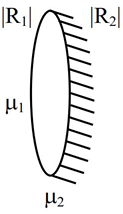
Given a thin convex lens (refractive index $\mu_2$ ), kept in a liquid (refractive index $\mu_1, \mu_1<\mu_2$ ) having radii of curvature $\left|R_1\right|$ and $\left|R_2\right|$. Its second surface is silver polished. Where should an object be placed on the optic axis so that a real and inverted image is formed at the same place?
  • A
    $\frac{\mu_1\left| R _1\right| \cdot\left| R _2\right|}{\mu_2\left(\left| R _1\right|+\left| R _2\right|\right)-\mu_1\left| R _1\right|}$
  • $\frac{\mu_1\left| R _1\right| \cdot\left| R _2\right|}{\mu_2\left(\left| R _1\right|+\left| R _2\right|\right)-\mu_1\left| R _2\right|}$
  • C
    $\frac{\mu_1\left| R _1\right| \cdot\left| R _2\right|}{\mu_2\left(2\left| R _1\right|+\left| R _2\right|\right)-\mu_1 \sqrt{\left| R _1\right| \cdot\left| R _2\right|}}$
  • D
    $\frac{\left(\mu_2+\mu_1\right)\left|R_1\right|}{\left(\mu_2-\mu_1\right)}$
Answer

Correct option: B.
$\frac{\mu_1\left| R _1\right| \cdot\left| R _2\right|}{\mu_2\left(\left| R _1\right|+\left| R _2\right|\right)-\mu_1\left| R _2\right|}$
(B)
Image
$\begin{array}{l}\frac{1}{ f _{ eq }}=\frac{2}{ f _{ L }}-\frac{1}{ f _{ m }} \\ f _{ m }=-\frac{\left| R _2\right|}{2} \\ \frac{1}{ f _{ L }}=\left(\frac{\mu_2}{\mu_1}-1\right)\left(\frac{1}{ R _1}+\frac{1}{ R _2}\right)\end{array}
$
$
\begin{array}{l}
\frac{1}{f_{eq}}=2\left(\frac{\mu_2-\mu_1}{\mu_1}\right)\left(\frac{R_1+R_2}{R_1 R_2}\right)+\frac{2}{R_2} \\
=\frac{2}{R_2}\left[\frac{\left(\mu_2-\mu_1\right)\left(R_1+R_2\right)+\mu_1 R_1}{\mu_1 R_1}\right] \\
=\frac{2}{R_2}\left[\frac{\mu_2 R_1+\mu_2 R_2-\mu_1 R_1-\mu_1 R_2+\mu_1 R_1}{\mu_1 R_1}\right] \\
\frac{1}{f_{eq}}=\frac{2\left[\mu_2 R_1+\mu_2 R_2-\mu_1 R_2\right]}{\mu_1 R_1 R_2}
\end{array}
$
For same size of image
$
\begin{array}{l}
u=2 f \\
u=\frac{\mu_1 R_1 R_2}{\mu_2 R_1+\mu_2 R_2-\mu_1 R_2}
\end{array}
$

Need a full question paper?

Generate a complete, print-ready paper with questions like this in minutes — across 16+ boards, with answer keys.

Start Generating Free

Similar questions

In Young double slit experiment, when two light waves form third minimum, they have
The focal length of a planoconvex glass lens is $20 \,cm \left(\mu_g=1.5\right)$. The plane face of it is silvered. An illuminating object is placed at a distance of $60 cm$ from the lens on its axis along the convex side. Then the distance (in $cm$ ) of the image is .........
$4$ moles of an ideal gas is at $0°C.$ At constant pressure it is heated to double its volume, then its final temperature will be ...... $^oC$
A very high magnetic field is applied to a stationary charge. Then the charge experiences
If the following input signal is sent through a $PN-$junction diode, then the output signal across $R‌‌_L$ will be
The dimensional formula of wave number is
Electric field at a place is $\overrightarrow {E\,}  = {E_0}\hat i\,V/m$ . A particle of charge $+q_0$  moves from point $A$ to $B$ along a circular path find work done in this motion by electric field 
$A$ hinged construction consists of three rhombs with the ratio of sides $5:3:2$. Vertex $A_3$ moves in the horizontal direction at a velocity $v$. Velocity of $A_2$ is ....... $V$.
A deviation of $2^{\circ}$ is produced in the yellow ray when prism of crown and flint glass are achromatically combined. Taking dispersive powers of crown and flint glass are $0.02$ and $0.03$ respectively and refractive index for yellow light for these glasses are $1.5$ and $1.6$ respectively. The refracting angles for crown glass prism will be $........\,^{\circ}$ (in degree) (Round off to the Nearest Integer)
The electric current through a wire varies with time as $I = I _0+\beta t$. where $I _0=20 A$ and $\beta=3 A / s$. The amount of electric charge crossed through a section of the wire in $20\  s$ is :